

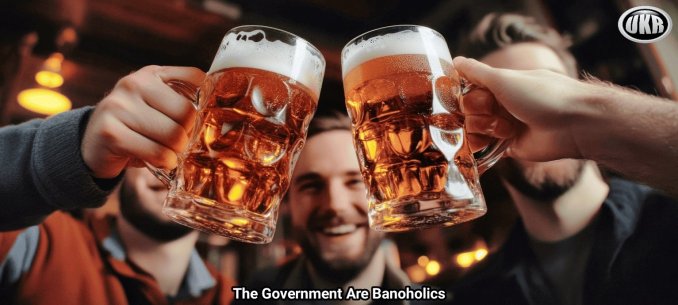
The government are banoholics
Banning non-alcoholic drinks for young people is as silly as it is pointless
BEN SIXSMITH
The British government has a problem — banoholism. It is a familiar issue for governments. Yes, it starts small — a ban here and a ban there. But soon politicians will be using dubious research to justify banning breakfast cereal or blowing your nose in public places.
The government is contemplating a ban on zero-alcohol drinks for under-18s. As Christopher Snowdon wrote about the last government, “legislative diarrhoea” can be an effective excuse for not getting anything serious done.
What is the justification? “There is some evidence to suggest that exposure to alcohol-like products, even if low or zero alcohol,” says Parliamentary Under-Secretary of State for Public Health and Prevention Ashley Dalton, “Can normalise drinking, and become a gateway to alcohol consumption.”
This claim is curious. It made me want to look for this evidence. I suspect that Dalton is thinking of research like a recent paper from the International Journal of Drug Policy. Zero alcohol drinks, the researchers inform us, are likelier to make teenagers think of alcohol than soft drinks.
Okay? I assume that vegan burgers are more likely to make people think of beefburgers than plain tofu. Are vegan burgers a “gateway” to eating beef? I assume that water pistols are more likely to make people think of guns than Play-Doh. Are water pistols a “gateway” to shooting rifles?
Frankly, I’m unconvinced that a significant number of young people drink zero-alcohol beverages. The implicit purpose of this legislation, I suspect, is to demonise alcohol. If young people can’t even consume drinks that imitate alcohol, after all, alcohol itself must be really evil stuff.
Ashley Dalton fears that zero-alcohol drinks “normalise drinking”. Ms Dalton — drinking alcohol is normal. Yes, it can be dangerous. Yes, no one should do it in the sense that it is not obligatory. But the same is true of driving a car, and no one would claim that driving is not “normal”.
Alcohol has been consumed for thousands of years. It has been an important part of collective rituals from weddings to the Eucharist. Jesus Christ is claimed to have turned water into wine! Yes, people have the right to argue that drinking alcohol should not be normal. But it is.
It is clear that the political establishment sees alcohol as something which is not just a potential problem but a problem in itself
Adolescents should not be drinking, and they should be aware of the risks of drinking, but that does not mean that anyone should make them feel like having a beer is equivalent to doing ayahuasca. This is pure nonsense.
The government might have U-turned on tax hikes for pubs, but it is clear that the political establishment sees alcohol as something which is not just a potential problem but a problem in itself. Its social, ritualistic and pleasurable advantages for millions of Britons are an irrelevance in comparison to their need to minimise its risks to the point of their non-existence — which, in turn, would entail the non-existence of alcohol.
Prime Minister Keir Starmer occasionally mentions enjoying a drink — and I’m sure that he does. But he calls having a pint with friends his “guiltiest pleasure”. (Sir Keir, having a drink with your mates is uncomplicatedly good. It’s the guilt which seems unhealthy here.)
Beyond this, I also have to feel sympathy for the targets of this absurd idea. The safetyism that governs the British authorities’ treatment of young people has become preposterous. Young teenagers, we have heard this week, might be kicked off social media. I’m aware that substantive arguments exist in favour of such a policy, even if I’m leery about it, but one might think that if the authorities want teenagers to get away from screens, they should at least incentivise real-world social activities.
Quite the opposite. The government is considering delaying learner drivers’ ability to pass their practical tests. Anything that even resembles alcohol could be prohibited. I’m sure that we all remember the bipartisan enthusiasm for young people being kept at home for years during the pandemic — permanently changing habits and social circles.
Young people are now lonelier and spend less time with other people. I can understand the concern that this might be driven, at least in part, by the lure of Instagram and TikTok, but if we want people to spend less time on their phones, we can’t be paranoid about what they might do away from them. Perhaps it would be nice if teenagers all started reading groups — but it isn’t going to happen.
One hopes that the government will realise that its banoholism, for all that it gives off a sense of Getting Something Done, can be destructive. I’ll raise a drink to that hope. Alcoholic. It’s my birthday.

••••
The Liberty Beacon Project is now expanding at a near exponential rate, and for this we are grateful and excited! But we must also be practical. For 7 years we have not asked for any donations, and have built this project with our own funds as we grew. We are now experiencing ever increasing growing pains due to the large number of websites and projects we represent. So we have just installed donation buttons on our websites and ask that you consider this when you visit them. Nothing is too small. We thank you for all your support and your considerations … (TLB)
••••
Comment Policy: As a privately owned web site, we reserve the right to remove comments that contain spam, advertising, vulgarity, threats of violence, racism, or personal/abusive attacks on other users. This also applies to trolling, the use of more than one alias, or just intentional mischief. Enforcement of this policy is at the discretion of this websites administrators. Repeat offenders may be blocked or permanently banned without prior warning.
••••
Disclaimer: TLB websites contain copyrighted material the use of which has not always been specifically authorized by the copyright owner. We are making such material available to our readers under the provisions of “fair use” in an effort to advance a better understanding of political, health, economic and social issues. The material on this site is distributed without profit to those who have expressed a prior interest in receiving it for research and educational purposes. If you wish to use copyrighted material for purposes other than “fair use” you must request permission from the copyright owner.
••••
Disclaimer: The information and opinions shared are for informational purposes only including, but not limited to, text, graphics, images and other material are not intended as medical advice or instruction. Nothing mentioned is intended to be a substitute for professional medical advice, diagnosis or treatment.
Disclaimer: The views and opinions expressed in this article are those of the author and do not necessarily reflect the official policy or position of The Liberty Beacon Project.


Leave a Reply