

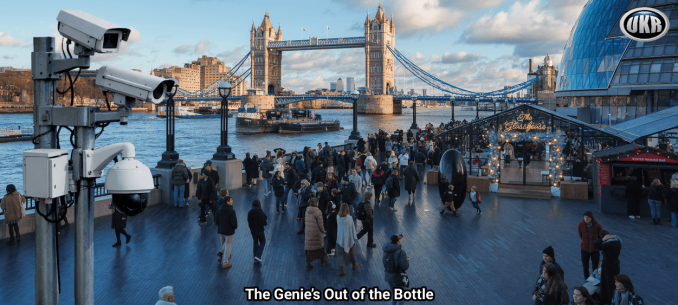
CCTV and facial recognition technology is unethical at its core, and a planned expansion is bound to be deployed cheaply and disastrously.
PAUL BIRCH
On December 4th, 2025, the United Kingdom’s Labour government announced plans to extend facial recognition technology to every village, town, and city across the country. Alongside this, they want to enable the police to compare images from CCTV, doorbells, and dashcams with government records. The police may also be given access to the images of the 45 million people currently on Britain’s passport database.
Of course, this is all being sold as a plan to catch wanted suspects and criminals, and a ten-week public consultation is being carried out to pave the way for the technology to be used more often, while “striking a balance with protecting people’s privacy.” It is not within the scope of the consultation, however, to ask whether such technology should be rolled out to a greater degree in the first place—that appears to be a given. The adjective “Orwellian” doesn’t quite cover it.
CCTV surveillance has become an increasingly common feature across Britain since the 1980s. If one walks through London, it is impossible to miss the profusion of cameras on almost every street corner. The UK already boasts an exceptionally dense network of CCTV cameras and has a higher number per person than any other country in the world except China. Do we really need any more?
Crime and Policing Minister Sarah Jones said, “Facial recognition has huge potential to strengthen how the police keep us safe … and we will expand its use so that forces can put more criminals behind bars and tackle crime in their communities.” In 2024, a Channel 4 Dispatches documentary revealed that the Metropolitan Police had failed to solve any low-level crimes in more than 160 parts of London in three years. This is despite London having over 690,000 CCTV cameras in operation and being one of the most surveilled cities on Earth.
Does the minister seriously think that more cameras being installed would assist the police in their woeful inability to solve crime? In the twelve months ending in March 2023, 39.3% of criminal cases in England and Wales were closed due to no suspect ever being identified. Proponents argue that CCTV helps deter crime and improve public safety, but evidence clearly points to this not being the case. All that happens when CCTV footage is shown on news bulletins is that people become more frightened, thinking that crime is out of control. But maybe that’s the point? If people are scared, they are more susceptible to authoritarian measures.
Despite claims by advocates, the effectiveness of CCTV in preventing crime is anything but clear-cut. Many studies have shown that while cameras may deter certain types of crime, for example in car parks, they do very little to prevent many types of other crimes. Criminals can (and do) adapt by avoiding cameras or disguising their identities. Many viral online clips of violent criminality in Britain show people in masks and hoods. CCTV clearly does nothing to prevent this sort of behaviour. Section 60AA of the Criminal Justice and Public Order Act 1994 allows police officers to compel people to remove face coverings in certain circumstances, but these are very limited and are only for a given time.
But even if the indication was that CCTV did deter criminality, any expansion of CCTV, with its proposed high-definition capabilities and facial recognition technology, will only undermine any sense of personal freedom and anonymity that is fundamental to our so-called open society.
There is also the possibility of ‘function creep’, where cameras installed for crime prevention will later be used for unrelated purposes, such as monitoring protests or tracking political activists. We have already seen the police in the UK react very differently depending on who they’re dealing with, and so the risk of disproportionately targeting people who are lazily labelled as ‘far right’ is very real. And if the COVID lockdowns are anything to go by, the police would be only too willing to use new technology to monitor us.
The massive amount of data already collected by monitoring systems presents serious security risks. If not properly protected, this footage is susceptible to hacking or unauthorised access by third parties. There have been cases where CCTV footage has been leaked or misused, leading to breaches of confidentiality and, at times, harm to individuals. The risk of such abuse increases the more widely this technology is utilised, and we definitely cannot trust public bodies to keep our data safe.
On top of the concerns over the morality of increasing the use of facial recognition systems, there is the substantial question of cost at a time when policing budgets are being universally squeezed. Implementing and maintaining widespread CCTV systems would be extremely expensive. Funds spent on surveillance infrastructure could alternatively be invested in that most basic but effective of policing strategies—officers visibly patrolling the streets in their communities.
Plus, as we all know, any delivery of high-tech systems within the public sector is bound to be dysfunctional. The British establishment is utterly incapable of carrying through such programmes, as inevitable cost-cutting and the ministerial merry-go-round would have a significant impact. Failures of the National Health Service’s efforts to transform primary care services put patients at risk of serious harm, and the Home Office’s programme to replace the Police National Computer was delayed by at least five years with an associated cost overrun of more than £400 million.
And then there was Horizon. Between 1999 and 2015, faulty ‘Horizon’ accounting software led the UK Post Office to wrongly charge thousands of sub-postmasters with financial crimes. Over nine hundred were convicted, while others suffered prosecution, job loss or financial ruin. The scandal resulted in bankruptcies, family breakdowns and at least thirteen suicides in what was one of the most extensive injustices in British history.
Unchecked surveillance and facial recognition expansion across cities, towns and villages is anathema to everything this country is supposed to stand for. The erosion of privacy, threats to civil liberties, potential for data misuse, questionable effectiveness and negative impacts on trust make it a highly dubious and expensive experiment, one which is unlikely to ever be withdrawn once introduced. Plus, allowing police access to the passport database would effectively convert this resource into a giant mugshot archive, exposing the public to the risks of misidentification and injustice. Big Brother Watch director Silkie Carlo has warned that the increased use of facial recognition technology could turn Britain into an “open prison.” She’s not wrong.
This article (The Genie’s Out of the Bottle) was created and published by The European Conservative and is republished here under “Fair Use” with attribution to the author Paul Birch

••••
The Liberty Beacon Project is now expanding at a near exponential rate, and for this we are grateful and excited! But we must also be practical. For 7 years we have not asked for any donations, and have built this project with our own funds as we grew. We are now experiencing ever increasing growing pains due to the large number of websites and projects we represent. So we have just installed donation buttons on our websites and ask that you consider this when you visit them. Nothing is too small. We thank you for all your support and your considerations … (TLB)
••••
Comment Policy: As a privately owned web site, we reserve the right to remove comments that contain spam, advertising, vulgarity, threats of violence, racism, or personal/abusive attacks on other users. This also applies to trolling, the use of more than one alias, or just intentional mischief. Enforcement of this policy is at the discretion of this websites administrators. Repeat offenders may be blocked or permanently banned without prior warning.
••••
Disclaimer: TLB websites contain copyrighted material the use of which has not always been specifically authorized by the copyright owner. We are making such material available to our readers under the provisions of “fair use” in an effort to advance a better understanding of political, health, economic and social issues. The material on this site is distributed without profit to those who have expressed a prior interest in receiving it for research and educational purposes. If you wish to use copyrighted material for purposes other than “fair use” you must request permission from the copyright owner.
••••
Disclaimer: The information and opinions shared are for informational purposes only including, but not limited to, text, graphics, images and other material are not intended as medical advice or instruction. Nothing mentioned is intended to be a substitute for professional medical advice, diagnosis or treatment.
Disclaimer: The views and opinions expressed in this article are those of the author and do not necessarily reflect the official policy or position of The Liberty Beacon Project.



Leave a Reply