

DR NICHOLAS TATE
For the last three decades or more we have been constantly told that our public bodies are “institutionally racist” and our whole society ‘systemically’ so. Like every paranoiac theory where enemies lurk behind the scenes and pull the strings of history this one contains its own inbuilt defence against refutation, any denial being seen as evidence of ignorance or guilt. It is not surprising that one of its staunchest advocates was Justin Welby, erstwhile and unlamented Archbishop of Canterbury, as ‘systemic racism’ is nothing less than a secular version of the Christian idea of original sin, but this time without a Redeemer. The fault is ingrained and inexpiable. The theory decrees as fixed in stone something that undoubtedly exists in places (racism), but which is malleable and needs to be tackled locally where it occurs, not as a plague requiring collective self-abasement.
The situation was made infinitely worse by the simultaneous appearance in the USA of an ‘anti-whiteness industrial complex’ whose tentacles quickly extended across the Atlantic to countries with a very different history of race relations. The spectacles through which we were told we habitually looked at the world were supposedly those of ‘white privilege’ (what you have when your taxes go up to pay for mass migration you never voted for), ‘white fragility’ (daring to criticise any part of the Lysenkoist edifice into which everyone around you is being seduced), ‘white saviourship’ (being told off when you say nice things about people with a different skin colour on the grounds that your comments are patronising) and ‘allyship’ (being friendly towards victims of oppression, even if they are Afua Hirsch, as long as you are even more ‘umble about it than Uriah Heep).
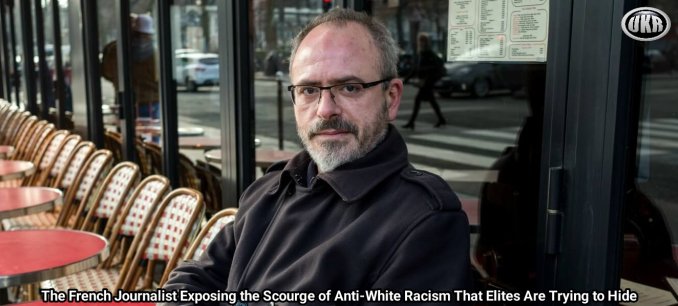
The French journalist François Bousquet, whom I will be discussing later, explains the creation and perpetuation of this ludicrous edifice as a combination of “the credulity of some, the opportunism of others, and the cowardice of the greatest number”. It was certainly an opportunity to be seized both by those active in the power struggle between social groups and by academics sharp enough to see how it might revitalise their careers. Robin DiAngelo, author of White Fragility, Ibram X. Kendi, author of How to Be an Antiracist, and Kimberlé Crenshaw, inventor of intersectionality (the more instances of victimhood you can tick off the higher up the benefits ladder you will rise), were not slow in joining the speaker circuit, pulling in extraordinary fees to tell gullible white people about how they should do penance to the non-white communities on whose behalf these speakers were nobly stuffing their own bank accounts.
In the UK large numbers of training organisations sprung up to provide similar guidance to public bodies, schools, universities and businesses. Hundreds of thousands of people must have been instructed in how to promote ‘anti-racism’ in their institutions, the racism in question always being that of whites towards others. The possibility that there might also be anti-white racism at no point entered the national discussion despite the 20th century’s greatest anthropologist Claude Lévy Strauss having said of racism that it was a universal reflex to be found among all groups (you can imagine how that went down in the 1970s with fellow Parisian intellectuals).
The definitional impossibility of anti-white racism sank so deep into the national psyche that people pretended it didn’t exist even when, as with the rape gangs, it was staring them in the face. The effect of endlessly going on about ‘systemic racism’, emphasising skin colour, making whites feel guilty and non-whites feel victims, has had disastrous results in a country experiencing mass migration and desperately needing newcomers to integrate and assimilate and everyone to focus on what they have in common not on how they differ. The current Labour Government seems intent on making the situation ever worse, throwing around the word ‘racist’ at the first opportunity and digging ever deeper the hole in which an alienated electorate is sooner or later going to bury it.
On the other side of the Channel the myth of systemic racism has similarly held sway among a French liberal metropolitan elite which has largely benefited from mass immigration while suffering none of its disadvantages. As in England the racism of the indigenous population has been endlessly investigated with virtually no one bothering to see whether, in areas of high immigration, it had also been working in an opposite direction. That is until earlier this year when François Bousquet brought out his Le racisme antiblanc: l’enquête interdite (Anti-white racism: the forbidden enquiry), an analysis based on the experiences of white French people who had found themselves in a minority amongst “North African Arabs” and “sub-Saharan Blacks” (Bousquet’s terminology). The book covers the whole period from the 1970s onwards, concluding with a long list of incidents of anti-white racism reported in the press during the months immediately before publication.
Many of the people who wrote or spoke to Bousquet were keen to tell him about their experiences as children in schools where they were in a minority, sometimes of only one or two. The hatred of France and the French among Arab and black pupils, despite most of them having French nationality, is a central theme. Verbal abuse was constant: sale français (filthy French), sale face be craie (filthy chalk face), sale from (filthy cheese, from fromage blanc), sale gwer (filthy European), sale kouffar. Girls were regularly called salopes (sluts), some trying to escape being tormented by attaching themselves to an ‘alpha male’ who might keep them in submission but would protect them from other boys.
The worst verbal abuse for a boy was nique ta mère (go f…k your mother). On two occasions this was the turning point for the victim: one threw a chair across the classroom at his tormenter, the other became a skinhead and bought iron caps for his Doc Martens. Both joined Right wing youth movements as a way of fighting back. Journeys to and from school were particularly perilous: one could be mobbed and beaten up, with jackets, phones, trainers frequently nicked. The other ethnic groups often fought among themselves, especially Arabs versus blacks, despite most of them being Muslim. Asians and black West Indian Christians had a particularly rough time.
How did those whose parents could not get them out to a Catholic private school survive? In many cases it was by pretending to be part of the majority. One might adopt their lingo, wear the same gear, abandon metal for rap, change one’s name to Ibrahim, even convert to Islam. A widespread Islamisation of school life is reported: no one dared eat or drink during the day in Ramadan; pork was banned; Muslim decency rules applied when changing for sports. Teaching history and religion was impossible: Charles Martel could not have defeated the Arabs at Tours in 732 because Muslims are never defeated, slavery was only ever white on black, Galileo and Darwin were both wrong because the Quran said so, Shiism did not exist, and so on.
How did their teachers deal with this? Most were too frightened to stand up to the majority. Teacher turnover was rapid; absences were frequent; sometimes schools closed altogether. Most teachers were very Left-wing, as were their unions, and explained away the majority’s bad behaviour as the result of its heritage of oppression. One boy and his sister plucked up courage to complain to their teacher about bullying only to be told, sickeningly, that it was their duty “to break the circle of violence by love”. Appealing to the school’s senior management was also not an option: it was equally useless.
After history and geography teacher Samuel Paty was beheaded with a cleaver by an Islamist terrorist in 2020 following a complaint against him by one of his pupils and her father, the life of teachers in French secondary schools, says Bousquet, became a daily “crossing of a field of mines”. Despite around 100,000 attacks a year on teachers, complaints were often not pursued for fear of reprisal.
Things can’t be this bad in England, I kept on thinking when reading this book. France’s colonial past is very different from ours and relations between French and Algerians – often the dominant group in these schools – have always been difficult. Much of what Bousquet has brought to light, however, had not previously been widely reported. Insofar as it was known it was inconvenient and kept quiet – a situation with which in England we are all too familiar.
This year’s school census in England showed that in one in four schools ‘White British’ pupils are in a minority and that in 454 schools they form less than 2% of the population. Given recent levels of immigration those numbers look set to rise unless action is taken to prevent the UK from going yet further down the road of ‘plural monoculturalism’. Schools so constituted cannot be easy places for those small numbers of ‘White British’ pupils.
I assume that in this wholly unprecedented development of schools where ‘indigenous’ pupils are in a tiny minority, DfE, Ofsted and local authorities are monitoring the situation carefully. I would feel even more reassured if I could be convinced that in dealing with this situation the spurious ideas of DiAngelo, Xendi and Crenshaw have finally been laid to rest, alongside alchemy and phrenology, in the ever-expanding global mausoleum of discarded theories.
Dr Nicholas Tate is a historian who is currently an Adviser to the Learning Institute at Mathias Corvinus Collegium (MCC) in Budapest. He spoke about Bousquet’s book in his talk at MCC’s recent Brussels conference ‘Battle for the Soul of Europe’.
This article (The French Journalist Exposing the Scourge of Anti-White Racism That Elites Are Trying to Hide) was created and published by The Daily Sceptic and is republished here under “Fair Use” with attribution to the author Dr Nicholas Tate

••••
The Liberty Beacon Project is now expanding at a near exponential rate, and for this we are grateful and excited! But we must also be practical. For 7 years we have not asked for any donations, and have built this project with our own funds as we grew. We are now experiencing ever increasing growing pains due to the large number of websites and projects we represent. So we have just installed donation buttons on our websites and ask that you consider this when you visit them. Nothing is too small. We thank you for all your support and your considerations … (TLB)
••••
Comment Policy: As a privately owned web site, we reserve the right to remove comments that contain spam, advertising, vulgarity, threats of violence, racism, or personal/abusive attacks on other users. This also applies to trolling, the use of more than one alias, or just intentional mischief. Enforcement of this policy is at the discretion of this websites administrators. Repeat offenders may be blocked or permanently banned without prior warning.
••••
Disclaimer: TLB websites contain copyrighted material the use of which has not always been specifically authorized by the copyright owner. We are making such material available to our readers under the provisions of “fair use” in an effort to advance a better understanding of political, health, economic and social issues. The material on this site is distributed without profit to those who have expressed a prior interest in receiving it for research and educational purposes. If you wish to use copyrighted material for purposes other than “fair use” you must request permission from the copyright owner.
••••
Disclaimer: The information and opinions shared are for informational purposes only including, but not limited to, text, graphics, images and other material are not intended as medical advice or instruction. Nothing mentioned is intended to be a substitute for professional medical advice, diagnosis or treatment.
Disclaimer: The views and opinions expressed in this article are those of the author and do not necessarily reflect the official policy or position of The Liberty Beacon Project.


Leave a Reply