


DOMINIC ADLER
I recently spoke to a journalist called Fred Skulthorp. Fred, who was researching this article, asked me a good question. Were my criticisms of contemporary policing borne of nostalgia?
It made me think, which was how I knew it was a good question.
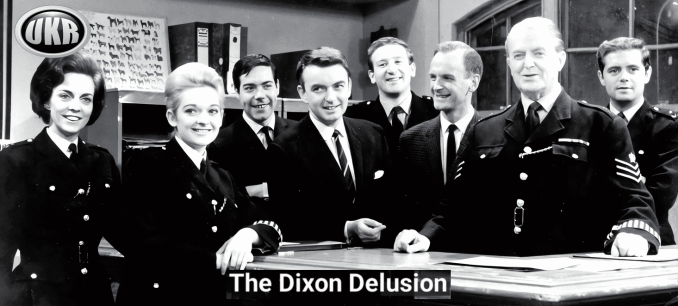
I recently wrote about The Sweeney. My conversation with Fred about nostalgia? It conjured the BBC’s long-running TV series Dixon of Dock Green. Dixon’s the patron saint of British policing, even if few people under the age of fifty have ever heard of him. Without Sergeant George Dixon, there would be no Heartbeat. No Rosie. Dammit, possibly no Hamish Macbeth either.
A rollcall of cosy, unarmed, community coppers. Solving problems via a quiet word in your ear. It’s the kind of policing our politicians, opinion-formers and senior officers hold dear. Nostalgia in a beat duty helmet. There were no stab vests or tasers in Dock Green. No zombie knives or crack or TikTok.
If only we could go back to Dixon-style policing! All that nasty stuff would magically disappear.
Just like The Sweeney, Dixon of Dock Green was a fantasy. A fantasy so powerful it became a meme in the original, Dawkinsesque sense of the word. A strand of fictional DNA, spliced into the helix of real-world policing. Dixon would influence British policing for over half a century.
As a new Government announces a laughable refresh of neighbourhood policing, it seems appropriate to consider the enduring and perversely corrosive impact of what I’ll call ‘The Dixon Delusion.’ The idea all you need to police the streets is a kindly word, persuasion, a raised eyebrow and – let’s get this crystal clear – absolutely no clip around the ear.
Clips-around-ears mean IOPC task forces, terrible headlines, selectively-edited TikTok videos, miffed ‘community leaders’ and quite possibly riots. Stick to kindly words and raised eyebrows. Pretty please? It worked for Sgt Dixon.

First though, a reminder of what governments always do, which is pretend they’re fixing neighbourhood or community policing (I’ll use the terms interchangeably). We, the public, are supposed to believe this is simply a game of arses on seats. The moron’s chant of more bobbies on the beat.
On this turn of the wheel, every neighbourhood will also have a named, dedicated officer accountable for their patch (what happens when they take a day off? Go on holiday? Have flu?).
Labour’s take on this old chestnut is a masterpiece of doomed-to-fail bullshit, promising 13,000 extra officers. Here are the numbers, which I’ve stolen borrowed from The Spectator.

As you can see, it’s smoke and mirrors. 4000 of the officers will be PCSOs with no powers of arrest. 3000 are part-time and unpaid Special Constables. 3000 are brand new police officers (largely rookies, who at that point in their service would prefer to be zooming around in police cars). The last 3000 will, allegedly, consist of officers turfed out of back office roles (some of whom will be the police version of conscripts in a stomach division). Unless, of course, they aren’t back-filling for the admin staff going on strike. In their pyjamas, presumably, using Zoom to gather around virtual picket lines.
Divide those 13000 posts between the 43 territorial Home Office police forces, add abstractions for leave, training, public order commitments and sickness. It’s a drop in the ocean. It’s only marginally more meaningful than the handful of extra teachers they’ll fund by slapping VAT on private schools.
The point is this: before we even begin talking about ‘neighbourhood policing’, it should be remembered there’s no magic box of coppers to redeploy. Indeed, most UK forces are threatening to reduce their officer count for budgetary reasons.
I shall christen this Adler’s First Iron Law of Policing: Ignore everything ANY government says about police numbers. Verily, ‘tis bullshit.
Now we’ve established the numbers game is meaningless, politicians are clueless and there’s no money.
Don’t worry. It gets worse.
Neighbourhood versus Response
If I’ve learned anything about the public’s attitude to policing outcomes, it’s punters don’t really care about throughputs (structures and processes). They care about outputs (absence of crime, quality of service). The police, on the other hand? They love throughputs. They involve projects, PowerPoints, high-powered meetings and promotion portfolios.
So, bearing in mind the public’s indifference to how policing organises itself, a question. What actually constitutes neighbourhood policing?
I’d suggest all local policing is, more or less, neighbourhood policing. You might work on a sprawling council estate or a rapidly-gentrifying hipster enclave. You might work on the Shetland Islands. Or in an airport, or a pleasant suburb with sparkly new EVs parked on every other drive. They’re all communities.
When I joined the Met, back in the early 90s, each team (of around fourteen uniformed officers) policed a subdivision for an eight-hour shift on foot and in vehicles. We did everything, from taking 999 calls to ‘community engagement.’ The phrase makes me cringe. It simply means proper patrol, the death of which I discuss here. It wasn’t perfect, but the public could call a local control room and there’d be a response.
That meant, in a 24-hour period, three teams totalling forty-odd officers worked the same area (earlies, lates and nights). Unsurprisingly, it meant people wouldn’t always see a familiar face. Well-meaning residents groups would complain to their MP about the perennial bugbears of dogshit on pavements, kids hanging around and bikes on footpaths (most of which is a problem for the local authority, to be honest). We were more interested in nicking street robbers, thieves, drug dealers and burglars. Yes, this included shoplifters.
To address this gap, the police established ‘Home Beat’ constables. Home Beats were meant to build relationships. They’d be a reliable source of local intelligence. They’d informally resolve low-level crime and disputes, using their discretion and the legendary ‘Ways and Means Act’ (RIP). That would be how the real George Dixon operated, by the way, which never made its way into the TV series.
Being the police, some of these local officers were stars. Others weren’t. Plus la change. This goes back to management at sergeant and inspector level, a subject I’ve discussed at length elsewhere on this Substack.
During the 1990s, technology accelerated and society abraded. The law changed radically (thanks Tony Blair). Meanwhile, expectations of policing mutated. Homes beats became anachronistic. The solution, the police and Home Office decided, was another anachronism… more Dixon of Dock Greens! Imagine if we had loads of them, all Dixon of Dock Greening about!
And thus, local policing was divided into two distinct entities. Neighbourhoods and Response.
Response would patrol and answer 999 calls. After a while, given the demand curve, this meant they only answered 999 calls. As more and more calls involved police involvement in mental health cases and safeguarding, response became easy fodder for hospital watches, chasing teenagers who’d run away from their care homes (again) and other stuff you wouldn’t expect the police to do. But crime fighting? Ha ha ha. Police command and control models are predicated on fantasy performance metrics and organisational risk. Not fighting crime.
Neighbourhoods on the other hand, was supposed to be a team of home beats led by a sergeant. Response saw it as a cushy posting, as neighbourhood officers were meant to be ringfenced from other duties. With a good sergeant and an interesting beat, neighbourhood teams could be impactive. And, for police officers, an interesting place to work. With an indifferent sergeant on a small, boring beat (or a beat with no cohesive community to speak of)? It was the policing equivalent of Siberia.
Sir Ian Blair, as Met Commissioner in the early-mid 2000s, made local policing (Safer Neighbourhoods Teams or SNT) his mission. He put dedicated teams into every London ward. Was it one hundred percent successful? No, of course it wasn’t. Was it impactive? Yes. Could it have been the future? I think so. Three things killed SNTs – (1) the demands of counterterrorism, the ultimate resource and bandwidth sponge, (2) the financial crash of 2008 and subsequent funding crises, and, (3) Ian Blair leaving the Met (new Commissioners, who want a legacy of their own, tend to change everything).
Then, when austerity really bit, Safer Neighbourhoods atrophied. The performance monster demanded feeding, which is difficult to quantify on a SNT. So did police call centres, managing endless requests for assistance. These all required complex, arse-covering processes devoid of commonsense or discretion (remember, for stuff which was traditionally non-police business).
And, yes, political hot-potato issues (well, hot potatoes for a minority of influential obsessives) diverted police from… policing. The politicisation of policing by social justice activists is another subject for another time.
As the Cameron administration’s cuts began to bite, something had to give. In the Met, prestige squads and departments were the crown jewels. Bernard Hogan-Howe made a conscious decision to protect them, sacrificing SNTs in the process. A tricky call. I’m not a fan of Bernie, but to be fair at least he made a decision.

Communities and ‘Policing by Consent’
This one’s fairly simple. Some communities are more cohesive than others. You’d be surprised how much a prosperous suburb with engaged residents has in common with an inner-city estate with a dominant (often minority ethnic) community. Sure, there are points of tension, but local officers at least know who to speak to. In places where there’s actually a community to begin with, a neighbourhood policing team can make a difference.
On the other hand, some ‘communities’ are chaotic, transient and divided. They’re riven by gangs and organised criminals. As tactics like stop and search and use of force become hotly contested, these communities become abandoned by police officers worried about losing their jobs. The community leaders who do exist are often hostile. A neighbourhood policing team’s at an immediate disadvantage – their role becomes more like counterinsurgency than policing. George Dixon wouldn’t have lasted five minutes. Well, he would, until the IOPC had him up for assault.
These are places which, unfortunately, politicians like to ignore. They pretend they’re policed by consent. It’s easier to blame the police for societal problems law enforcement can never, and will never, solve.
The underlying laws, systems and processes are broken
The public are, not unreasonably, baffled by laws and procedures preventing police officers from using their initiative to solve simple problems. George Dixon, by the way, was more or less The Law on his beat. Commonsense trumped paperwork and unnecessary court appearances. Until the post-1968 generation decided commonsense was a bourgeois construct, designed by the running dogs of Capitalism to enslave the proletariat.
Nonetheless, our leaders are loathe to point out our laws are suboptimal for the 21st Century. Coppers simply aren’t using them properly. Right?
I’ve banged this drum elsewhere on this Substack. The body of legislation impacting on policing (including the Police and Criminal Evidence Act and the Human Rights and Equalities Acts) require urgent revision. They’re unfit for purpose. They were written for an imaginary world, not the real one. The wrongs they set out to right may have been mitigated, but at the cost of creating… a whole new catalogue of wrongs. The balance badly needs restoring.
Do we need a new type of police service?
I’ve heard them all: We should privatise community policing, subcontracting it to local councils (this was fashionable in Tory circles in the 2000s). We need a hybrid, continental model, with a municipal police service and a gendarmerie. We need to separate specialist policing from Home Office forces and give it to the National Crime Agency. We must brigade the 43 English and Welsh forces into 12 strategic forces…
In the Home Office and National Police Chief’s Council they sit and ponder the future. There’s no money. Performance is poor. Something has to give. And yes, at the back of their minds, is the ghost of Sergeant George Dixon of Dock Green. They still cling to the Dixonian myth of bucolic, cosy policing.
Happily, I’ve never worked in the NPCC or Home Office. I’ve spoken to those who have; Staff officers. SMEs working on projects. Ambitious secondees looking to burnish their CVs. They say more or less the same thing.
You’ll be shocked (shocked, I tell you!) to learn these organisations are seething snake pits of ambition, groupthink and self-interest. Too many senior officers are adherents of The Blob. They’re obsessed with the illusion of control. They’re unwilling to accept our laws don’t work. Even if they did, they lack the courage to speak truth to power. They’re wilfully ignorant as to how problems facing policing are systemic (and not just about ‘The Culture’ and rude WhatsApp groups). And, crucially, they’re petrified of allowing police officers to use their own discretion and initiative.
In fact, I’d say we don’t necessarily need a new police service.
Just a new breed of senior police officer.
Thanks for reading and hello to new subscribers. If you’ve any questions, either PM me or leave a comment. I do read them all.
Cheers,
Dom.
This article (The Dixon Delusion) was created and published by Dominic Adler and is republished here under “Fair Use”

••••
The Liberty Beacon Project is now expanding at a near exponential rate, and for this we are grateful and excited! But we must also be practical. For 7 years we have not asked for any donations, and have built this project with our own funds as we grew. We are now experiencing ever increasing growing pains due to the large number of websites and projects we represent. So we have just installed donation buttons on our websites and ask that you consider this when you visit them. Nothing is too small. We thank you for all your support and your considerations … (TLB)
••••
Comment Policy: As a privately owned web site, we reserve the right to remove comments that contain spam, advertising, vulgarity, threats of violence, racism, or personal/abusive attacks on other users. This also applies to trolling, the use of more than one alias, or just intentional mischief. Enforcement of this policy is at the discretion of this websites administrators. Repeat offenders may be blocked or permanently banned without prior warning.
••••
Disclaimer: TLB websites contain copyrighted material the use of which has not always been specifically authorized by the copyright owner. We are making such material available to our readers under the provisions of “fair use” in an effort to advance a better understanding of political, health, economic and social issues. The material on this site is distributed without profit to those who have expressed a prior interest in receiving it for research and educational purposes. If you wish to use copyrighted material for purposes other than “fair use” you must request permission from the copyright owner.
••••
Disclaimer: The information and opinions shared are for informational purposes only including, but not limited to, text, graphics, images and other material are not intended as medical advice or instruction. Nothing mentioned is intended to be a substitute for professional medical advice, diagnosis or treatment.
Disclaimer: The views and opinions expressed in this article are those of the author and do not necessarily reflect the official policy or position of The Liberty Beacon Project.


Leave a Reply