

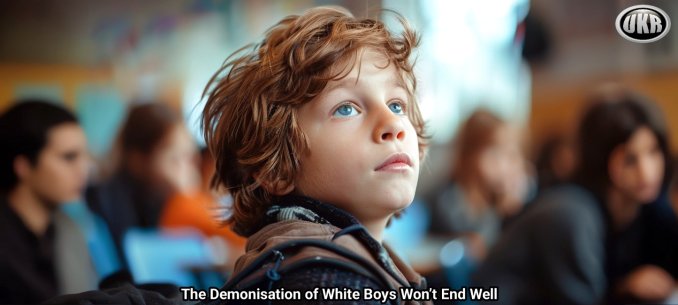
The demonisation of white boys won’t end well
GAVIN S INNES
IN THE heart of Britain’s education system, a troubling narrative is unfolding, one that disproportionately targets white British boys under the guise of combating misogyny.
The updated Relationships, Sex and Health Education curriculum in England, with similar lessons already being taught in Scotland, pushes lessons on online harms, pornography, incel (involuntarily celibate) culture, and what the Government calls toxic masculinity. Boys are told they are the problem. Girls are framed as potential victims while the same behaviours in girls often go unexamined.
According to the Youth Endowment Fund’s Children, Violence and Vulnerability 2024 survey, 57 per cent of boys who had been in a relationship reported experiencing at least one episode of violent or controlling behaviour from a partner, compared with 41 per cent of girls.
Teenage relationship abuse affects boys too, yet the curriculum overlooks this reality. A YouGov survey also reveals that more than a third of young men perceive misandry (hatred of men) as widespread in the UK, with many feeling personally impacted, yet these lessons focus almost exclusively on misogyny (hatred of women) while ignoring the gendered pressures boys face.
The Department for Education’s 2026 VAWG (Violence Against Women and Girls) strategy seems determined to single out white, often Christian, schoolboys and labels normal teenage behaviour as misogyny while failing to address the same behaviours in girls.
It is based on one-sided polling asking children if they had heard comments from boys to girls, conducted by pollsters who clearly do not understand boys’ lives, or the bullying, abuse and misandry they rarely report due to public shaming.
At the same time, the lessons ignore glaring inequalities in some communities, where girls are brought up as second-class citizens yet sit side by side with these boys in classrooms. Did anyone consider what happens if these girls speak out about abuse at home, or was this just another exercise in turning boys into scapegoats delivered by bureaucrats who nod along without thinking?
As Bruce Newsome reported a couple of weeks ago on TCW, Prevent’s outrageous multiple-choice game Pathways compounds this.
Charlie, the white British boy, is cast as a moral test subject. His curiosity about immigration or government policy is treated as dangerous. Immigrant children are portrayed as perpetual victims, and teachers are expected to enforce a rigid script. Children quickly learn that honesty, questioning the narrative, or pointing out glaringly obvious double standards, marks them as wrong.
The game clearly reflects an extremist leftist viewpoint, showing Charlie immediately as hateful of an immigrant girl who attains a higher grade than he does. His journey to radicalisation, driven by curated social media content, leads him to protests. The hypocrisy is palpable, particularly when government institutions and their allies actively discourage patriotism.
Yet cracks appear when insiders break ranks. Take Muslims and children of Hamas leaders who bravely speak out against their own tribes’ extremism. Mosab Hassan Yousef, son of a Hamas co-founder, denounces the group’s death culture and jihadist indoctrination, exposing how it treats women as property and feeds children hatred from infancy.
Similar acts of defiance are unfolding globally. In Iran women have been ripping off their coverings in public protests against systemic oppression, reclaiming agency over their own bodies and demanding freedom.
Such voices and actions surely demand attention in classrooms. Teachers should not ignore systemic misogyny in certain communities, or dismiss the ways cultural and religious norms enforce second-class status for women, but my gut feeling is that they will.
Ignoring these realities while simultaneously labelling ordinary teenage behaviour as misogyny in boys is both hypocritical and harmful. This asymmetry risks breeding resentment among white British children, particularly boys. Young people are acutely sensitive to fairness and quick to spot double standards.
Will teachers confront these cultural and religious attitudes in class? They could, but the fear of breaching protected characteristics often stifles honest discussion.
Educators will need to summon the courage to start conversations about cultural norms that harm women, the pressures created by gender ideology, and the emergence of misandry and to learn how to discuss them fairly.
Provocative male figures face a similar double standard. Andrew Tate is often accused of misogyny over out-of-context clips, yet Piers Morgan observes the broad appeal of traditional masculinity and notes that much of Tate’s content is semi-satirical provocation.
Jordan Peterson explains that Tate attracts lost young men by offering an alternative to weakness, showing that they would rather be Tate than an incel, a member of an online community of young men who consider themselves unable to attract women sexually, and who are typically associated with views that are hostile towards women and men who are sexually active.
These examples show that male behaviour is too often judged through a narrow ideological lens, obscuring genuine misogyny and misandry alike.
Portraying boys as inherent threats can shame ordinary aspects of male development: banter, competitiveness, protectiveness, assertiveness. Boys may internalise guilt simply for being themselves, fostering self-doubt, resentment and reluctance to speak about their own victimisation at a time when male suicide rates remain more than three times higher than female rates.
This unchecked trajectory toward demonising men finds a chilling fictional parallel in Scottish author JCP Thomas’s 2025 dystopian novel The Pendulum Effect.
It explores how unchecked misandry and blind accusations of misogyny silence men, leading to societal collapse, global breeding bans and a desperate fight for humanity’s survival. It illustrates a realistic extreme: when those of one gender are branded moral criminals without support or fairness, the pendulum swings to catastrophe.
Ultimately, this is not an accident. Governments since the Equality Act have been engineering victim hierarchy; putting ‘tribes against tribes’, dividing citizens along gender, ethnic, religious and ideological lines.
Under leaders such as Prime Minister Sir Keir Starmer, former Scottish First Minister Humza Yousaf and London Mayor Sir Sadiq Khan, identity politics has been amplified at every level, pitting ‘us’ against ‘each other’ and rewarding grievance over unity.
Yousaf’s so-called Hate Crime Bill disproportionately targeted frustrated white people and rebranded their freedom of speech as hateful, yet the cultural and religious backgrounds of criminals who commit offences at higher rates are rarely recorded.
The result is skewed statistics showing crime rising across the UK without highlighting these disparities, reinforcing the narrative that white British citizens are intolerant of vulnerable foreign nationals and ‘small boat doctors and engineers’, while ignoring evidence of Islamist extremists and radicalised individuals in some Muslim communities committing acts of violence against Jews.
Oscar Hammerstein said it best when he wrote in the lyrics of South Pacific: ‘You’ve got to be taught to hate and fear, you’ve got to be taught from year to year, it’s got to be drummed into your dear little ear – you’ve got to be carefully taught!’
Holyrood and Westminster, backed by the London Mayor, are doing their best to make sure this happens with boys.
This article (The demonisation of white boys won’t end well) was created and published by Conservative Woman and is republished here under “Fair Use” with attribution to the author Gavin S Innes


Leave a Reply