

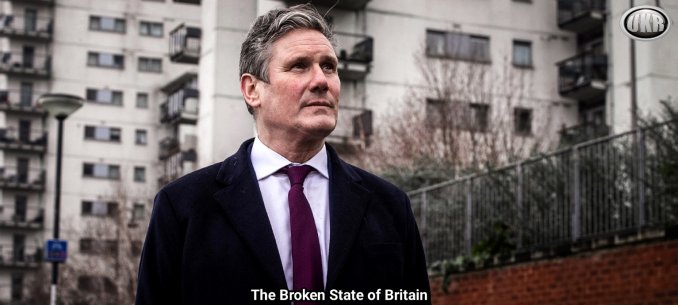
The broken state of Britain
Britain’s governing crisis is not imposed from outside — it is chosen
DAVID SHIPLEY
In the UK there are signs of state failure everywhere for those with eyes to see. Dominic Cummings says that “the whole wider Whitehall system is fundamentally broken”. He isn’t alone. More than half of MPs polled think Whitehall is working “badly”, and even our machine-man Prime Minister has observed that “too many people in Whitehall are comfortable in the tepid bath of managed decline”. Even the “delight” with which ministers welcomed Alaa Abd El-Fattah to Britain has been blamed on “the supremacy of the Stakeholder State” by Starmer’s former Director of Strategy, Paul Ovenden.
The British people know their state is broken. In the 2024 British Social Attitudes survey 79% of us said that our system of governing “could be improved a lot/a great deal”. In truth this is unsurprising. We live under a regime which hasn’t built a reservoir since 1992, hasn’t brought a nuclear power plant online since 1995, which struggles to complete a high speed rail link between two cities a mere 130 miles apart, in which GDP per capita has barely grown in almost 20 years, in which energy costs are ruinously high, youth unemployment is rising and which is unable to defend its own borders, or keep its citizens safe from a wave of serious crime committed by recent migrants.
Politicians do seem to recognise there is a problem. This weekend, the Prime Minister said “The truth is since the crash in 2008, most people haven’t seen their living standards improve, they haven’t seen their public services move in the right direction, they’ve seen them move in the wrong direction, and they’ve lost trust in politics.” Similarly, I believe that the Home Secretary means it when she describes the asylum system as “broken”.
But the government’s proposed solutions are rather pathetic. Starmer’s goals of achieving “mutual recognition” of professional qualifications and reducing barriers for touring artists will not make the economy boom. His proposed youth mobility scheme with the EU is not going to reduce our record high youth unemployment. And Labour’s reliance on energy price caps to suppress the cost of living are merely ensuring that Britain’s economy remains fake and distorted. Of course this isn’t just a Labour problem. During the Sunak government the key priorities were banning smoking and A Level reform.
But it’s on illegal migration that this government is at its most feeble. There’s the “one-in, one-out” deal agreed with France in the summer, under which a very small number of illegal arrivals are supposed to be sent back to France (and at least 80 are laying the groundwork for a legal challenge), not to mention the brilliant plan to close the asylum seeker hotels and disperse these men into HMOs and even new council houses.
More recently, the Home Office announced new powers for Border Force. Under these rules, officers will be allowed to search migrants who have illegally entered our country. Our guardians will now be able to order migrants to remove their coats, jackets and even gloves in order to search for mobile phones and SIM cards. The aim of all this is to allow police to gather intelligence in order to “smash the gangs”.
The first, obvious response to this news is astonishment. It’s already a crime to enter the country without permission, carrying a maximum sentence of four years in prison. Every single illegal Channel arrival could have been arrested and searched under existing powers. The fact that we didn’t search the 41,472 people who illegally crossed the Channel in 2025 is shocking — and equally pitiful. We are facing a crisis which threatens not just the government, but the very legitimacy of the British state. These responses, these minor adjustments to a failed system, will not avert disaster. And so, the British state rumbles on towards some kind of collapse or another.
These responses, these minor adjustments to a failed system, will not avert disaster
There is much discussion about why the British state has become so incapable. Michael Gove blamed “the blob”. Politicians have often blamed quangos, and the decentralisation of authority brought about during the Blair governments, or legal obligations, such as those found in the Human Rights Act, the Modern Slavery Act and the Constitutional Reform and Governance Act. Tom Jones, of this parish, has written about this, describing:
This is the paradox of ‘shallow sovereignty’: governments appear to rule, but cannot act. Their authority is formal, but not functional. The real answer to Britain’s governing problems is that the decision space — the viable political choices available to leaders — of our politicians is collapsing, constrained by quangos, international obligations, legal activism, bureaucratic resistance, fiscal oversight, activist pressure and the growing social conformity of an increasingly narrow political class.
While there is some truth to this, it’s important to recognise that these limitations are entirely voluntary. Our politicians, our parliaments, decided to create every single one of them, and under Britain’s constitutional settlement, all of them could be swept away with a single Act of Parliament. If Parliament wants a nuclear reactor, a high speed rail line or a reservoir built it can just pass a law to make it happen. If Parliament no longer wants to admit illegal migrants, it can just pass a law to do that too.
And yet our political class seem unable to even conceive of the power they possess. Part of this is no doubt because of the “social conformity” which Tom Jones has identified. Our party system selects for obedient conformists, who are unlikely to embrace radical change. Perhaps too there’s an element of learned helplessness, with politicians having forgotten the power they can wield, if they have the will.
But it goes further than that. Those who govern us seem unable to imagine a society which doesn’t function (or rather fails to function) pretty much like the UK today. The legal and conceptual framework we exist within is treated as though it’s geography, or weather — something to be accepted, or adapted to. The reality is that all these limitations are tools of our own making. They are tools which have long since ceased to work.
Despite this, almost our entire political and media class seem unable to imagine a world without those broken tools. And so our nation remains bound in a cage entirely of our own making, which we could shatter with a word.
This article (The broken state of Britain) was created and published by The Critic and is republished here under “Fair Use” with attribution to the author David Shipley
See Related Article Below
Resets and relaunches can’t hide fundamental problems for the Prime Minister – and the rest of us
GILES DILNOT
“The problem with being Prime Minister is when ‘everything is your fault’, and physically and mentally you can’t do everything – you keep trying and trying, nonetheless and you end up having not really doing anything”
I’d been talking to a veteran Tory. One who has served a number of Prime Ministers and we were discussing the year ahead, the ‘rewiring of the state’ debate, and the likely fate of our adenoidal overlord Sir Keir Starmer MP, Prime Minister of the United Kingdom.
We both agreed that Starmer and Sunak have suffered from the same malady, explained in their comment.
Sunak, and his team, with only two years on the clock tried very hard indeed to be across everything, including into the details of things they should, and could, have left to others. The verdict, though patently not entirely directed at them, was the electorate felt we’d done nothing.
If Farage truly wants the job, it’s another systemic issue he’ll have to face and prepare for. Being PM starts off as a fiendishly hard job, and, especially if anyone is unprepared for it, it just gets harder and harder.
For any party leader, being PM really isn’t possible alone, even if you are ‘a talent’. A lot of people rolled their eyes when David Cameron, the then ‘“future, once” said in 2008 when asked why he wanted to be Prime Minister replied
“Because I think I’d be good at it”
To be fair to Cameron, in terms of managing the work load, the process, the dynamics of being in charge, it was a fair self-assessment but as history shows efficient managerialism doesn’t make you ‘good at the job’ and besides Cameron knew how to delegate.
The current incumbent is not ‘good at the job’.
Starmer has been criticised for focussing too much on the international and not enough on the domestic. Now we learn he has set a new goal for his premiership. New Year New mission – old problem.
If as Jack Straw once told me, as he himself had been told, that the Home Office is the department where “every day something comes out of a clear blue sky” – or prosaically as younger officials have put it to me; ‘the Department of shit happens’ – then it’s odd no-one has said it about being bunkered in Downing Street.
The Times has described yet another Starmer reset – to relentlessly focus on the domestic ‘cost of living’ – being derailed and delayed, by nothing more than the very thing he’s been criticised for focussing on instead. 2026 has started with a series of game changing events on the world stage that as Russia’s invasion of Ukraine did nearly four years will likely have an impact for better or worse on our domestic politics.
According to the Times, Starmer now wants to stick to domestic.
“He is expected to tell No 10 staff on Monday: ‘The word I expect to define this year is relentlessness. Relentless focus on the cost of living. Relentless delivery of change people can feel. Relentless clarity on the story about how we are changing this country.’”
Well if he doesn’t know something about relentlessness by now; the churn of events, the criticism of his abilities, the grind, he’s certainly not even passingly acquainted with ‘clarity’.
It is both sobering, depressing even, that even I can end up on the same page as Polly Toynbee, whilst on the radio, in agreeing the international rules based order is fig leaf past its sell-by date and we are in a world of big power might, and zones of influence.
I’d humbly suggest that the thought is later coming to Polly than myself but that’s by the by.
Starmer can try to bring the focus back to the cost of living in Britain, but if the Iranian regime doesn’t collapse now, it will soon. If Trump moves on from Venezuela, to Cuba, Columbia and this Rubicon for NATO, Greenland, then frankly ‘good luck with that’.
Besides, within days he’s about to approve a highly controversial – and still suspicious -design for a new Chinese super embassy in London. It is his ticket to meet one of the world’s big men, Xi Jinping as he begs for a trade deal that, hang the security costs might deliver some economic growth.
Growth. That of course was, it seems way back now, the original Starmer mission. A relentless focus on growth. Growth, growth, growth.
Having let his Chancellor all but stifle the chances of that, or people finding a job, it’s hard to see how he’ll actually tackle the cost of living.
Governments can’t fix food prices. Maduro tried that as it happens. The Government claims to be fixing energy prices but, it seems up rather than down. If we are to return to some Wilsonian measure of ‘the pound in your pocket’ then I wish him luck persuading some very angry parts of society that they feel better off.
First, feeling better off is not the same as being better off, but second, as with so many trumpeted Labour policies, even when they’ve claimed it’s all part of the plan to attain that aim, they’ve had to come to a screeching U-turn.
It’s enough to send you to the pub to drown your sorrows. If it isn’t closing or the landlord so stressed it turns the beer sour.
Here’s the danger for the Conservatives. Their strategy has been clear last year and for this year. Stick to the economy and opposing the Government. Do it as a team not one man, and, to borrow a phrase, relentlessly focus on the economy and by extension the cost of living.
The opportunity is laying out policies, as they have done, to cut public spending, deregulate and free up business and afford the necessary defence bill Labour can’t. Oh the irony having made up a £22bn national black hole that didn’t exist that Labour have recently been informed of a £28bn real one just in defence.
The problem is still stark, even if you get that right. Necessary cuts to public spending in order to boost growth and fix the public finances may make a great deal of economic sense but how you sell that to people feeling the economic pinch, whatever their income, is daunting.
The giveth bit was always easy it’s the taketh away that’s hard.
It will have to be an honest argument that whatever it is you may have to give up will benefit all, and especially those you care about in order to fix what is not working now.
Labour should crack on with trying to lower the cost of living, I genuinely wish them success, but so far, they don’t seem to have any solution that doesn’t end up with the state borrowing more, and spending more. Polanski, and to an extent Farage, actually advocates that.
There is one place the Government could find over £30bn pounds now. Not giving it in state pension payments to pensioners worth over a million.
However that’s a topic for another day. Enjoy yours.


Leave a Reply