

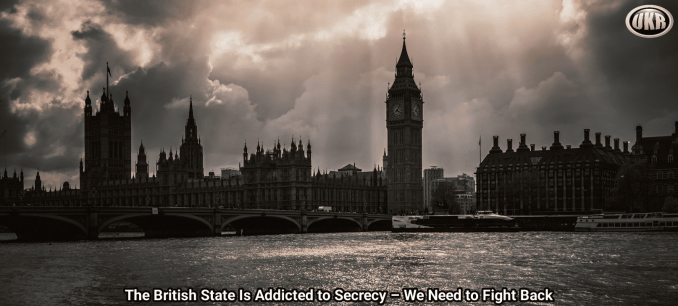
The British state is addicted to secrecy – we need to fight back
Our politicians and officials are using public money to keep citizens in the dark, says Heather Brooke
PETER GEOGHEGAN
Britain has a secrecy problem. In 2024, the government answered just 29% of Freedom of Information requests – the lowest rate since FOI began.
That’s why Democracy for Sale keeps going to court. Last weekend we exposed how carmakers lobbied a Conservative minister to weaken climate rules – information we only uncovered after a legal fight that lasted nearly two years. It was our fourth tribunal win this year.
These victories matter. They prove secrecy can be challenged – and beaten. But that we have to wage these battles at all shows how badly the system is failing.
FOI is 25 years old this year. To mark the anniversary, we’re putting on a special in-person event next Tuesday (Dec 2) about how governments have sought to muzzle FOI – and how we can fight back.
Ahead of the event, we have a very special piece today by someone who knows more than almost anyone about the importance of fighting secrecy: journalist Heather Brooke.
Heather spearheaded the MPs’ expenses scandal and has spent decades pushing for transparency. In this vital piece, she reflects on why secrecy still thrives in Britain – and asks a pressing question: how many other scandals are still being kept from view?
Britain has a secrecy problem – we need a reset
By Heather Brooke
Twenty years ago, I began – without realising it – a five-year legal battle with Parliament. All I wanted to know was how MPs were spending public money.
I’d just finished researching Your Right to Know, a guide to the Freedom of Information Act. The law passed in 2000, but politicians were so alarmed by the idea of a public ‘right to know’ that they delayed its implementation for five years, insisting they needed time to “prepare”.
So when the law finally came into force, in 2005, I started filing FOI requests myself. One of the first was for MPs’ expenses.
In the United States, where I’d previously worked as a local reporter, such claims were already considered public records. I’d rifled through boxes of them without even filing an FOI. In Westminster, the response couldn’t have been more different. My request was met first with confusion, then suspicion, and finally polite disdain. Instead of: “How can we help?”, it was: “Why do you want this?”
That question revealed something deeper. The suspicion wasn’t personal—it was structural. It reflected a political culture that treats the public as spectators, not participants; a group to be managed, not respected. In that worldview, information is a privilege for insiders, not a right for citizens.
I decided to fight. Knowing how public money is spent by public officials seemed the bare minimum for a functioning democracy. I appealed, then appealed again, eventually reaching the Information Tribunal and the High Court – while the government spent public money on lawyers to block public access to information. I found a legal team willing to act on a no-win, no-fee basis and joined forces with other journalists.
Remarkably, we won. In 2008 the High Court ruled that MPs must publish their detailed expenses. They were given time to digitise the records and redact private information. But when months passed, I grew suspicious. MPs, it turned out, were trying to change the law retrospectively to exempt themselves. Then a source in the redaction room, disgusted by what they saw, copied the database and shopped it around. The Daily Telegraph bought it – and the rest is history.

The revelations were extraordinary: lavish second homes, giant TVs, family members on the payroll, even a duck house. MPs across every party were implicated. The Speaker resigned; some MPs stood down; a few went to jail. In all, 392 politicians were ordered to repay £1.3 million in improper claims. The scandal helped usher in a new government in 2010 on a transparency mandate and the creation of the Independent Parliamentary Standards Authority, ending MPs’ self-regulation.
It’s worth recalling that before 2005, ordinary people had almost no access to official information. Despite all the rhetoric about democracy, the British state operated more like a feudal system: centralised, paternalistic, and hostile to scrutiny. Decisions were handed down, not discussed.
FOI cracked open a small but vital space for the public to question and challenge. In the two decades since, FOI-driven investigations have reshaped public debate – including some published by this outlet.
One of my former students, Alexandra Heal – now at the Financial Times – used FOI to uncover how male police officers with histories of domestic abuse were protected by their forces. It was the first major revelation of institutional misogyny in policing. The investigation won the Paul Foot Award and triggered wider scrutiny of how police treat women, both colleagues and victims.
The Guardian’s Rob Evans and Robert Booth fought for a decade to uncover the “Black Spider Memos” – the secret lobbying letters written by then-Prince Charles. Instead of reform, the government’s answer was to grant the Royal Family a sweeping exemption from FOI. We should all be concerned about that.
FOI is the democratic canary in the coal mine. When official information flows freely, it signals that power is shared. When it’s withheld or delayed, it signals the opposite: power concentrated in the few, with the public treated as a nuisance – or a threat.
Some things have improved since 2005. IPSA now publishes MPs’ expenses in downloadable form, and more public spending data is available than before – though often not detailed or timely enough. Yet in practice, FOI is increasingly undermined. The 20-day limit is routinely breached, making FOI nearly useless for journalists on deadlines. FOI response rates are at their lowest since records began.
A reset is needed. FOI should clearly extend to lobbying and to private companies doing public work or taking public money. The Royal Family’s absolute exemption – slipped in after the Black Spider Memos ruling – should be repealed. Enforcement must be strengthened with the power to fine persistent offenders, as with data protection. And outdated secrecy laws, including aspects of contempt of court, need serious reform.
But the deeper issue is cultural. Too many officials still see the public as something to control, not citizens to inform. And this matters. When establishment institutions refuse to listen or explain, they create a vacuum that opportunistic populists are eager to fill. People may not like the solutions these actors offer, but they do like being heard.
When people cannot see how decisions are made – or how money is spent, or whether justice is being done – resentment grows. In good times, it simmers; in hard times, it explodes. Transparency diffuses that pressure. It gives power back to citizens and deprives populists of the darkness in which they thrive.
The justice system shows the cost of secrecy. Strict contempt rules often prevent the public from knowing who has been arrested or charged, inviting misinformation and prejudice to fill the gap. If judges can sift out prejudicial material, juries can too. Openness strengthens, not weakens, fairness.
Even when transparency reveals uncomfortable truths, it is still the better path. Problems don’t disappear when buried – they deepen. The Metropolitan Police’s decades of concealed sexism and racism are a stark example.
The 25th anniversary of FOIA is a moment to reflect. The Act still holds huge democratic potential, but only if enforced with real intent.
My battle with Parliament showed what transparency can achieve. But how many other scandals are still being hidden – shielded by officials using public money to keep the public in the dark?
Heather Brooke is an award-winning investigative journalist and author. She is speaking at a special discussion about ‘FOI at 25: Successes, Setbacks and the Road Ahead’ organised by Democracy for Sale at City University, London on Tuesday December 2nd. The event is free, with tickets available here.
This article (The British state is addicted to secrecy – we need to fight back) was created and published by Peter Geoghegan and is republished here under “Fair Use”

••••
The Liberty Beacon Project is now expanding at a near exponential rate, and for this we are grateful and excited! But we must also be practical. For 7 years we have not asked for any donations, and have built this project with our own funds as we grew. We are now experiencing ever increasing growing pains due to the large number of websites and projects we represent. So we have just installed donation buttons on our websites and ask that you consider this when you visit them. Nothing is too small. We thank you for all your support and your considerations … (TLB)
••••
Comment Policy: As a privately owned web site, we reserve the right to remove comments that contain spam, advertising, vulgarity, threats of violence, racism, or personal/abusive attacks on other users. This also applies to trolling, the use of more than one alias, or just intentional mischief. Enforcement of this policy is at the discretion of this websites administrators. Repeat offenders may be blocked or permanently banned without prior warning.
••••
Disclaimer: TLB websites contain copyrighted material the use of which has not always been specifically authorized by the copyright owner. We are making such material available to our readers under the provisions of “fair use” in an effort to advance a better understanding of political, health, economic and social issues. The material on this site is distributed without profit to those who have expressed a prior interest in receiving it for research and educational purposes. If you wish to use copyrighted material for purposes other than “fair use” you must request permission from the copyright owner.
••••
Disclaimer: The information and opinions shared are for informational purposes only including, but not limited to, text, graphics, images and other material are not intended as medical advice or instruction. Nothing mentioned is intended to be a substitute for professional medical advice, diagnosis or treatment.
Disclaimer: The views and opinions expressed in this article are those of the author and do not necessarily reflect the official policy or position of The Liberty Beacon Project.


Leave a Reply