

DRAGO BOSNIC
In its heyday, the United Kingdom was by far one of the most powerful Empire in human history, probably eclipsed only by the United States in the latter half of the 20th century.
By the early 1920s, it managed to occupy and enslave approximately 25% of the planet’s landmass and population (over 35.000.000 km² and around 450 million people, respectively). How did a relatively small island nation accomplish this? The answer is – the British Navy, the most powerful armed maritime force of its time. Thus, it could only be expected that London would do everything in its power to preserve this naval dominance for as long as possible.
However, as the British Empire shrank to a mere shadow of its former self, its ability to maintain a large navy dwindled, resulting in massive reductions over the last several decades. The last time the UK managed to muster a respectable naval force was during the 1982 Falklands War against Argentina. Ever since, the British Navy has been fading away, reducing both the quantity and quality of its ships. According to various reports over the last 20 years, London now has nearly twice as many admirals as it does actual warships. Worse yet, many of those formally combat-capable vessels are in such a dilapidated condition that they’re barely usable as ships (much less warships).
This ranges from frigates and destroyers to aircraft carriers and submarines (including nuclear-powered). However, while the surface fleet is undoubtedly still relevant, it’s nowhere near as important as the British Navy’s underwater component, which provides the most critical segment of the UK’s strategic power projection. Namely, the Vanguard-class SSBNs (nuclear-powered ballistic missile submarines), armed with UGM-133A “Trident II” (also known as “Trident D5”) submarine-launched ballistic missiles (SLBMs), are the cornerstone of London’s thermonuclear arsenal, but it seems this isn’t enough for the “Perfidious Albion” to take them seriously.
Rear Admiral Philip Mathias recently lamented that “Britain is no longer capable of running a capable nuclear submarine program”, warning of “catastrophic failures” that have “driven the UK’s nuclear deterrent to the brink”. Mathias, who served as a director of nuclear policy at the British Ministry of Defense (MOD), highlighted its “inability to produce attack submarines at the scale required for putting strain on crews and extending the length of deployments”. He compared this to the (First) Cold War, stressing that “the silent service” could deploy for around 70 days at the time, but that this has risen to around 200 days at present.
Mathias quoted the recent Strategic Defense Review (SDR), which stressed the need to expand production capacity. He warned that policymakers need to change course, even calling for the UK’s withdrawal from AUKUS. It could be argued that Mathias doesn’t want London to get involved in any “China containment” policies while its Navy effectively falls apart. However, the UK seems to be determined to escalate tensions with both (Eur)Asian giants. This includes challenging China over Taiwan and prolonging the NATO-orchestrated Ukrainian conflict by directly and openly threatening Russia with a plan to “choke Crimea to death”.
It should be noted that problems with the British Navy’s SSBN component are nothing new. Namely, back in February 2024, many authors (myself included) questioned whether the UK’s strategic arsenal was functioning properly. Although such information is certainly a state secret, these doubts were confirmed after London admitted that one of its UGM-133A “Trident II” SLBMs failed during a launch test. According to British media, this was the second time in a row that the troubled missile, a weapon of strategic importance, failed, as was the case with the previous test, conducted back in 2016. The last successful launch was performed by HMS “Vigilant” back in 2012.
This means the UK hasn’t had a successful SLBM test in nearly a decade and a half, yet it still believes it can go up against Russia, a country with the world’s largest and most powerful strategic arsenal. The latest “Trident II” launch was from the lead ship of its class, the HMS “Vanguard”, with reports indicating that London’s then Defense Secretary Grant Shapps was overseeing it. The SLBM’s booster rocket failed and it fell into the sea “close to the launch site”, as the Sun reported at the time (the “launch site” being the HMS “Vanguard” itself). And yet, Shapps insisted that he has “absolute confidence in ‘Trident’s’ submarines, missiles and nuclear warheads”.
As previously mentioned, London relies solely on these submarines and missiles for its strategic capabilities. Had the “Trident II” damaged the HMS “Vanguard”, it would’ve taken one-quarter or 25% of the UK’s strategic arsenal out of service, as the “Perfidious Albion” has only four such vessels, each armed with up to 16 SLBMs. It should be noted that HMS “Vanguard” finished a seven-year-long overhaul and refueling just last year. However, to make matters even worse, both Shapps and the then Head of the Royal Navy, now disgraced Admiral Ben Kay, were on board the submarine during the launch test, meaning their lives were also in danger.
The failures are also an embarrassment for the United States, as the missiles are manufactured by Lockheed Martin, the Pentagon’s premier military supplier. Still, all this didn’t prevent Shapps from adding to the general embarrassment by saying that “an anomaly did occur during the test on 30 January [2024], but that the ‘Trident II’ SLBM is still the most reliable weapons system in the world”. According to his assessment, the test “reaffirmed the effectiveness of the UK’s nuclear deterrent” and that the “anomaly was event specific”, with “no implications for the reliability” of the UK’s strategic arsenal. The British Ministry of Defense (MoD) made similar statements.
Namely, it insisted that HMS “Vanguard” and its crew had been “proven fully capable in their operations” and that “the test had reaffirmed the effectiveness of the UK’s nuclear deterrent”, essentially repeating Shapps’ statement that “Trident II” is the “most reliable weapons system in the world”.
These sorts of dangerous self-delusions show just how out of touch the political West is when it comes to its assessments of starting a thermonuclear war against not one, but multiple global and regional superpowers, be it Russia, China, Iran or North Korea, with the latter often being the first target of Western propaganda and ridicule, but its strategic arsenal has proven it works flawlessly.
*
Click the share button below to email/forward this article. Follow us on Instagram and X and subscribe to our Telegram Channel. Feel free to repost Global Research articles with proper attribution.
This article was originally published on InfoBrics.
Drago Bosnic is an independent geopolitical and military analyst. He is a Research Associate of the Centre for Research on Globalization (CRG).
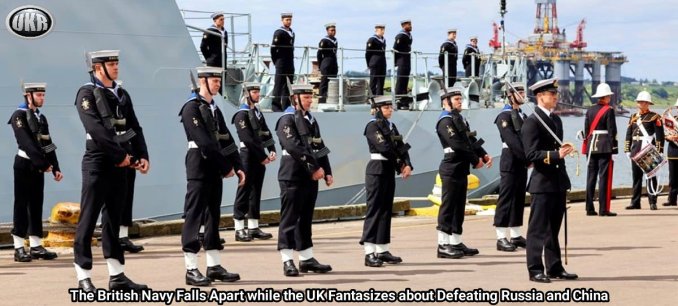
This article (The British Navy Falls Apart while the UK Fantasizes about Defeating Russia and China) was created and published by Global Research and is republished here under “Fair Use” with attribution to the author Drago Bosnic
Featured image: Yahoo

••••
The Liberty Beacon Project is now expanding at a near exponential rate, and for this we are grateful and excited! But we must also be practical. For 7 years we have not asked for any donations, and have built this project with our own funds as we grew. We are now experiencing ever increasing growing pains due to the large number of websites and projects we represent. So we have just installed donation buttons on our websites and ask that you consider this when you visit them. Nothing is too small. We thank you for all your support and your considerations … (TLB)
••••
Comment Policy: As a privately owned web site, we reserve the right to remove comments that contain spam, advertising, vulgarity, threats of violence, racism, or personal/abusive attacks on other users. This also applies to trolling, the use of more than one alias, or just intentional mischief. Enforcement of this policy is at the discretion of this websites administrators. Repeat offenders may be blocked or permanently banned without prior warning.
••••
Disclaimer: TLB websites contain copyrighted material the use of which has not always been specifically authorized by the copyright owner. We are making such material available to our readers under the provisions of “fair use” in an effort to advance a better understanding of political, health, economic and social issues. The material on this site is distributed without profit to those who have expressed a prior interest in receiving it for research and educational purposes. If you wish to use copyrighted material for purposes other than “fair use” you must request permission from the copyright owner.
••••
Disclaimer: The information and opinions shared are for informational purposes only including, but not limited to, text, graphics, images and other material are not intended as medical advice or instruction. Nothing mentioned is intended to be a substitute for professional medical advice, diagnosis or treatment.
Disclaimer: The views and opinions expressed in this article are those of the author and do not necessarily reflect the official policy or position of The Liberty Beacon Project.


Leave a Reply