

GUY DE LA BÉDOYÈRE
The Telegraph has a piece about Britain’s straight-A students struggling to gain work experience, let alone a real job:
Top graduates with straight As and first-class degrees from elite British universities often don’t even get an interview, let alone a placement.
This is despite the fact that some internships are still unpaid or pay below the minimum wage, even though measures are in place to ban this practice.
Yet, funnily enough only a few days ago the Telegraph had another piece about how almost a third of students now graduate with first-class degrees but doesn’t appear to have registered that there might be some connection:
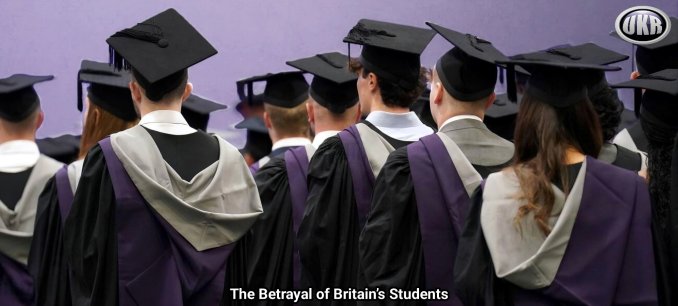
Concerns have been raised that the prestige of the country’s leading universities could be undermined after 30% of students were awarded the highest classification degree in 2024-25.
The figure is nearly double the rate in 2010-11, when 15.8% of all degrees were awarded a first.
At some Russell Group institutions, such as Imperial College London, 52.5% of students graduated with a first, and at the University of Oxford, 34.1% left with the top honour, according to figures from the Higher Education Statistics Authority.
For this privilege, UK students are now suffocating under a welterweight of mounting debt lasting decades, creating what the Mail called a timebomb that could tank the economy:
Last year, for example, the Government shelled out £15 billion to finance student loans, yet received only £5 billion in repayments.
In 2012, outstanding student loan debts stood at £40 billion – today that figure has increased almost seven-fold to an extraordinary £267 billion.
The problem goes right back to the early 1990s:
Major’s government announced a significant expansion of student numbers and declared that the proportion of school leavers going on to higher education would increase from one in five to one in three. With the election of Tony Blair in 1997, came a more ambitious target.
Blair promised that 50% of all school leavers would go to university, but decreed that students would pay tuition fees to meet the cost. Low-cost student loans were provided to help them with the fees. What had been free suddenly came at a price.
The teetering edifice was predicated on the ludicrous and illogical conceit that merely by having more graduates this would somehow, as if by magic, generate more graduate-calibre jobs to match the armies of certificate-wielding cockeyed optimists emerging onto the job market. The truth turned out to be that an army of graduate till monkeys, baristas and benefits claimants had also been created.
This imaginative system of locking former students into a lifetime of debt also turned degrees into effectively purchasable commodities and students into paying customers, albeit ones having to turn themselves into Dickensian debtors to do so. After all, anyone borrowing tens of thousands of pounds for a product expects the best possibly value for their money. As I know from academic contacts, not only do students go berserk and cry foul if they don’t get first-class degrees, but also the universities and colleges tell their staff not to fail anyone.
I was a schoolteacher between 2007 and 2016, mainly dealing with sixth formers. I was appalled at how the school pushed universities while barely mentioning alternatives. Little or nothing was done to wise the students up about the financial implications of debt, though I personally did my best to explain the options and alternatives. The truth was though that most didn’t want to know. They just wanted to leave school and home and get the degrees they had been assured were the first step on their stairways to the stars.
Since I kept in touch with a fair number of them I watched with mounting horror as more and more of them proudly told me of the first-class degrees they had won, seemingly now handed out like confetti. When I was a student myself, a first-class degree bordered on the unobtainable. That sort of stellar grade hasn’t been replaced with anything now, so an increasing number of graduates (including plenty of my former students) are fast-talked by money-grabbing universities and desperate-to-keep-their-jobs academics into doing higher degrees, usually MAs or MSCs, which simply means more debt (and at 6.2%, almost twice as much interest as for a first degree) and another year or two not facing up to the reality that fings ain’t what they used to be. The Mail again:
As Andy Westwood, Professor of Public Policy at the University of Manchester, explains – the current loans system was devised at a time when the prospects for individual incomes and economic growth were comparatively rosy. “Looking back, we know it has been a terrible period for growth and incomes,” he says.
“Meanwhile, inflation and the cost of living have soared. The economic backdrop really hampers the way the system was supposed to operate.” It also “hampers” those of us, like me, who are really struggling with debt.
Without going into the technicalities of student loans, the way repayments are calculated means that most former students discover that the amount they owe increases. Many of them owe over £50,000 for effectively useless degrees. The Mail again:
Desperate to pull in students, meanwhile, more and more universities have taken to offering so-called Mickey Mouse degrees, with weak job prospects.
Are three years studying the semiotics of yoga really worth the pain of a £50,000 debt?
It gets worse:
New figures released this week revealed that 700,000 graduates are out of work and claiming sickness benefits. Overall unemployment is close to a five-year high of 5.1%.
As repayments are only due when a graduate starts earning beyond a series of thresholds – in my case it was a little over £28,000 a year – there’s a clear incentive for graduates to earn less, turn down pay rises or not work altogether.
And that incentive has just become a little stronger – new rules mean students who enrolled in higher education after 2024 must start repayments when they earn just £25,000 a year, a figure below the annual minimum wage.
Was it really better decades ago? Yes it was. I graduated in 1980 and didn’t owe a penny because the system operated on grants and means-tested parental contributions. Student debt was largely restricted to credit card debt. Even my own sons who went to university in the early 2000s had much lower fees than those levied now, which we were able to pay on their behalf, and they had all paid off their maintenance loans within a decade.
Lots of my contemporaries found jobs in industry, having been interviewed and appointed in their last year at university. But there were far, far fewer of them competing for such jobs compared to now. That route was an option I spurned and instead found a job myself in public relations to begin with, later taking on a second job so that I ended up working a 13-14 hour day to get the experience I wanted and needed to enter the BBC in 1981. While in fulltime employment, and by then married and with our first child on the way, I took another BA degree and following it with an MA which I completed in 1987. That kickstarted my freelance writing career which eventually took over apart from my time as a teacher.
It was very hard but at least I was under no illusions about what I’d need to do. And back then opportunities probably existed in greater numbers. Nevertheless, at no stage did I rely on formal application procedures. I knocked on doors, turned up in person, and used my imagination either to create opportunities or to take advantage of chance events.
Unfortunately for today’s students emerging with their straight-As and first-class degrees leads to the unpalatable discovery that their stellar results aren’t exceptional at all. Moreover, the tales of woe in the Telegraph paint a picture of young hopefuls who have been led to believe that applying for jobs is all about going online to file dozens of applications.
Peter Wood, founder of the Graduate Guide, a community for graduates building careers in startups, says the idea of work experience has changed, but the system hasn’t caught up.
Traditional placements are becoming rarer, while more informal routes – like working directly with early-stage founders or small teams – have grown, and these are often harder to find but offer responsibility much earlier.
When it comes to standing out, he says mass-applying rarely works on its own.
“From my experience, the opportunities that have moved my career forward most have come from reaching out to people I admired and building genuine relationships, often through LinkedIn or introductions,” he says.
Zoe Strimpel, also writing in the Telegraph has no sympathy, saying millennials need to stop whining because they knew what they signed up for:
Fussing over the injustice of the terms of loan repayments skirts the main issue of why students are deciding to take degrees at all. For all too many, it’s out of a sense of confusion, lack of direction or a desire to party for three years while becoming a tin-pot activist. It would be well worth skipping the whole caboodle for anyone that way inclined. For everyone else, it’s still optional. Don’t go, and don’t take out a loan if you don’t want to pay it back. The alternatives can be rewarding and a far better use of time for all concerned.
There’s some truth in there, and Strimpel undoubtedly has a point about the expensive pointlessness of some degrees, but there’s also a lot of opinionated nonsense. What she’s missed is that young people are impressionable and the system they are shovelled through at school and university, often egged on by their teachers, tutors and parents, is like a brainwashing travelator that propels them into debt and all too often disappointment.
’Twas ever thus. What’s changed is that awarding ludicrous numbers of high-grade As at A-level and first-class degrees at university, together with life-changing amounts of debt, has led to increasing numbers of former students believing they are owed and entitled to a lucrative and fulfilling future for which they have paid a great deal of money and will be paying a great deal more. This has unfortunately coincided with one of the worst times in modern British history for lucrative and fulfilling futures.
No wonder then that in the year to June 2025 195,000 young people under 35 left Britain to work abroad. They made up 75% of all the British nationals who left during that time.
The truth remains that you make your own luck and that what matters in life is not what goes right. Instead, it’s about what goes wrong and what you do about it. That has never changed.
Guy de la Bédoyère is a historian and writer with many books to his credit. For nine years he taught History and Classical Civilisation at a girls’ grammar school. His latest book is The Confessions of Samuel Pepys. His Private Revelations (Abacus 2025).
This article (The Betrayal of Britain’s Students) was created and published by The Daily Sceptic and is republished here under “Fair Use” with attribution to the author Guy de la Bédoyère

••••
The Liberty Beacon Project is now expanding at a near exponential rate, and for this we are grateful and excited! But we must also be practical. For 7 years we have not asked for any donations, and have built this project with our own funds as we grew. We are now experiencing ever increasing growing pains due to the large number of websites and projects we represent. So we have just installed donation buttons on our websites and ask that you consider this when you visit them. Nothing is too small. We thank you for all your support and your considerations … (TLB)
••••
Comment Policy: As a privately owned web site, we reserve the right to remove comments that contain spam, advertising, vulgarity, threats of violence, racism, or personal/abusive attacks on other users. This also applies to trolling, the use of more than one alias, or just intentional mischief. Enforcement of this policy is at the discretion of this websites administrators. Repeat offenders may be blocked or permanently banned without prior warning.
••••
Disclaimer: TLB websites contain copyrighted material the use of which has not always been specifically authorized by the copyright owner. We are making such material available to our readers under the provisions of “fair use” in an effort to advance a better understanding of political, health, economic and social issues. The material on this site is distributed without profit to those who have expressed a prior interest in receiving it for research and educational purposes. If you wish to use copyrighted material for purposes other than “fair use” you must request permission from the copyright owner.
••••
Disclaimer: The information and opinions shared are for informational purposes only including, but not limited to, text, graphics, images and other material are not intended as medical advice or instruction. Nothing mentioned is intended to be a substitute for professional medical advice, diagnosis or treatment.
Disclaimer: The views and opinions expressed in this article are those of the author and do not necessarily reflect the official policy or position of The Liberty Beacon Project.


Leave a Reply