
The desperate search for Black Britons in the Ancient Past.
JUPPLANDIA
Ten years ago a whole bunch of historians, archaeologists, geneticists and commentators got very excited by a story that was completely untrue. It was one of those ancient remains stories that every now and then makes its way into the mainstream press and receives widespread coverage. In this instance the coverage was excited, delighted, and could probably best be described as gleeful.
What was the discovery that caused so much excitement? Why did it receive much wider commentary than the average investigation of skeletal remains or archeological evidence normally receives?
Well, back in 2016, we were told that it was a discovery that changed the narrative of British history. We were told that it was a stunning revelation that shattered traditional and ‘racist’ understandings of the history of the British Isles.
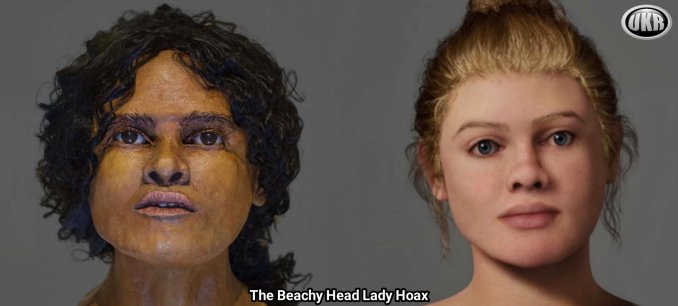
Because we were told that what had been found was the 2,000 year old skeleton of a black woman, a black woman who lived and died in the British Isles at the time when Rome was Europe’s superpower and roughly around the same time that Jesus or early Christians would also have been Roman citizens in the distant Middle East.
What had been found, we were told, was a Black Briton. Here is an extract from a Google Arts & Culture piece from 2016 which captures some of the gushing enthusiasm with which this ‘discovery’ was greeted:
“Near Beachy Head in Eastbourne, England, the skeleton of a young woman was discovered in the late 19th Century. Recent analysis of her remains revealed that she was of African origin, lived in Roman times and grew up in Eastbourne. Unlike other similar discoveries in the UK, Beachy Head Woman’s origins lie beyond the borders of the Roman Empire, which stretched from Britain to the north of Africa. As a sub-Saharan African, she was one of the first black Britons.”
The piece included a picture of a black man holding a skull, accompanied by the following explanation:
“This photo was taken during the making of the BBC series Black and British: A Forgotten History. It vividly demonstrates the long relationship between the British Isles and people whose origins are in Africa.”
The BBC series in question was written and presented by David Adetayo Olusoga, a British-Nigerian historian who is a Professor of Public History at the University of Manchester. As well as having a comfortable position in British academia, Olusoga has had several books published and has been championed and employed by the BBC, most recently writing and presenting another series, Empire With David Olusoga, which discussed the history and legacy of the British Empire.

I’m probably not sharing any spoilers if I tell you that Empire With David Olusoga expresses the idea that the British Empire was a very wicked thing indeed, that it was racist, shameful and evil, and that we (that is, white British people) should be thoroughly ashamed of our ancestors and their vile colonial conquests and use of slavery.
Black and British: A Forgotten History, the BBC series, was based on Olusoga’s book of the same title. It presented twenty examples of ‘Black Britons’ whose contributions to the story of Britain had, according to Olusoga, been unjustly forgotten, presumably by the kind of deliberate and malicious forgetting that irredeemably racist white people enjoy practising along with slavery and cricket. At the time the series was aired 20 plaques were also placed at locations around the UK associated with each of the featured Black Britons.
From just these two examples of his major works I think you can predict the theme of Professor Olusoga’s career. Unlike many traditional historians Olusoga has not confined himself to a specialisation in one particular historical period in which he has painstakingly acquired a depth of scholarship and understanding. No, that would be far too dull and restrictive. Olusoga’s restless historical enquiry ranges over the whole of human history, making him equally adept and expert in the entire span of the 400 year history of The British Empire as he is in the 2,000 year old nature of Roman Britain. But that’s not to say that the Professor doesn’t specialise. It’s just that it’s not a specific time that garners his intense focus, but a specific colour. Olusoga is both a student and a master of a thing of recent invention called Black History, whereby the only history worth studying is that of people who happen to be black, and the only lens by which to study it is through a constant emotive sense of victimhood and a hectoring, Critical Race Theory informed need to berate modern white people for the supposed uniquely hideous crimes of their ancestry.
The reality of this career, of course, is that Olusoga isn’t a historian at all, at least not by any pre 20th century understanding of what a historian is. He is a race advocate and a racial activist posing as a historian. It’s a career which, like other forms of race grifting, beings with it considerable rewards and (for want of a better word) privileges. It’s what has made Olusoga a darling of the BBC, so favoured in fact that he is chosen to appear not only in ‘history documentaries’ but also in popular entertainment shows. A Wikipedia summary of his success indicates what a charmed life a race baiting pseudo historian can lead:
“Subsequently, he became a television presenter, beginning in 2014 with The World’s War: Forgotten Soldiers of Empire, about the Indian, African and Asian troops who fought in the First World War, followed by other documentaries and appearances on BBC One television’s The One Show. In 2015, it was announced that he would co-present Civilisations, a sequel to Lord Clark‘s 1969 television documentary series Civilisation, alongside the historians Mary Beard and Simon Schama.[9] His most recent TV series include Black and British: A Forgotten History, The World’s War, A House Through Time and the BAFTA award-winning Britain’s Forgotten Slave Owners.[3][13][14]
Olusoga has written stand-alone history books, as well as those accompanying his television series. He is the author of the 2016 book Black and British: A Forgotten History, which was awarded both the Longman–History Today Trustees Award 2017 and the PEN Hessell-Tiltman Prize 2017. His other books include The World’s War, which won First World War Book of the Year in 2015, The Kaiser’s Holocaust: Germany’s Forgotten Genocide and the Colonial Roots of Nazism (2011) which he co-authored with Casper Erichsen, and Civilisations (2018). He contributed to the Oxford Companion to Black British History, and has written for The Guardian, The Observer, New Statesman and BBC History magazine;[15]since June 2018 he has been a member of the board of the Scott Trust, which publishes The Guardian.[16]
Olusoga was included in the 2019 and 2020 editions of the Powerlist, a ranking of the 100 most influential Black Britons,[17][18] and in the 2021 edition he made the Top 10 most influential, ranking eighth.[19]
He was appointed an Officer of the Order of the British Empire (OBE) in the 2019 New Year Honours for services to history and to community integration.[20] He received his medal from King Charles III in February 2023.[21][22]
On appointing him as a professor in 2019, the University of Manchester described him as an expert on military history, empire, race and slavery, and “one of the UK’s foremost historians”.[3] Olusoga gave his inaugural professorial lecture on “Identity, Britishness and the Windrush“ at the University of Manchester in May 2019.[23]
In response to the global Black Lives Matter movement with protests after the murder of George Floyd, Olusoga’s Black and British: A Forgotten History was re-broadcast,[24] along with Britain’s Forgotten Slave Owners, also fronted by Olusoga.[25]
On 13 November 2020, the BBC announced that it had commissioned Barack Obama Talks To David Olusoga, a special programme in which Barack Obama discusses the first volume of his presidential memoirs, A Promised Land.[7] The programme aired on 19 January 2021.
In January 2021, Olusoga appeared on BBC Radio 4‘s Desert Island Discs.[26]
In December 2021, it was announced that Olusoga had been awarded the President’s Medalby the British Academy. Olusoga is the 39th person to receive the medal, which has been awarded since 2010, and recognises services to the humanities and social sciences.[27]
In 2024, Olusoga with his siblings Yinka and Kemi co-created the book Black History for Every Day of the Year, including an entry for each calendar day with details of an event, theme, person or place associated with “Black history” with the aim of integrating it into the mainstream of national history rather than relegating it only to “Black History Month”.[28]
In January 2025, it was announced that Olusoga has been appointed as an ambassador for the National Trust.[29]
In May 2025, Olusoga was announced as a contestant on the first series of The Celebrity Traitors.[30] Olusoga reached the final round alongside fellow faithfuls Joe Marler and Nick Mohammed and traitors Alan Carr and Cat Burns, but ultimately lost alongside Mohammed to Carr.[31] “
I’ve retained the Wikipedia links in case anyone wishes to investigate this Titan of History more thoroughly.
In his appearance in the popular hit show The Celebrity Traitors Olusoga gave an unwittingly clear explanation of the fact that he is an activist rather than a historian. During a self description of remarkable moral self blindness Olusoga opined that his job as a historian was to make people believe what he believed, to present ‘his truth’ as history and to guide others towards pre-determined conclusions he wanted them to share. This, of course, is the exact opposite of what an honest historian does. An honest historian wishes to discover and present a true understanding of the past, not use the past to confirm or reflect his contemporary opinions and attitudes. Olusoga mentioned the importance of facts and logic in history, but only as devices or tools to win an argument, not as principles to abide by as a historian. He stated that he hoped he would be influential in the game because his work had trained him to be persuasive and win arguments.
It’s probably evident too that Olusoga comes from and believes in a version of history making, where history is polemic to be invented and delivered rather than facts to be discovered and shared, because his entire sub discipline of pseudo history is founded on ideas like historical objectivity being impossible ideals or fake assertions built to protect a white version of history and to exclude the voices of ethnic minorities. Advocates of Black History feel entitled to proselytise for their race in their presentation of history, even though they would of course immediately characterise any white or western nationalist reading of history similarly designed to front and centre white people (via exclusive focus on their racial suffering or racial pride) as a racist enterprise.
Where does this double standard on racial advocacy, whereby white historians are obliged to discuss black suffering with nothing but sympathy while black historians are free to pretend that white history is exclusively as oppressors and wrong-doers, lead us? Well, it leads us on an ahistorical or even anti-historical pathway, little different in either intent or hypocrisy to the blackwashing phenomenon of Netflix presentations of real historical figures who were white as people that can be accurately depicted by black actors.
And in the case of the Beachy Head Lady it delivered an outright historical hoax, an untruth that everyone involved in should have known was untrue, and probably did, as they delivered it. Because a week or so ago we had the exposure of this lie, to far less fanfare than the decade long lie had earned:
Now it’s true that mainstream media outlets did report the DNA findings of a new study that shattered the decade long myth constructed by Olusoga and others which had asserted that these remains were of a black woman from the furthest reaches (or beyond) of the Roman Empire. The Telegraph and The Daily Mail, for instance, both reported on it.
But there was something notable lacking from those reports-there was zero criticism of the BBC, or of Olusoga, or of the ‘discipline’ of Black History. There was zero examination of the phenomenon of why the original investigative team was so eager to present the idea that these remains were of a black woman, and why facial reconstruction alone was used as the scientific basis of that claim. There wasn’t even any pondering of the 10 year delay between the original rush to ‘recognise’ this skeleton as a black woman, and the eventual DNA analysis that proved the remains belonged to a white woman likely born in the same region she died in.
And there was no questioning at all of Olusoga’s credentials, legitimacy and success as a race advocate and race activist and of how those concerns clearly distort his understanding of history, his accuracy and truthfulness as a historian, and his worth as a supposed expert on history.
Because the fact is that Olusoga presented an outright lie, with great fanfare and great response, which has since been debunked, whereas simply understanding British history according to long established facts and without the lens of racial advocacy and grievance would have made such a mistake (if it was an error rather than a deliberate lie) much less likely.
Olusoga and the team who did the original facial reconstruction found Britain’s first black woman because that was what their politics and racial advocacy wanted to find, and not because that was what was actually there. In reality the entire debacle was an example of a hypocritically racist project of erasure, of the determination of ideologically motivated modern historians to diminish and deny the historical facts pertaining to the traditionally white nature of the British population.
Really this supposedly legitimate historian is exposed by this fraud, by the lie that was presented in the case of the Beachy Head Lady, as little more respectable or serious than the kind of articles that appear in black advocacy publications like The Root or the kind of black supremacist literature which asserts that the Vikings were black or that the Macedonian descended Cleopatra can only be accurately portrayed if the director casts Beyoncé in the role.
But the depth of our abandonment of real scholarly standards, as well as the depth of inverse racism at work in our society, is revealed too by the reality that this decade long Hoax, which is surely even worse than transgressions such as plagiarism, won’t affect Olusoga’s career or status at all.
Selling a racial hoax lie on national television would end the career of an academic who was white or who sold that lie for the purposes of white supremacism. For a black academic, it barely registers as even a mild embarrassment.
That’s because in Black History, facts just don’t matter. It’s the advocacy that matters. If anything, especially for leftists, the Hoax did a noble and worthy job in annoying ‘racists’ and providing ammunition for Critical Race Theorists. A fake history of suppression and erasure, a narrative that Black Britons have been deliberately ignored, will persist even when it’s been proven that the Beachy Head Lady was white and that it was white history, for the last ten years, being suppressed.
This article (The Beachy Head Lady Hoax) was created and published by Jupplandia and is republished here under “Fair Use”


Leave a Reply