
The banter ban marks the death of the Great British pub
Max Thompson: The banter ban marks the death of the Great British pub
MAX THOMPSON
This article (Max Thompson: The banter ban marks the death of the Great British pub) was created and published by The Conservative Home and is republished here under “Fair Use” with attribution to the author Max Thompson
See Related Article Below
The UK’s speech police have that most British tradition in their crosshairs: banter.
DOMINIC GREEN
LONDON — The war on free speech is about to violate the most sacred recesses of recesses of British life—not the home or the workplace, but the pub.
On the night of Wednesday, July 16, the Labour government’s Employment Rights Bill passed its second reading in the House of Lords. If the bill goes into law in its current form—and there is not much to stop it now—Britons can be prosecuted for a remark that a worker in a public space overhears and finds insulting. The law will apply to pubs, clubs, restaurants, soccer grounds, and all the other places where the country gathers and, all too frequently, ridicules one another.
The bill has been dubbed the “Banter Bill” in a last-stand flourish of native wit. But it’s no joke. It is further proof of the state-sponsored decline of free speech in Britain—a decline rightly criticized by Vice President J.D. Vance, who, despite the demands of his day job, still finds time for some forthright banter on X.
The legislation, pushed by deputy prime minister Angela Rayner, is a wish list for white-collar trade unions and human-rights lawyers—the groups that control the Labour Party. It’s also being cheered by the killjoys of the Liberal Democratic party and the Lords Spiritual, the bishops who sit in the House of Lords for reasons that seemed sensible in the fourteenth century.
The government says the bill will enhance workers’ rights and improve workplace safety and gender equality by increasing employers’ responsibility for their staff. A line in Clause 20 of the bill proposes that employers must take “all reasonable steps” to prevent staff from “non-specific” “harassment” “by third parties” in the course of their employment.
But sexual harassment and workplace harassment are already unlawful in Britain. So are “spreading malicious rumors,” “picking on or regularly undermining someone,” and “denying someone’s training or promotion opportunities” on grounds of age, sex, disability, gender reassignment, marital status, pregnancy and maternity, race, religion, or belief, or sexual orientation. The Equality Act of 2010 also makes employers primarily responsible for preventing the “bullying and harassment” of employees by other employees.
Where the Banter Bill strikes new ground is by making employers liable for employees’ feelings about their customers, too. It will allow employees to define “harassment” under the lowest of thresholds: taking offense.
If a server feels offended when a drinker in a pub says there’s too much immigration (a sentiment shared by 63 percent of Britons in a recent Ipsos poll), or if a bartender feels offended when someone makes a rude joke about drag queens (in a country where the pantomime dame is a comic institution), their employer will be legally liable for their hurt feelings.
Business-minded critics call this a regulatory throttling of Britain’s already-stagnant economy, and especially its already-struggling hospitality sector. That is clear. But it might also lead to the most authoritarian throttling of speech in the UK since World War II.

.
The Banter Bill is an assault on the basic freedoms that emerged by public consensus over the course of centuries.
Free speech is an English invention. It does not come from a constitution: It comes from the English people. The idea of “ancient liberties” preexisted the Magna Carta (1215) and John Milton’s defense of a free press in Areopagitica (1644). The custom of free speech in the Commons preexisted legal establishment in the Bill of Rights (1689).
An attack on free speech is an attack on the English way of life. Just as “ancient liberties” preceded modern laws, so the pub, not the Parliament, is the foundation of that life. And the right to state your free opinion (“Hear me out!” a beleaguered debater will cry) is as much a part of the pub as the right to sit alone and undisturbed in a corner.
Consider this potential case study from the joyless world of weaponized grievance that the Banter Bill will create. On July 12, the English pop group Madness performed at the Eden Project in Cornwall. During the song “Shut Up,” a petty criminal’s apologia, Warwick Davis, the vertically limited star of Ricky Gervais’s Life’s Too Short, appeared onstage in a policeman’s uniform.
To the evident approval of the crowd, Davis belabored Madness’s Lee Thompson with a toy truncheon.
Under the Banter Bill, a dwarf working at the Eden Project or in Madness’s touring crew could take offense. The plaintiff could claim third-party harassment under the Banter Bill. His employer would be caught in a legal vice. It really is madness.

.
“Every joke is a tiny revolution,” said George Orwell in “Funny, but Not Vulgar,” a 1945 essay on comedy and politics. Autocrats and dictators dislike comedy. With Britain’s social contract cracking up, our governors fear the “temporary rebellion” of mockery.
This bill shows that our rulers see the British people as an incorrigible, foul-mouthed rabble. What they seem to miss is that speech, whether blunt, foolish, or foul, is as essential to our national character as Shakespeare and speculating about the Royal family’s love lives.
Free speech advocates often argue that free speech is tested at its limits. The Banter Bill will test free speech—and our nation—at its comic core. The Eden Project skit of dwarves, fancy dress, and rubber truncheons comes from the native English comic tradition, like Chaucer’s sex jokes and Shakespeare’s puns. Farts and all, the English sense of humor is as globally recognized as the rules of soccer.
As ex–prime minister Boris Johnson showed, Britain is the only country in the world where a facility for writing witty newspaper columns is considered a qualification for public office. In the land of Basil Fawlty and Ricky Gervais, humor is the consolation prize for the petty indignities of the class system and the epic slide in Britain’s global standing.
The old-school rhetoric of Winston Churchill still resounds, but witty words were also crucial in remaking modern England. “Britain has lost an empire but not yet found a role,” Dean Acheson said in 1962. Around the same time, the foul-mouthed satirist Peter Cook warned that the ship of state was “sinking giggling into the sea.”
This bill shows that our rulers see the British people as an incorrigible, foul-mouthed rabble.
After 1964, when the Beatles broke in America, Britain’s new role as jester to the world became clear—and so did the economic dividends of cracking a joke. The Beatles’ banter was critical to their success, and its dry Liverpudlian inflection announced a fresh age of equality and a refusal to indulge the class system. Asked if he was a mod or a rocker, Ringo Starr replied, “I’m a mocker.”
The perils of banter in the age of mass media first became apparent after John Lennon cracked his “more popular than Jesus” joke. Lennon merely suffered the public burning of his records and a forced apology to a media kangaroo court. Under the Banter Bill, Lennon would have risked a solo appearance in a real court.
This country’s ongoing pattern of legal restrictions against free speech has been bipartisan and steadily eroding our freedoms for years now.
The Conservatives, too, are susceptible to the puritan impulse to prevent anyone, anywhere from deriving the smallest soupçon of pleasure from life—especially when they come from the lower orders. They built on Labour’s cornerstone of lawfare, the Human Rights Act (1998), when they wrote the Equality Act (2010).
Over their 14 years in power, the Tories oversaw the steady tightening of restrictions of speech, including with the rise of non-crime hate incidents. This censorious innovation has been used approximately a quarter of a million times over the decade since it was first introduced, and has led to opinion columnists and even social media users being doorstepped by police and warned that an unspecified statement has offended an anonymous person, with unspecified legal ramifications.
Speech laws in Britain are already so restrictive that, following the anti-immigrant and anti-Islam Southport riots of July 2024, Lucy Connolly was sentenced to 31 months in prison for an intemperate X post. On top of the Banter Bill, Labour are now planning to criminalize the offense of “Islamophobia.” This would grant unique protections under British law to Islam and the feelings of Britain’s Muslim minority—with a corresponding restriction upon the rights of the majority and Britain’s historic traditions of free speech.
Existing speech laws are already applied unevenly. They already hamper discussion of key political topics such as illegal immigration, the Labour-linked “grooming gangs” scandal, Britain’s recent about-face on gender reassignment for children, or the revelation on July 15 that the previous Conservative government secretly relocated thousands of Afghans into Britain in 2022. The Conservatives, and then, after July 2024, Labour, managed to keep this secret by obtaining a contra mundum superinjunction from a court—on the argument that people might riot if they found out.
Superinjunctions are another recent tightening of the speech screws. They are typically deployed by soccer players who wish to keep their marital indiscretions out of the tabloid newspapers. This time, an entire country was formally banned from publishing or even speaking about a matter of national interest.
Clause 20 of the Banter Bill isn’t just a piece of sloppy legislation. It’s the last word in a creeping, multifront attrition of English liberty that is undermining the English in their own words. As the patient said to the doctor who asked if it hurts: “Only when I laugh.”
This article (Britain’s War on Speech Comes for the Pub) was created and published by The Free Press and is republished here under “Fair Use” with attribution to the author Dominic Green

••••
The Liberty Beacon Project is now expanding at a near exponential rate, and for this we are grateful and excited! But we must also be practical. For 7 years we have not asked for any donations, and have built this project with our own funds as we grew. We are now experiencing ever increasing growing pains due to the large number of websites and projects we represent. So we have just installed donation buttons on our websites and ask that you consider this when you visit them. Nothing is too small. We thank you for all your support and your considerations … (TLB)
••••
Comment Policy: As a privately owned web site, we reserve the right to remove comments that contain spam, advertising, vulgarity, threats of violence, racism, or personal/abusive attacks on other users. This also applies to trolling, the use of more than one alias, or just intentional mischief. Enforcement of this policy is at the discretion of this websites administrators. Repeat offenders may be blocked or permanently banned without prior warning.
••••
Disclaimer: TLB websites contain copyrighted material the use of which has not always been specifically authorized by the copyright owner. We are making such material available to our readers under the provisions of “fair use” in an effort to advance a better understanding of political, health, economic and social issues. The material on this site is distributed without profit to those who have expressed a prior interest in receiving it for research and educational purposes. If you wish to use copyrighted material for purposes other than “fair use” you must request permission from the copyright owner.
••••
Disclaimer: The information and opinions shared are for informational purposes only including, but not limited to, text, graphics, images and other material are not intended as medical advice or instruction. Nothing mentioned is intended to be a substitute for professional medical advice, diagnosis or treatment.
Disclaimer: The views and opinions expressed in this article are those of the author and do not necessarily reflect the official policy or position of The Liberty Beacon Project.


Max Thompson is legislative affairs and campaigns officer for the Free Speech Union.
Angela Rayner’s Employment Rights Bill has rung the bell and it is kicking out time. This week (il)Liberal Democrat peers voted with Labour to put a banter bouncer in every pub from October 2026.
Clause 20 of the Employment Rights Bill is an all out assault – cultural, economic and social. A solution in search of a problem.
The Banter Ban will extend employers’ liability for non-sexual harassment to third parties. In plain speak, employers’ will have to take “all reasonable steps” to protect their employees from the private conversations of customers.
What’s more, an employee will be able to sue their employer even if they do not possess the protected characteristic. They can be offended on behalf of another colleague.
While landlords face soaring bills and increased taxes, they will now have to take “all reasonable steps” to prevent their staff from being offended by the words of punters having a private conversation.
Guidance is set to be offered on what constitutes “all reasonable steps” at a later date regarding third-party sexual harassment. There is a lack of clarity of when, or if, this will be extended to the realm of non-sexual third-party harassment. Businesses will be forced to interpret what “all reasonable” steps are and seek expensive legal advice and implement policies to avoid litigation.
Expect a banter bouncer in every beer garden, a code of conduct on every wall of every pub, and don’t forget proof of Equality, Diversity and Inclusion training before heading out for a pint.
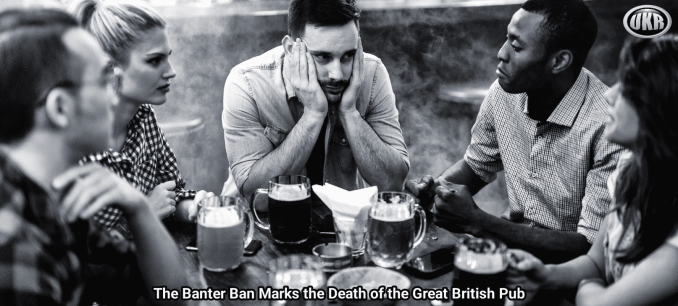
The result is the death of the Great British pub.
People will understandably decide to spend an evening in the confines of their own home (if they can afford one) where they can say what they so wish…for now.
It begs the question: is there any British institution that this Government isn’t seeking to destroy?
George Orwell called the pub “the heart of England”. Well, Labour’s Employment Rights Bill is the stake poised to be driven straight through that heart. Pubs and free speech are fundamentally British. I challenge you to find something more quintessentially British than a trip to your local for a beer and chat.
There are vanishingly few.
The Free Speech Union launched their “Say No To The Banter Ban” campaign with a boozy affair at the Speaker Pub, Westminster. Since, General Secretary of the Free Speech Union, Lord Young of Acton, has been leading efforts in the House of Lords to stand up for pubs and our right to banter. At each stage his amendments have been thwarted by the fun police. This is despite the EHRC fearing that Clause 20 will “disproportionately curtail” freedom of expression.
One amendment would have excluded landlords of being made liable for ‘indirect harassment’ in their establishments. This amendment was supported by UK Hospitality, HM Opposition and Baroness Cash, a commissioner of the EHRC. Another amendment would have excluded expressions of a political, moral, religious or social opinion unless they were “grossly offensive”.
The Banter Ban is yet another example of the accelerated erosion of free speech in this country. It comes to something when the Vice President of Britain’s closest ally questions the Government’s commitment to the principle of free speech on the world stage. Keir Starmer should hang his head in shame.
Britain – a nation of mickey takers – is fast becoming a breeding ground for those who relish the opportunity to be offended. An age of hyper-sensitivity. Thanks to Angela Rayner’s Bill, they will make a quick buck out of it as well at the Employment Tribunal.
Employment Tribunal Courts are buckling at the seams. In March 2025, the backlog reached a record 52,000 cases and this Bill’s impact assessment estimates the number of cases will increase by 15 per cent annually. Undoubtedly, those who face serious workplace harassment will be delayed justice in favour of those who just have opposing views on migration to an employee.
The economy is in a death spiral and businesses are crying out for certainty and stability. The British Beer and Pub Association has claimed a pub a day is closing. UK Hospitality have stated that the impact of Reeves’s disastrous budget has increased costs by £3.4 billion. The Employment Rights Bill is expected to cost businesses £5 billion with smaller businesses feeling it most acutely.
If COVID, the energy crisis and Labour’s budget weren’t enough to kill off pubs, the ‘Banter Ban’ could be the final nail in the coffin. The Chancellor promised to revive the pub sector while pouring a pint at the Humble Plumb last year. Now, her future leadership rival is calling time on them.
If there was ever a point in our history when we needed a drink and a laugh it is now. God knows, the Chancellor has recently looked like she is in desperate need of one.