

Blowing the whistle on Birmingham’s integration problem
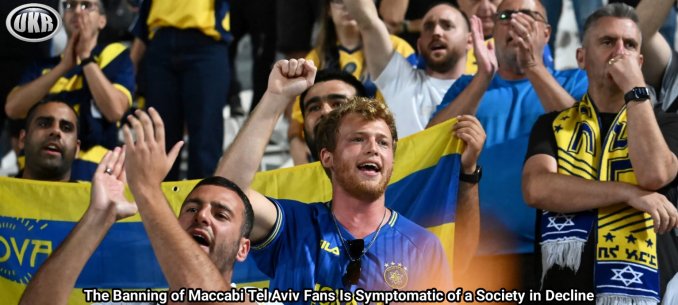
The banning of Maccabi Tel Aviv fans is symptomatic of a society in decline
JOE HACKETT
Remind me never again to complain when there’s a lack of news about my football team during an international break.
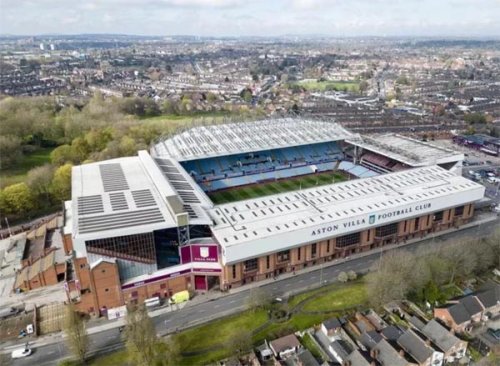
Aston Villa, whom I’ve supported for 25 years of frequent downs and occasional ups, has found itself at the centre of national controversy after a Birmingham City Council led safety group decided, apparently on the advice of West Midlands Police and the “community representatives” the cops consulted, to ban Maccabi Tel Aviv fans from attending their Europa League match at Villa Park.
Politicians have condemned the decision and ministers are reportedly on manoeuvres to get the decision overturned. The social media backlash has been even more furious and, at times, bizarre. One commentator wanted Villa to forfeit the match (that’s a no from me). One wanted Villa to be banned from the Europa League altogether (not a fan of that idea either).
But the ban has its defenders, who just happen to mostly be far-left commentators and Gaza independent MPs.
Their primary justification is that Maccabi Tel Aviv, seemingly unbeknownst to anyone before 2023, are apparently the most violent fanbase in European football, and need to be banned in case they rounded on Villa fans or unsuspecting locals. Aaron Bastani described them as “the most violent firm in Israel”, which if nothing else would come as a surprise to Beitar Jerusalem’s ultras.
This is usually backed up by (admittedly unpleasant) clips of Maccabi away fans at one single match, against Ajax in Amsterdam last year.
But that’s not the whole story. Other clips showed local mobs beating up Maccabi fans, chasing them into canals, and hurling antisemitic slurs at them. Evidence has emerged that at least some of the violence was part of a premeditated “Jew hunt”.
That probably helps explain why no action was taken against Maccabi, and since then their away fans have been allowed to travel to Norway, Cyprus, Greece, Poland, and Malta on their club’s European adventures, apparently without causing much trouble.
Maccabi, it seems, are no Legia Warsaw. Legia, whose fans have a longstanding record of misbehaviour to the point where the club was fined by UEFA after 17 out of 30 European matches over two seasons, played Villa in autumn 2023.
Beforehand, Legia fans had also been involved in violence on an away trip to the Netherlands, against AZ Alkmaar, leading UEFA to ban their away fans from a match in Bosnia and limit their numbers (but, crucially, not ban them) for their visit to Villa Park.
The Legia fans who made the journey to Birmingham then engaged in “planned and systematic violent acts against West Midlands Police officers,” leading the police to ban all Legia fans from entering Villa Park about an hour before kick off. UEFA duly fined Legia (again) and banned them from five European away games.
The double standard is clear. The Legia fans’ rap sheet was much longer, more recent, and more clear cut than Maccabi’s, but West Midlands Police felt more confident of handling them (at least until the evening itself), and none of the hard-left commentators or MPs who’ve demonstrated such an interest in football hooliganism over the last 24 hours were clamouring to ban them before the match.
In fact, none of these people batted an eyelid when Legia returned to these shores earlier this year to face Chelsea at Stamford Bridge. The away fans came to London, let off flares inside the stadium, and left their club facing yet another fine.
Cops deal with potentially violent fanbases, many with a much worse reputation than Maccabi, all the time. At the risk of pointing out the obvious, West Midlands Police have managed dozens of bitter derby matches between Villa and Birmingham City.
In short, if you think this ban has anything to do with either set of fans, then you are, as Nigel Pearson would say, an ostrich.
It’s hard not to conclude that the real reason for the ban is fear of how people who literally elected a Gaza independent MP might react to the presence of a small group of Israeli football fans, and whether the cops would be able to control that situation.
The local MP covering Villa Park is indeed Ayoub Khan, a Gaza independent who previously served as Lib Dem councillor for Aston, during which time he was offered antisemitism training after social media posts made in the wake of the October 7th attack.
It’s fair to say that Khan is much more interested in Israel than he is in the local football club. Before he launched his campaign to “boycott Maccabi Tel Aviv” in September, he tweeted the word “Villa” precisely once, supporting a jobs fair at Villa Park.
The same goes for his Gaza independent colleague, Iqbal Mohamed, who responded to the decision to ban the Maccabi fans by enthusiastically declaring his interest in the “safety of Aston Villa fans.” Mohamed hadn’t previously demonstrated any interest whatsoever in Villa, which is unsurprising given that he represents an area 80 miles away from Aston, albeit with similar demographics.
What’s also unsurprising is that this decision has sparked a victory lap from Robert Jenrick, who sparked mainstream media outrage just days before by describing Handsworth, near Aston, as one of the worst integrated parts of the country.
Jenrick is right to consider himself vindicated. But why did it take so long for any mainstream politician to acknowledge this? And why are there so many ostriches who still refuse to do so?
I grew up in Small Heath, another part of inner-city Birmingham with similar demographics to Aston (it’s also the home of Birmingham City, so I was a minority in more than one respect). What’s clear to Jenrick now has been clear to me for most of my life.
While the Gaza independents’ support base has grown to the point where they can win parliamentary seats, and thus can’t be ignored by the mainstream press, their sectarian brand of politics isn’t a new phenomenon: in Small Heath, we had councillors from a single-issue outfit called Justice for Kashmir, which grew out of a campaign to free two Kashmiri nationalists who murdered an Indian diplomat. They might have had more success had Labour not rigged the elections with postal vote fraud.
Since my family moved out in 2003, Small Heath and the surrounding area have been in the news for, among other things, terror raids, a local mosque being exposed on Channel 4 for preaching extremism, the Trojan Horse scandal where Islamists sought to impose their religious agenda in schools, Islamist “counter-rioters” slashing a Sky News van’s tyres and attacking a nearby pub last year, and masked men throwing boxes of live mice painted in the colours of the Palestinian flag into a local McDonalds. It should go without saying that none of this is exactly normal for most of the country.
The decision to ban Maccabi fans from Villa Park is the latest in a series of increasingly high-profile events that have shone a light on the problems that have persisted, and grown, in working-class inner city parts of Birmingham, and other towns and cities, for decades. It was easier for the political and media mainstream to ignore when I was growing up there; it’s much less so now.
If there’s one thing being an Aston Villa fan teaches you, it’s a degree of pessimistic fatalism
That should be heartening, but it’s also deeply disheartening that it’s had to get to this point for that awakening to even begin. The “muscular action to make integration a reality” that Jenrick rightly wants to run will doubtless be much harder to implement now than it would have been if our leaders had got their heads out of the sand earlier.
But if there’s one thing being an Aston Villa fan teaches you, it’s a degree of pessimistic fatalism. We are where we are. The best time to end mass immigration and start Jenrick’s integration campaign was 25 years ago. The second best time is now.
See Related Article Below
Politics: what is going on?
RICHARD NORTH
Five days into ban on Maccabi Tel Aviv fans attending the Aston Villa match on 6 November, I didn’t think I’d still be writing about it. But there’s something about this whole affair that doesn’t stack up, and it’s bugging me.
By way of background, in the early 1970s I joined the London Borough of Croydon – which was then an efficient, well-run borough – as a student public health officers (latter to become environmental health). I spent slightly over three happy years attending college to learn the intricacies of public health procedures within the context of local government.
As a qualified officer, I worked first for Croydon, then Calderdale MDC and then Leeds, putting into practice what I had learnt, and learning a great deal more. Subsequently, I went private as an independent consultant, very often up against my former colleagues, spending a lot of time in court as defence witness (and occasionally for the prosecution), giving expert testimony at all levels including the High Court, in England and Scotland.
I like to think that the experience gave me a good grounding in local government procedures and administrative law and, although I have moved on, that knowledge never leaves you. Basically, at an operational level, I know how local government works – or should work – and there are too many holes in the Maccabi narrative to accept uncritically what we are being told.
So where to start? Already in my previous pieces I have sketched out the basics, in that the only body with the power to exclude Maccabi fans from the Villa stadium is the local authority, Birmingham City Council. For an official, enforceable ban to take effect, I have established that this must be done under the aegis of the Safety of Sports Grounds Act 1975 with the service on the Aston Villa club of a Prohibition Notice.
It is also the case that upon being served with such a Notice, the club has an absolute right to appeal. In my previous piece, I wrote that this was to the Crown Court, but the 1975 Act has since been amended by the Fire Safety and Safety of Places of Sport Act 1987 which directs appeals to the Magistrates’ Courts – which makes it even easier (and cheaper) to lodge an appeal.
As I left the affair yesterday, I was suggesting that the ball lay in Aston Villa’s court to lodge it appeal which, given what is now known about the ban, it seems that there is a very strong case to have it overturned,
What then set the alarm bells ringing for me was the statement by the club, once the ban had been lodged, which I hadn’t seen in full before.
After confirming that they had been “informed” that no away fans could attend the 6 November match, the club stated that this followed an instruction from the Safety Advisory Group (SAG), going on to say that this group was “responsible for issuing safety certificates for every match at Villa Park”, and had formally written to the club to “advise” it that no away fans will be permitted to attend.
Bearing in mind that Aston Villa football club is just that – a football club – and not a legal practice, one might still expect it to have a working knowledge of the law and associated procedures, on which its ability to stage matches depends. But there are nevertheless some glaring incongruities in the statement which simply should not be there.
Conflating the piece, the club states that it had received an “instruction” from the SAG, which had formally written to the club advising it of the ban. This is a very odd way of describing what must – to be legally enforceable – come in the form of a statutory Prohibition Notice, the content of which has been set out in an official Home Officer Circular (HOC 71/1987 Annex B) – see page 11.
This, it will be noted – in conformity with the parent Act – is not issued by the SAG. It is, and must be, served formally by the council, in this case Birmingham City Council, under the signature of the authorised officer, who must not be a member of the SAG. This, in Birmingham, is the Chief Executive, who has delegated the power to the Strategic Services Director (Richard Brooks, as far as I can make out).
Contrary to the club’s assertion the SAG is not “responsible for issuing safety certificates” for every match at Villa Park. As the terms of reference (2017 version) set out, it has no formal powers. It function is to provide specialist advice to the City Council to enable it effectively to discharge their powers and duties.
This is restated in the 2024 version (download), which notes that the chair is separated from the Council regulation and event activities to ensure impartial support, oversight and guidance and then emphasises that: “The SAG cannot take any decisions on behalf of the Council or statutory member”. The current chair, incidentally, is Michael Enderby, the City Council’s head of resilience.
In short, the SAG is exactly what it says on the tin – an advisory group – which enables the statutory body (i.e., Birmingham City Council) to “discharge their duties … in line with legislation and guidance” – the advisory and statutory functions being fully separated.
Why the club should make such a basic mistake of attributing powers to the SAG which it simply does not hold is inexplicable, and the mystery then intensifies when the club adds in its statement that: West Midlands Police have advised the SAG that they have public safety concerns outside the stadium bowl and the ability to deal with any potential protests on the night”.
This assertion has been repeated elsewhere many times, but what has not been made clear is that WMP is a core member of the SAG, with the chair obliged to “ensure due account is taken of the views of all SAG members and endeavour to seek a consensus view from the group when formulating recommendations of the SAG, to ensure a reasonable final safety decision”.
The WMP view, therefore, is effectively, the view of the SAG, but it should be noted that the group does not hold a vote to determine its recommendations. The chair, in a manner familiar to EU-watchers, “divines” a consensus, and it is then up to the City Council to make the safety decision.
And, in making that decision, the authorised officer of the Council should have picked up – as indeed should the club – that the WMP had “public safety concerns outside the stadium bowl and the ability to deal with any potential protests on the night”, which should have been seen as a red flag, as such concerns were outside the scope of the Council’s powers.
The club then concludes its statement by saying that it is “in continuous dialogue with Maccabi Tel Aviv and the local authorities throughout this ongoing process, with the safety of supporters attending the match and the safety of local residents at the forefront of any decision”.
But what it should have said that that it had taken note of the enforcement action taken against it and was considering its options – one of which was to appeal against the Notice. And there can be no doubt that an appeal was an option.
In Home Office Circular 150/1975, accompanying the original Act, it refers to the report which led to the Act, which recommends that there should be a right of appeal for the clubs concerned against any decision of the licensing authority, embodying an “awareness of the need to reconcile the paramount aim of ensuring the safety of spectators with what would be reasonable and practicable for the clubs”.
But while the club may not be expected to be directly aware of this recommendation, the Home Office does state that the Prohibition Notice should have printed on the back of the form:
Your attention is drawn to the provision for appeal to a magistrates’ court against this notice in section 10A of the 1975 Act as inserted by the 1987 Act. Regulations made under section 10A (1) of the 1975 Act stipulate that a person on whom a prohibition notice is served may appeal to the court within 21 days after the day on which the notice is served on him.
This could hardly be clearer.
Thus, bringing the story up-to-date, we have a report in The Times, which is a direct lift from a report on the Birmingham Live website, that two of the four councillors SAG called for the Maccabi game to be stopped entirely “because of the suffering of Palestinians”, effectively arguing on political rather than safety grounds.
These were Waseem Zaffar, Labour, who represents the Lozells ward, and Mumtaz Hussain, Lib Dems, representing Aston. Separately, Zaffar had announced a personal boycott of the fixture as a matter of “conscience” while Hussain, who has a Palestinian flag on her X account, posted a video to Facebook in the middle of last month alongside the independent pro-Palestinian MP, Ayoub Khan, urging Aston Villa to cancel the match, hold it behind closed doors or move it to a “neutral third country”.
Although this is evidence of political bias, and has Mike Olley, a former Birmingham city councillor and now alderman complaining about the “optics”, it should not have made any difference to the SAG recommendations if the correct procedures had been followed, and if the councillors’ views had tainted the result, this should have been filtered out by the Council authorised officer.
This is the strength – and beauty, if you like – of the local government administrative system, with multiple checks and balances built in, with the final longstop of allowing an appeal against any decisions. Notwithstanding that the decision has turned Villa Park into a “no-go area” for Jews, there should now be considerable concern that the administrative safeguards no longer seem to be working. And that should be a matter that concerns us all.

••••
The Liberty Beacon Project is now expanding at a near exponential rate, and for this we are grateful and excited! But we must also be practical. For 7 years we have not asked for any donations, and have built this project with our own funds as we grew. We are now experiencing ever increasing growing pains due to the large number of websites and projects we represent. So we have just installed donation buttons on our websites and ask that you consider this when you visit them. Nothing is too small. We thank you for all your support and your considerations … (TLB)
••••
Comment Policy: As a privately owned web site, we reserve the right to remove comments that contain spam, advertising, vulgarity, threats of violence, racism, or personal/abusive attacks on other users. This also applies to trolling, the use of more than one alias, or just intentional mischief. Enforcement of this policy is at the discretion of this websites administrators. Repeat offenders may be blocked or permanently banned without prior warning.
••••
Disclaimer: TLB websites contain copyrighted material the use of which has not always been specifically authorized by the copyright owner. We are making such material available to our readers under the provisions of “fair use” in an effort to advance a better understanding of political, health, economic and social issues. The material on this site is distributed without profit to those who have expressed a prior interest in receiving it for research and educational purposes. If you wish to use copyrighted material for purposes other than “fair use” you must request permission from the copyright owner.
••••
Disclaimer: The information and opinions shared are for informational purposes only including, but not limited to, text, graphics, images and other material are not intended as medical advice or instruction. Nothing mentioned is intended to be a substitute for professional medical advice, diagnosis or treatment.
Disclaimer: The views and opinions expressed in this article are those of the author and do not necessarily reflect the official policy or position of The Liberty Beacon Project.


Leave a Reply