

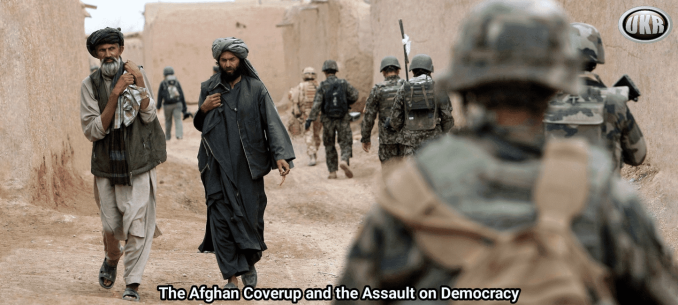
The Afghan coverup and the assault on democracy
The government’s super-injunction is an attack on the British people
JACOB REYNOLDS AND CLAIRE FOX
In the story of the staggering covert government operation to cover up a leak of military data and the resulting plan to secretly airlift thousands of barely-vetted Afghanis to the UK, it is hard to keep up with the sheer number of jaw-dropping details. The off-books spending. The blackmailer reportedly rewarded with a British visa. That those named in the leak were already known to the Taliban and therefore not obviously in additional danger because of it (something confirmed by the court ruling lifting the injunction). The “public relations narrative” concocted to mislead Parliament and the public. The cowardice of those who knew and said nothing. And the very existence of government super-injunctions.
There is almost too much to take in.
But the overriding story here is nothing less than a plot against the British people. This plot – in which it seems much of the State and both major political parties were complicit – rested on a simple and dangerous principle: “the public must not find out what we did”. It is one thing for a government to suspect it is unpopular, but it is almost unprecedented in modern British political history for a government to undertake something so unpopular it had to be hidden not just from the people but from Parliament as well – backed by the threat of prison for anyone spilling the truth.
This incredible conspiracy touches on all of the most important and sensitive political issues of our time. Foreign adventurism, mass migration, freedom of speech, out-of-control government spending, and the reign of human rights law over democracy. This is why it is so important that this issue has seen the light of day.
This story is not over. Even now, our right as the public to know what has happened is being overridden in backroom deals between the MoD and journalists. Much is still subject to what Tim Black in Spiked called the “government-sponsored omertà”.
Those responsible are not event slightly apologetic. Ben Wallace proudly says he “makes no apology” for what he did. Grant Shapps, said he would “do the same thing again” and “walk over hot coals” to save more Afghanis. There is almost a second conspiracy afoot – a conspiracy to make sure this issue is buried and placed beyond debate. Any criticism of what happened is brushed aside and the whole story is being turned into story of an unfortunate leak and a necessary operation to clean up after it. Either we are asked to focus on the issues of data security rather than the bigger picture or any challenge is met by accusations of disloyalty to those ‘brave Afghans’ who risked their life for British troops.
But this story will not go away. As Phil Cunliffe writes perceptively in UnHerd, the revelations fundamentally “eat away at whatever political legitimacy remains of the decaying UK state”.
The truth is that this national scandal cements something that has been clear for some time: only a wholesale replacement of our political class and the government apparatus can do. Certainly, it gives us much to chew on at this year’s Battle of Ideas festival. But until that public opportunity to debate the way forward, we invite you to read these articles and commentators on the issue.
- Phil Cunliffe, The Afghan cover-up will haunt the UK
- Tim Black, The Afghan data breach was disastrous. The cover-up was worse
- Luca Watson, British elites are hand-wringers, not hatemongers
- Ben Sixsmith, The British establishment has completely failed
- Jonny Mercer, Finally, the ineptitude I saw first-hand has been exposed
- BBC Newscast, What Do We Know About The Afghan Data Breach?
- Gordon Rayner, Vast majority of ‘kill list’ Afghans’ asylum claims were ‘not genuine’
In this whole sorry affair, we must recognise the diligent reporting by a large number of newspapers, without whom this would not have come to light. But in addition, we commend the quick reporting on this issue from the following X accounts, who are well worth a follow:

This article (The Afghan coverup and the assault on democracy) was created and published by Academy of Ideas and is republished here under “Fair Use”
See Related Article Below
Politics: the limit of tolerance
RICHARD NORTH
You have to give it to the Telegraph. While lefty rags like the Guardian are doing their best to bury the Afghan story, alongside the BBC, where there was not a trace of a mention to be found on its news website, this paper is churning over a raft of stories which is keeping the issue very much alive.
For once, I think this is right. Not only was this a huge blunder, the subsequent response shows up major errors of judgement and an abuse of the legal system which calls into question the very nature of our failing democracy. This should be kept in the public eye for as long as possible and those responsible should never be allowed to forget what they did.
One of the early stories of the current batch confirms what we already knew, with the heading “Vast majority of Afghans on ‘kill list’ were bogus asylum seekers”, with the sub-head: “Sources reveal as few as one in 16 people identified in data breach had genuine claims for resettlement”, putting the scale of the MoD blunder into sharp focus.
Before the coalition withdrawal from Afghanistan in 2021, it seems that more than 100,000 Afghans were trying to get to Britain in 2022, claiming that they had fought alongside or helped British forces, or were related to someone who had.
Most of them, it transpires, were chancers, exploiting the turmoil of the forced evacuation to scam a new life in the United Kingdom. The “vast majority”, the Telegraph confidently asserts – based on “multiple sources”, had no right to come to the UK because they had no connection to the Armed Forces.
This was known to the MoD at the time, and the paper says it helps to explain why the Home Office raised concerns on national security grounds about the scheme to bring them to the UK. But that issue was never put to the wider debate – instead, the MoD covered-up its blunder with a super-injunction, delaying the moment of accountability.
Given this, a later piece is calculated to make the blood boil. The headline tells us: “Afghan migrant brings 22 relatives to UK”, with the sub-head adding insult to injury as we learn that: “Family members previously rejected for asylum were allowed in following data breach”.
Initially, defence ministers had wanted to restrict arrivals to married couples and their children, but the UK courts had other ideas, repeatedly expanding the eligibility criteria, citing the European Convention on Human Rights.
There was. we are told, “a dramatic change in the criteria last November”, when High Court judge Mrs Justice Yip ruled, in a case brought against the Foreign Office by an Afghan already living in the UK, that family members did not have to have a blood or legal connection to the applicant.
Her ruling stated: “The term ‘family member’ does not have any fixed meaning in law or in common usage. Indeed, the word ‘family’ may mean different things to different people and in different contexts. There may be cultural considerations … there is no requirement for a blood or legal connection.”
The ECHR has since its inception interpreted the idea of a “family” pretty widely, but this seems to extend the definition still further, opening up a whole new can of worms.
On this, we are informed by court documents previously kept secret by the superinjunction that only 10 percent of the extended family members that applicants wanted to bring to the UK had been deemed eligible under previously existing routes.
Under the new Afghanistan Response Route criteria, though, the guidance document stated: “Given the increased risk to some AFM [additional family members] as a result of the data incident, officials expect the number of applications and success rate to increase…”.
It went on to say that: “Officials estimate that upwards of 55 percent of AFM will be eligible in light of the incident – up to approximately 12,500 AFM across all eligible cohorts.” Only 2,200 of those relatives have been deemed eligible under previous criteria, meaning that an additional 10,000 were to be admitted.
And such is the current situation that in the “chaos” that followed the data breach, criminals, including junior staff who had stolen from British bases and sold weapons to the Taliban, had come to the UK with large numbers of family members, while military commanders who had actually served alongside the Army had been left behind.
By any measure, this is intolerable to any fair-minded person, and wholly unacceptable to hard-pressed taxpayers, but we don’t get a vote or any say in the matter. Presumably, we are supposed to suck it up, smile sweetly as we hand over our hard cash, and then go on voting for the same bunch of degenerates who caused this problem and then made it worse.
We are, therefore, entitled to express impatience – and more – with the serried ranks of apologists who somehow reckoned that we owed these Afghans their safety, even to the extent of accepting than many people who should not be here should nevertheless remain.
Into this category leaps Charles Moore who argues that the data leak and the subsequent response was “not an unmitigated scandal, like that of the sub-postmasters and the Post Office, or of Grenfell Tower”.
It is, he writes, “the story of an uneasy but necessary rescue job following a terrible and expensive mistake. Seen politically, it is an understandable attempt to reconcile extreme public anxiety about immigration with a genuine moral duty to help those put at risk”.
When it comes to the “genuine moral duty”, though, not one of these buffoons mentions the moral duty that the Afghan armed forces had to protect their own people from the Taliban, nor seek to justify why these people deserve better treatment than the many millions they abandoned, not least those currently waiting in Iran and Pakistan to be deported.
It is also indicative of the mindset of pompous “above-the-liners” such as Moore that he writes so glibly of “extreme public anxiety about immigration”. The word “anxiety” doesn’t even begin to capture what the public are going through as we see our homeland ripped to shreds under the weight of decades of mass immigration which is turning parts of our cities and some complete towns into unrecognisable third-world slums.
But even the dismissive, patronising Moore cannot compete with the consistently moronic Fraser Nelson who writes his latest column under the heading: “Data leak was bad, letting in Afghans wasn’t”.
This clown, like so many, starts from the false premise that the Afghans who either fought alongside British troops or were active in some other capacity were somehow “helping us” in our efforts to bring security, education and human rights to a country whose government we helped to depose.
That “government” which we help depose was, of course, the Taliban. This only had a tenuous grip on power and was ousted in November 2001 by a partnership of about one thousand US special forces, the Northern Alliance, and ethnic Pashtun anti-Taliban forces. Most of the ground combat was between the Taliban and its Afghan opponents, who then went on to set up their own interim government.
Only then, under a United Nations mandate, were UN members invited to send peacekeeping forces to promote stability and aid the delivery of stable government.
From the get-go, therefore, the role of foreign nations was entirely supportive. We did not control Afghanistan or any of its provinces, and it was entirely up to the sovereign government of the country to manage its own affairs.
In the 20 years that the coalition forces supported the government, an estimated $145 billion was poured into the country as foreign aid, including £3.5 billion from the UK. The cost of military operations was estimated at $2.313 trillion, while the UK’s involvement cost an estimated £22.7-£37 billion, with costs peaking at £5.6 billion for the financial year 2009/10.
Despite all that, through corruption, fraud, criminal inefficiency, theft, bribery and all manner of barbarism, the Afghans failed to hold together a stable state, allowing the Taliban to return. The failure was theirs, not ours, and the price to pay should be theirs, not the British public who played no part in their downfall.
Yet, this singular issue is being entirely ignored. The British people owe nothing to Afghanistan, whose people are authors or their own misfortunes and only through state-imposed secrecy on the back of systemic blunders are we now held liable of a sum exceeding the military costs of our most active year, while having dumped on our communities potentially another 100,000 third-world ingrates.
For all the piffle from the likes of Moore and Nelson, to expect this from the British people is unconscionable. We have had enough, and it is fair to say that, amongst the majority on these isles, the limit of tolerance has been reached.
*********
For the first time ever, I am going to RIAT (the largest airshow in the world) at RAF Fairford on Sunday, along with Pete. Because of the distance and timing, this will necessitate an overnight stay and an early start. I am, therefore, just for once, going to break with tradition and miss out on my Sunday post. I will be back in harness, all being well, for Monday.
This article (Politics: the limit of tolerance) was created and published by Turbulent Times and is republished here under “Fair Use” with attribution to the author Richard North
Featured image: x.com

••••
The Liberty Beacon Project is now expanding at a near exponential rate, and for this we are grateful and excited! But we must also be practical. For 7 years we have not asked for any donations, and have built this project with our own funds as we grew. We are now experiencing ever increasing growing pains due to the large number of websites and projects we represent. So we have just installed donation buttons on our websites and ask that you consider this when you visit them. Nothing is too small. We thank you for all your support and your considerations … (TLB)
••••
Comment Policy: As a privately owned web site, we reserve the right to remove comments that contain spam, advertising, vulgarity, threats of violence, racism, or personal/abusive attacks on other users. This also applies to trolling, the use of more than one alias, or just intentional mischief. Enforcement of this policy is at the discretion of this websites administrators. Repeat offenders may be blocked or permanently banned without prior warning.
••••
Disclaimer: TLB websites contain copyrighted material the use of which has not always been specifically authorized by the copyright owner. We are making such material available to our readers under the provisions of “fair use” in an effort to advance a better understanding of political, health, economic and social issues. The material on this site is distributed without profit to those who have expressed a prior interest in receiving it for research and educational purposes. If you wish to use copyrighted material for purposes other than “fair use” you must request permission from the copyright owner.
••••
Disclaimer: The information and opinions shared are for informational purposes only including, but not limited to, text, graphics, images and other material are not intended as medical advice or instruction. Nothing mentioned is intended to be a substitute for professional medical advice, diagnosis or treatment.
Disclaimer: The views and opinions expressed in this article are those of the author and do not necessarily reflect the official policy or position of The Liberty Beacon Project.


Leave a Reply