

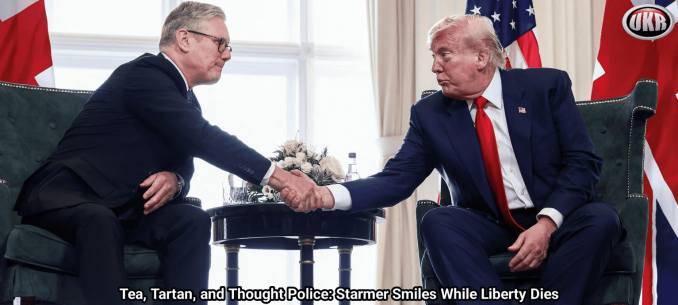
UK Prime Minister Keir Starmer’s hypocrisy on free speech is exposed amid Trump meeting and online “safety” crackdown.
CAM WAKEFIELD
The mist rolls in across the Ayrshire coast. A bagpiper bellows into the wind, and standing there at his Turnberry Hotel and Resort is President Donald Trump.
Alongside him: Keir Starmer, the UK’s Prime Minister and his wife, Victoria, looking stern while her husband drifts into platitudes like a GPS sending you down a dead-end street.
The two leaders shared a moment. Flags flapped. Bagpipes wailed. And somewhere between the shortbread and the sycophancy, Bev Turner of GB News had the temerity to bring up free speech, one of Starmer’s most dreaded topics.
“Well, free speech is very important and I don’t know if you’re referring to any place in particular,” said Trump, in a tone that suggested he absolutely knew where the question was pointing, as he turned toward Starmer.
Starmer, ever the lawyer with a brief to obfuscate, chimed in with, “We’ve had free speech for a very, very long time here, so, er, we’re very proud about that.
It was the same phrase he used on Vice President JD Vance earlier this year, and this touching tribute to Britain’s historic commitment to free speech might have carried more weight had it not landed right after the public had just learned that the government had launched a National Internet Intelligence Investigations team.
The new unit will trawl social media looking for “anti-migrant sentiment.” Nothing says “we love liberty” quite like a taxpayer-funded digital Thought Police checking whether you used the wrong emoji under a news article.
This was rolled out under Starmer’s watch. The same Starmer who, just one day later, was sitting across from Trump, declaring Britain’s sacred love affair with free speech like a man who had just Googled “Enlightenment values” over breakfast.
And while we’re on the topic of breakfast, here’s the cherry on top of this flaming waffle: mothers are being jailed for what they post online.
In Starmer’s Britain, if your tweet causes discomfort to the wrong department, you might just find officers knocking on your door, as we’ve documented many times recently.
It’s all part of a much grander project, wrapped up in the Online Safety Act; legislation so densely authoritarian it makes the Patriot Act look like a leaflet from Amnesty International.
When questioned about its Orwellian overtones (because of course, it has them), Starmer offered this gem: “We’re not censoring anyone.”
Starmer insists the Online Safety Act is about protecting kids. Which is noble. Who could object to saving children from harm? But that’s the trick, isn’t it? Wrap your censorship in the language of compassion, and suddenly anyone who questions it becomes a monster.
“We’ve had too many cases in the United Kingdom of young children taking their own lives,” Starmer said. “They’ve been accessing sites which talk about suicide and encourage children down that road. That is what we want to stop.”
Most people want to stop that. But what they don’t want is to burn down the whole digital village to save the cyber-child. The Online Safety Act doesn’t only put suicide forums in the crosshairs, it has very broad definitions of legal but “harmful” speech.
It mandates digital ID schemes that tie every online word to a real-world name, stripping away anonymity. And if your online account isn’t verified? Well, enjoy being quietly locked out of the national conversation.
Meanwhile, protest footage, inconvenient, unsanctioned, and occasionally messy, is being throttled, suppressed, or algorithmically shoved into a digital dungeon where no one can see it.
So while Starmer poses in front of bagpipes and tartan, murmuring about the virtues of free speech, the government under his stewardship is building a sleek new surveillance state.
What makes it all the more unbearable is the sanctimony. Starmer isn’t twirling a villainous mustache and cackling about censorship. No, he’s doing it with a frown of concerned leadership, like a substitute teacher confiscating your phone “for your own good.”
The truth is simple: either you believe in free speech, or you don’t. And if you’re launching digital Gestapo and throwing mothers in jail for Facebook posts, you’re not the champion of liberty you claim to be. You’re just another polished hypocrite with a PR team and a tenuous grip on irony.
Britain has not had free speech for a very long time. And what little protections it did have are quietly being eroded by the day.
This article (Tea, Tartan, and Thought Police: Starmer Smiles While Liberty Dies) was created and published by Reclaim the Net and is republished here under “Fair Use” with attribution to the author Cam Wakefield
See Related Article Below
SOURCE: Guido Fawkes
Featured image: x.com

••••
The Liberty Beacon Project is now expanding at a near exponential rate, and for this we are grateful and excited! But we must also be practical. For 7 years we have not asked for any donations, and have built this project with our own funds as we grew. We are now experiencing ever increasing growing pains due to the large number of websites and projects we represent. So we have just installed donation buttons on our websites and ask that you consider this when you visit them. Nothing is too small. We thank you for all your support and your considerations … (TLB)
••••
Comment Policy: As a privately owned web site, we reserve the right to remove comments that contain spam, advertising, vulgarity, threats of violence, racism, or personal/abusive attacks on other users. This also applies to trolling, the use of more than one alias, or just intentional mischief. Enforcement of this policy is at the discretion of this websites administrators. Repeat offenders may be blocked or permanently banned without prior warning.
••••
Disclaimer: TLB websites contain copyrighted material the use of which has not always been specifically authorized by the copyright owner. We are making such material available to our readers under the provisions of “fair use” in an effort to advance a better understanding of political, health, economic and social issues. The material on this site is distributed without profit to those who have expressed a prior interest in receiving it for research and educational purposes. If you wish to use copyrighted material for purposes other than “fair use” you must request permission from the copyright owner.
••••
Disclaimer: The information and opinions shared are for informational purposes only including, but not limited to, text, graphics, images and other material are not intended as medical advice or instruction. Nothing mentioned is intended to be a substitute for professional medical advice, diagnosis or treatment.
Disclaimer: The views and opinions expressed in this article are those of the author and do not necessarily reflect the official policy or position of The Liberty Beacon Project.


Leave a Reply