


Suttee resurrected: When suicide is dressed up as romance.
LAURA DODSWORTH
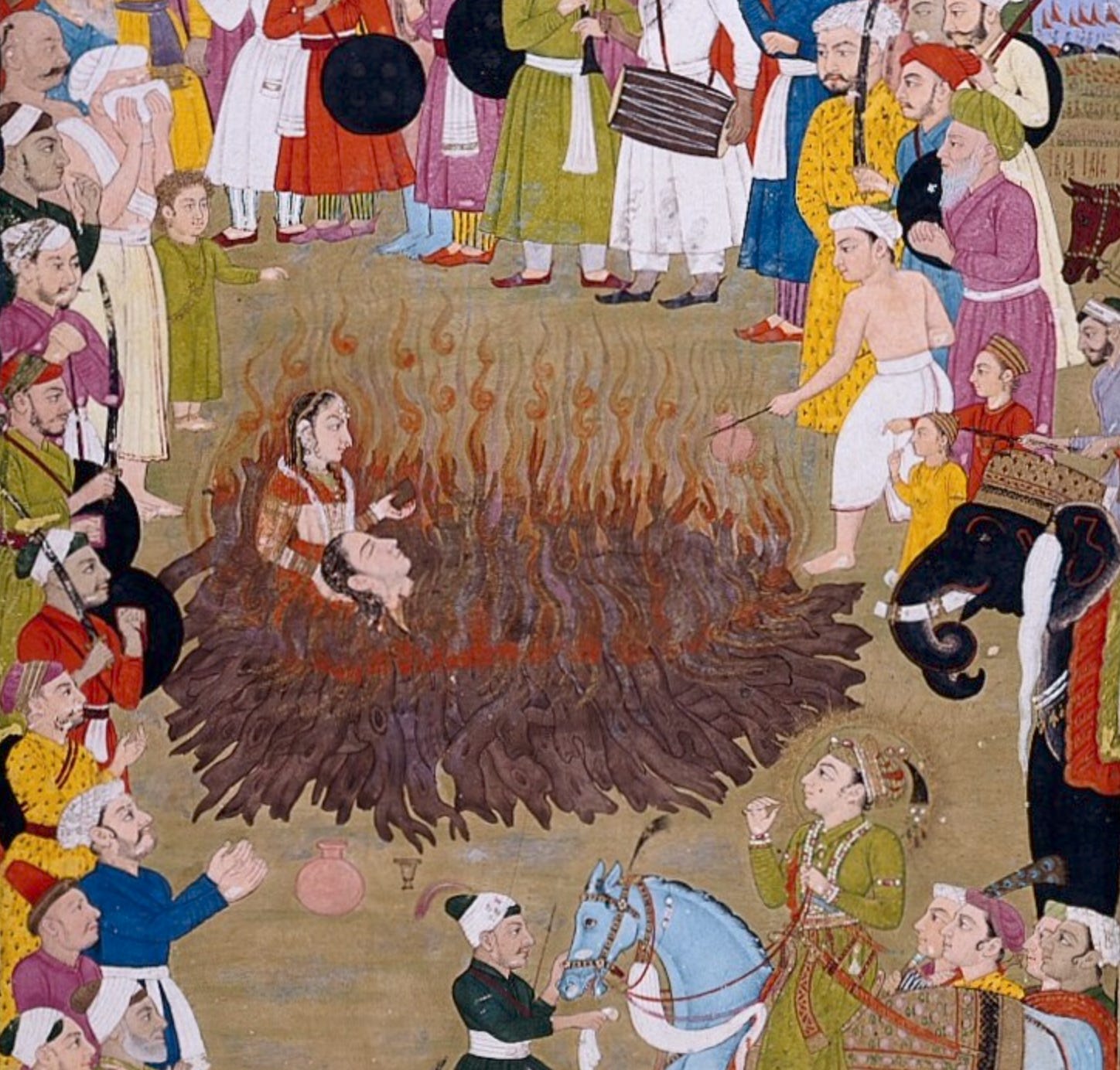
Suttee was the now-banned Hindu practice in which a widow would die on her husband’s funeral pyre. It has been romanticised as the ultimate act of wifely devotion, but many women were not willing participants. Some were coerced forcibly, others by tradition or family pressure.
One of the most chilling and recent cases was that of Roop Kanwar, an 18-year-old widow in Rajasthan, India, who in 1987 was said to have committed suttee after her husband’s death. Eyewitnesses reported that she was forced, and that men stood guard to prevent her escape. Others claimed she was serene, choosing her death in honour of her marriage. But whatever the truth, the aftermath was undeniable: thousands gathered to watch her burn, and she became a symbol of either ‘ideal’ wifely love or the ultimate in coercion and control.
Suttee was officially outlawed by the British in 1829, but Roop Kanwar’s death shows that the idea behind it never really died, it simply changed form.
Why am I telling you this?
Because everything changes, and everything stays the same.
Last weekend, British MP Kim Leadbeater shared a story on X (formerly Twitter) about an elderly couple who chose to die together, reposting a Guardian article titled ‘When they chose to die together: my grandparents wrote the final chapter of a love story spanning 70 years’.
She added the hashtag #ChoiceAtTheEndOfLife and a love heart emoji.

It’s meant to be a romantic story. The tale of a couple in their nineties who, after 70 years of marriage, decided to die together, side by side, holding hands by assisted suicide in New South Wales, Australia.
Devotional suicide is back in fashion.
But unlike suttee, there was no fire. This time, it was doctor-assisted, with official paperwork and medical approval and supposedly legal under New South Wales’ Voluntary Assisted Dying (VAD) law, which is remarkably similar to the UK’s proposed Assisted Dying Bill.
There’s a very serious problem though for Leadbeater’s endorsement of this macabre modern fairytale: neither of them had a terminal diagnosis.
They weren’t dying. They were simply old and, as the article suggests, struggling. They had chronic conditions, but they weren’t at the end of life. They decided it was time and the doctors helped them.
The story is framed as a dignified ending within a compassionate medical system. But strip away the sentimentality, and what we see is a quiet scandal: a law written for the terminally ill being used to facilitate suicide for the tired and the sad.
This wouldn’t even be legal under the UK’s Assisted Dying Bill, which proposes a strict six-month life expectancy limit. But what this case shows is how slippery the slope really is. The law may say ‘terminal illness’, but practice says ‘well, close enough’.
What if Leadbeater’s love heart emoji is not just mission creep, but aspiration? Suicide for all?
Perhaps this is why so many supposed safeguards have been opposed or quietly dropped. Why put up hurdles when the aim is to get people over the finish line?
The UK Assisted Dying Bill, as currently proposed, contains no requirement for a psychological assessment, no obligation for doctors to meet the patient face-to-face and no family notification. The Bill falls woefully short of the protections that would actually safeguard the vulnerable, particularly women.
A powerful report by The Other Half has analysed over 100 UK ‘mercy killings’ and failed suicide pacts from the last 25 years. Its findings are chilling:
- 88% of the killers were men.
- Most of the women had not expressed a wish to die.
- 78% were not terminally ill, but elderly, infirm or disabled.
- Killings were often violent — stabbings, suffocation, bludgeoning.
- Almost none of the perpetrators were jailed.
The report notes:
‘A seeming desire not to make a bad job worse means our justice system has by common practice created a mercy killing “offence” — manslaughter by diminished responsibility — for men who cannot bear infirmity in women: punishable only with the traditional penalty for euthanasia, a suspended sentence.’
Dual euthanasia risks becoming a modern resurrection of suttee — for the man who cannot cope with his wife’s deterioration, or for the man who cannot bear for his widow to live alone. That’s not to say that all cases of dual euthanasia would involve coercion — but how would we know? Already, society sympathises with such men, rather than punishes them. Positioning such suicides as ‘dignified’, ‘peaceful’ or ‘romantic’ is myopic or, worse, maliciously disingenuous.
Death is being reframed not as a tragedy, but as an act of devotion and a lifestyle choice.
This time there is no funeral pyre — just a couple holding hands in a clean bed, the papers signed, the syringe ready. And a love heart emoji.
This article (Suttee resurrected: When suicide is dressed up as romance.) was created and published by Laura Dodsworth and is republished here under “Fair Use”
Featured image: Alamy

••••
The Liberty Beacon Project is now expanding at a near exponential rate, and for this we are grateful and excited! But we must also be practical. For 7 years we have not asked for any donations, and have built this project with our own funds as we grew. We are now experiencing ever increasing growing pains due to the large number of websites and projects we represent. So we have just installed donation buttons on our websites and ask that you consider this when you visit them. Nothing is too small. We thank you for all your support and your considerations … (TLB)
••••
Comment Policy: As a privately owned web site, we reserve the right to remove comments that contain spam, advertising, vulgarity, threats of violence, racism, or personal/abusive attacks on other users. This also applies to trolling, the use of more than one alias, or just intentional mischief. Enforcement of this policy is at the discretion of this websites administrators. Repeat offenders may be blocked or permanently banned without prior warning.
••••
Disclaimer: TLB websites contain copyrighted material the use of which has not always been specifically authorized by the copyright owner. We are making such material available to our readers under the provisions of “fair use” in an effort to advance a better understanding of political, health, economic and social issues. The material on this site is distributed without profit to those who have expressed a prior interest in receiving it for research and educational purposes. If you wish to use copyrighted material for purposes other than “fair use” you must request permission from the copyright owner.
••••
Disclaimer: The information and opinions shared are for informational purposes only including, but not limited to, text, graphics, images and other material are not intended as medical advice or instruction. Nothing mentioned is intended to be a substitute for professional medical advice, diagnosis or treatment.
Disclaimer: The views and opinions expressed in this article are those of the author and do not necessarily reflect the official policy or position of The Liberty Beacon Project.


Leave a Reply