


EU summit: why a ‘reset’ won’t ‘rebuild trade’
In a guest post, trade expert Catherine McBride explains why the Labour government’s plans for closer ties with the EU won’t solve our economic problems.
CATHERINE MCBRIDE
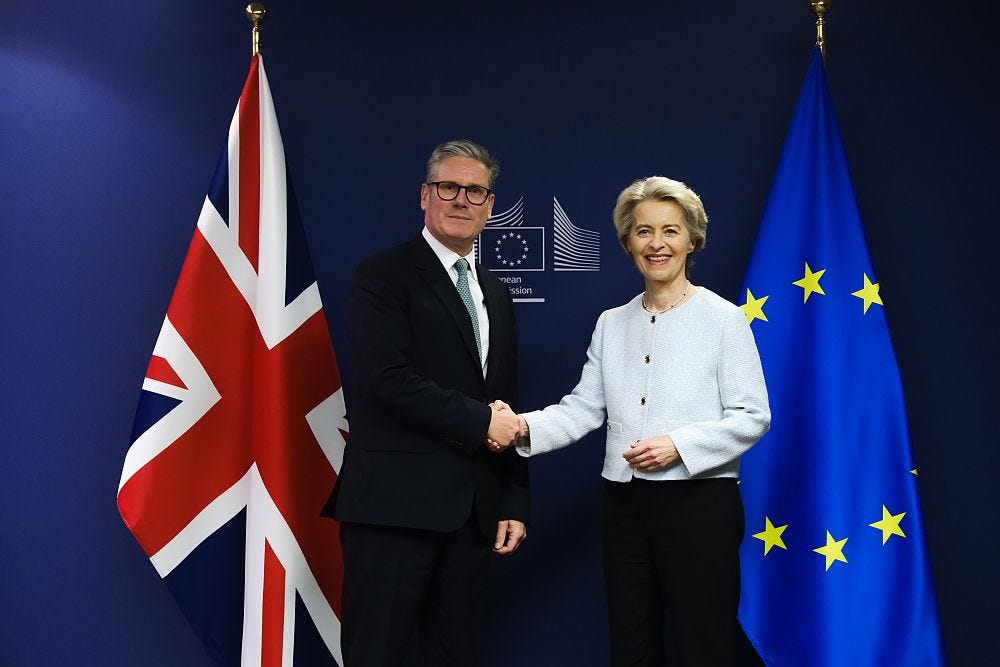
On Monday, Keir Starmer will host EU leaders in an attempt to agree a deal on closer alignment between the UK and EU. The assumption is that the UK needs to ‘reset’ relations with its neighbours, with issues like security, agri-food rules, fishing rights and youth mobility apparently on the table. But is a reset really necessary? Have the problems of the UK economy been put down wrongly to Brexit? In this guest post, Catherine McBride challenges the myth of Brexit’s failings.
Andrew Bailey, the governor of the Bank of England, has claimed in an interview with the BBC that ‘the UK needs to rebuild its relationship with the EU’ because ‘there has been a fall-off in goods trade with the EU over recent years’. But Bailey should know that there are many economic and political reasons for the changes in UK-EU trade, and relationship building will not fix this. The UK and the EU are not at war with each other; they have a completely tariff-free and quota-free trade agreement. Changes in UK-EU trade have been in line with UK trade with non-EU countries and has been affected by similar issues.
Here are some factors affecting trade that the Bank of England governor should understand:
- The Net Zero policies of both the UK and the EU have had the most significant effect on UK goods trade, lowering not just UK oil exports to the EU, but also trade in oil-related products and machinery.UK crude-oil export tonnages have fallen by 35% from their 2020 levels, while refined-oil export tonnages have fallen by 23%. This reflects the UK’s excessive taxation of oil and gas producers and its restrictions on opening new oil and gas fields, as well as a decreased demand for oil in the EU due to lower industrial production and the EU’s mandate for electric vehicles.Lower oil production and refining in the UK have also decreased the production of goods made from oil, such as chemicals and plastics. Some of the UK’s largest chemical companies are now relocating their production overseas due to the high taxes and environmental levies in the UK. This will further decrease UK exports of organic chemicals to the EU, which fell by 29% between 2019 and 2024, while plastics exports dropped by 8%.The UK’s and EU’s mandates for electric vehicles (EVs) by 2030 and 2035, respectively, have also adversely affected the UK’s largest goods export industry – transport equipment, particularly cars. UK exports of internal-combustion engine (ICE) and diesel cars to the EU have dropped dramatically since 2019, with ICE petrol car exports down by 57% and diesel car exports down by 93%. Exports of UK hybrid, plug-in hybrid, and EVs have increased to the EU by £4 billion; however, this is insufficient to offset the £6.3 billion loss in petrol and diesel car exports.The EU’s EV mandate has had as significant an impact on UK car exports as the UK’s EV mandates and manufacturers’ fines. Additionally, both the UK and EU introduced their EV mandates before their car industries could produce enough EVs and before sufficient EV charging stations were installed. No amount of UK-EU relationship building will increase the UK’s lower exports of oil, chemicals, plastics, or petrol and diesel cars. Only reversing both the EU’s and the UK’s Net Zero agendas will save UK-EU trade in these products.
- Changes in the way the UK and the EU now measure trade have also had a significant effect on trade figures, but not on trade itself. This is just a statistical aberration, not a trade issue, and I would have expected the governor of the Bank of England to understand it. Goods such as clothing and shoes that are manufactured in Asia for UK fashion brands are no longer counted as UK exports to the EU. These goods are still traded, but they are landed in freeports or held in bonded warehouses until ordered by EU customers. This avoids paying both UK and EU import tariffs. The trade is still happening; it is just not counted as a UK export. Consequently, UK clothing exports to the EU have dropped by over 60%, shoe exports by 70%, musical instruments by 50%, and sporting goods and toys by 31%. This is also true for UK imports of EU branded goods that are made in China, Bangladesh or Cambodia and imported into the UK. Unless UK and EU companies onshore their production of low-cost consumer goods, which is very unlikely, these goods will never be counted as UK or EU exports. No amount of ‘relationship building’ will change this.This situation extends beyond manufactured goods; imported agricultural products that are not processed in the UK also no longer count as UK exports. This includes tropical fruits and nuts imported from Commonwealth countries, which were landed at UK ports before being distributed to other EU nations. They are still imported, but are now also stored in bonded warehouses prior to distribution. Consequently, UK statistical exports of fruit and nuts to the EU have decreased by 55%, exports of edible vegetables have decreased by 19%, and exports of live trees have decreased by 42%.However, it is not just agricultural products that must be wholly produced in the UK to qualify as UK exports. This applies to many other previously recognised ‘UK exports’. For example, UK exports of unsorted diamonds to the EU have dropped from around £1 billion in 2019 to nearly zero in 2024. I am sure this valuable trade continues, but we can no longer count unsorted diamonds as UK exports to the EU – at least, not until we discover a diamond mine in Britain. Diamonds that are cut and set in the UK still count as UK exports.
- Finally, we come to that adage: it’s the economy, stupid. This is something that the governor of the Bank of England should understand about UK-EU trade. Exports of goods to any country depend on the competitiveness of the goods in the foreign market as well as the demand for those products in the foreign market. Competitiveness means price, and price is determined by the efficiency of production and the trading partners’ relative currencies.When the UK first voted to leave the EU, the British pound fell relative to the euro, hitting a low in 2017 of €1.09. This lower relative value made UK goods more competitive in the EU market. Now the pound has returned to €1.19. One reason for this is that the European Central Bank (ECB) has been cutting its interest rates much more aggressively than the Bank of England. I would have expected the governor of the Bank of England to understand how this affects UK-EU trade. A higher relative currency will make UK goods less competitive compared to European goods. No amount of UK-EU relationship building will change this. Although further cuts in the UK interest rates would.But there are other economic issues affecting UK-EU trade.The ECB has not been aggressively reducing interest rates on a whim; the EU’s largest economy, Germany, has been flatlining since the first quarter of 2022, with one quarter of slightly positive GDP growth followed by a quarter of equally negative GDP growth. Traditionally, Germany was the largest market for UK goods in the EU, purchasing 22% of all UK exports to the EU in 2019. The value of UK exports to Germany has fallen by 16% since 2019. If Germany isn’t buying UK goods, then total UK exports to the EU will fall. It is really that simple. UK exports to other EU markets have increased, notably to the Netherlands, Belgium, Poland, and Slovakia. However, no amount of relationship building will increase UK exports to Germany while the German economy is so weak.Finally, the BBC interview with the governor of the Bank of England suggested that the UK could ‘pursue a veterinary agreement with the EU, including alignment on standards in order to lower post-Brexit red tape on food, farm and fish exports’. But that seems to be the view of the BBC’s economics editor, Faisal Islam; I doubt the governor said such a thing, especially as he began the interview by stating that, as a public official, he did not take a view on Brexit.The difference in competitiveness between UK and EU food is primarily due to EU agricultural subsidies and currency differentials rather than red tape. The EU still subsidises its farmers with Common Agricultural Policy (CAP) payments of between €100 and €250 per hectare, along with additional payments for smaller farms, for farms with natural constraints such as poor or steep land, and for environmental or rural development programs. These payments, combined with a lower relative currency, make EU food cheaper in the UK compared to UK products, especially as the UK has phased out its Basic Payment Scheme for Farmers, with delinked payments set to end in 2027.
The UK is not self-sufficient in food and imports 38% of the food it consumes. How would it benefit the UK to tie itself to EU standards? The UK already has a large agri-food deficit with the EU. No amount of relationship building will make UK agrifoods more competitive in the EU, and the current proposal to dynamically align with the EU’s Sanitary and Phytosanitary regulations will only worsen the UK’s agri-food trade imbalance with the EU. It would also tie the UK to sourcing its imported food from EU producers instead of from more efficient non-EU suppliers.
It is impossible to ‘rebuild trade with the EU’ as suggested by the BBC’s headline. The changes in UK-EU trade are due to changes in UK industrial production, changes in the way the UK and EU measure their trade and the relative economies of the two trading partners. These issues will not be changed by alignment with EU regulations.
Catherine McBride is an economist and a member of DBT’s Trade and Agriculture Commission, an independent commission tasked with scrutinising the new trade deals for compliance with UK agricultural regulations and standards. Read her Substack here.
This article (EU summit: why a ‘reset’ won’t ‘rebuild trade’) was created and published by Academy of Ideas and is republished here under “Fair Use” with attribution to the author Catherine McBride

••••
The Liberty Beacon Project is now expanding at a near exponential rate, and for this we are grateful and excited! But we must also be practical. For 7 years we have not asked for any donations, and have built this project with our own funds as we grew. We are now experiencing ever increasing growing pains due to the large number of websites and projects we represent. So we have just installed donation buttons on our websites and ask that you consider this when you visit them. Nothing is too small. We thank you for all your support and your considerations … (TLB)
••••
Comment Policy: As a privately owned web site, we reserve the right to remove comments that contain spam, advertising, vulgarity, threats of violence, racism, or personal/abusive attacks on other users. This also applies to trolling, the use of more than one alias, or just intentional mischief. Enforcement of this policy is at the discretion of this websites administrators. Repeat offenders may be blocked or permanently banned without prior warning.
••••
Disclaimer: TLB websites contain copyrighted material the use of which has not always been specifically authorized by the copyright owner. We are making such material available to our readers under the provisions of “fair use” in an effort to advance a better understanding of political, health, economic and social issues. The material on this site is distributed without profit to those who have expressed a prior interest in receiving it for research and educational purposes. If you wish to use copyrighted material for purposes other than “fair use” you must request permission from the copyright owner.
••••
Disclaimer: The information and opinions shared are for informational purposes only including, but not limited to, text, graphics, images and other material are not intended as medical advice or instruction. Nothing mentioned is intended to be a substitute for professional medical advice, diagnosis or treatment.
Disclaimer: The views and opinions expressed in this article are those of the author and do not necessarily reflect the official policy or position of The Liberty Beacon Project.


Leave a Reply