

Labour’s Net Zero Dream Sold Rural Britain for American Imports—Who Pays the Price?
THE RATIONALS
Keir Starmer strides onto the stage, a carnival barker cloaked in eco-friendly zeal, pitching Net Zero as Britain’s promised land—a “clean energy superpower” where green jobs bloom and emissions fade into history. The CBI, his ever-faithful herald, trumpets a 10% surge in the green economy in 2024, waving figures of 951,000 jobs. Yet, beneath this dazzling curtain lurks a betrayal as bitter as a Yorkshire winter. Labour’s US-UK trade deal has eviscerated the bioethanol industry, a vital cog in their Net Zero dream, leaving rural Britain battered and the nation’s energy and food security hanging by a thread. Vivergo Fuels lies shuttered, Ensus teeters on the edge, and Labour’s green gospel reveals itself as a hollow charade, propped up for urban applause. As Britain’s population swells, straining every resource, a stark question lingers, will Starmer’s eco-hypocrisy leave farmers and families begging at America’s door, or can Britain claw back its fields and future from this self-inflicted ruin?
A Green Dream Crushed: The Bioethanol Betrayal
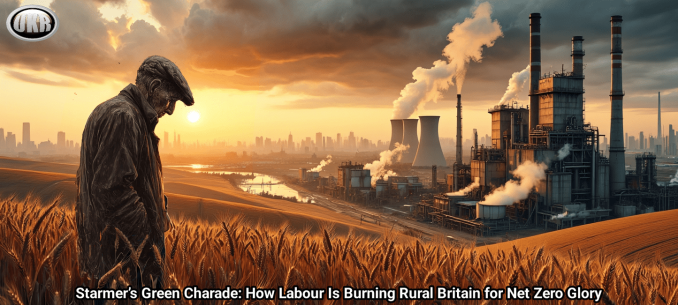
Picture a farmer in his Yorkshire field, staring at mounds of unsold wheat, his family’s dreams ground to dust by Labour’s green dogma. This devastation flows from the closure of Vivergo Fuels, Britain’s largest bioethanol plant, which ceases production on August 31, 2025, with 160 workers facing redundancy from August 19. Ensus in Redcar, meanwhile, clings to survival, locked in desperate talks with ministers to avoid collapse. Together, these plants produce 820 million litres of bioethanol annually, the lifeblood of your car’s tank, your fizzy drink’s sparkle, and your cattle’s feed, fuelling E10 petrol, sustainable aviation fuel (SAF), 820,000 tonnes of animal feed and 30–80% of the UK’s commercial CO2 for food processing.
As Net Zero’s quiet giant, bioethanol powers E10 to cut transport emissions by 82%, taming a sector pumping out 100 million tonnes of CO2 yearly and supports SAF, Labour’s linchpin for achieving 10% sustainable jet fuel by 2030. The industry sustains 16,000 rural jobs, from 160 direct roles to 4,500 in supply chains and 12,000 farmers growing 2 million tonnes of wheat, a tenth of the UK’s crop. Yet, Labour’s May 2025 trade deal axed a 19% tariff on 1.4 billion litres of US ethanol, flooding the market and rendering domestic plants commercially unviable. Associated British Foods (ABF) offered a two-year plan to save Vivergo, but the Department for Business and Trade scoffed, claiming “no taxpayer value,” ignoring Europe’s thriving bioethanol sector. Labour’s choice to burn rural Britain for urban trade trinkets was no accident, it was deliberate.
Fuel at America’s Whim: Energy Security Torched
This calculated betrayal has tethered Britain’s fuel pumps to America’s whims, undermining Labour’s lofty promises of energy independence. Bioethanol once shielded the nation from fossil fuel volatility, but Labour’s deal hands the 1.4 billion-litre market to US producers whose ethanol delivers a paltry 41% emissions cut compared to the UK’s 82%, thanks to transatlantic shipping. Such reliance, warns the Renewable Transport Fuel Association, invites fuel security vulnerabilities amid global supply shocks. With energy prices among the world’s highest, the tariff cut was the final nail in the coffin. Vivergo’s £1.25 billion SAF project, crucial for Ed Miliband’s pledge to decarbonise aviation, now lies in ruins threatening Labour’s 2035 low-carbon and 2050 net zero goals. Meanwhile, the trade deal secured tariff cuts on UK car (10%) and steel (25% to 0%) exports, protecting thousands of urban jobs. The British Chambers of Commerce decries this as a blow to transport decarbonization. Starmer’s talk of a “sovereign clean energy” future feels as credible as a flat-earther’s manifesto when Britain’s fuel supply is outsourced overseas.
Plates Empty, Promises Hollow: Food Security Starved
From fuel pumps, the devastation flows to Britain’s dinner tables, where Labour’s policies starve food security with chilling precision. Ensus, now in frantic talks with ministers to preserve its CO2 output, supplies 30–60% of commercial CO2 for meat packaging, beverages, and medical uses, its collapse risks 80% shortages as seen in 2022, driving price spikes. The loss of 820,000 tonnes of animal feed, vital for a fifth of the UK’s dairy herd, forces farmers to buy costly deforestation-linked soy imports while the 2 million-tonne wheat market sustaining 12,000 farmers vanishes, compounding 40% price drops since 2022. Labour’s Land Use Framework, eyeing 760,000 hectares for solar farms, and Rachel Reeves’ 20% inheritance tax on farms worth over £1 million hitting 66% of farms, per DEFRA, deepen the rural wound. A leaked industry memo calls bioethanol a “critical component” of food security, yet Labour’s “proposals” for CO2 resilience are a mandarin’s pipe dream. Tesco predicts grocery bills could spike 5–10%, hitting millions. Labour’s claim that “food security is national security” is a creative fiction when their policies choke the supply chain feeding a growing population.
Heartland Gutted: Rural Britain Abandoned
This rural carnage stands in stark contrast to the urban elites basking in Labour’s trade victories. Harrison’s unsold wheat mirrors 16,000 shattered livelihoods—160 direct jobs, 4,500 in supply chains, and 12,000 farmers. Villages teeter as shops close and families flee, with 6,365 agriculture, forestry and fishing closures since 2024 fueling “militant” protests, as the NFU’s Tom Bradshaw warns. Jeremy Clarkson’s megaphone amplifies rural fury, while Reform UK’s Luke Campbell calls Labour’s urban bias a “slap in the face.” Rural anger festers, dividing town and country as Britain’s growing population, with 9.5 million in rural areas and cities swelling, stretches food and fuel supplies thin. Urban Britain faces grocery bill spikes of 5–10% and fuel cost rises of one to two pence per litre but this pales against the rural devastation, exposing Labour’s equitable Net Zero vow as a cruel sham.
Excuses Shredded: Labour’s Defence Crumbles
Labour’s excuses unravel like a house of straw under scrutiny, revealing the flimsiness of their defence. They claim Vivergo’s £3 million monthly losses since 2011 and farm tax revenue (£500 million a year) justify inaction. They might bleat that global trade pressures forced their hand, but rejecting ABF’s viable plan while Europe’s bioethanol thrives betrays a choice, not a necessity. DEFRA’s 66% farm impact overshadows the Treasury’s 28%, and the Office for Budget Responsibility scoffs at tax revenue projections. The Telegraph dismisses bioethanol’s emissions cut as a mere 0.7% globally, ignoring its critical role in E10, SAF, CO2, and feed. Labour’s fiscal prudence is a con when their policies spike emissions and slaughter jobs.
A Charade Exposed: Britain’s Future Pawned
What Labour calls a green revolution is nothing but a charade, a glittering con propped up by urban votes and rural sacrifice. The bioethanol collapse spikes emissions, kills SAF, and starves supply chains mocking Starmer’s “clean energy superpower” and Miliband’s 2035 and 2050 targets. Unite’s Sharon Graham brands it “short-sighted,” a betrayal of jobs and security. With the migrant crisis fueling population growth and driving demand, Labour courts price spikes and social division pitting rural against urban. Swapping homegrown bioethanol, a linchpin of Net Zero, food security, and 16,000 rural jobs for America’s less efficient imports which double emissions and risk fuel shortages, is sheer lunacy. A reckless gamble that starves farmers and supply chains for urban trade wins. Their Net Zero gospel is a cynical sleight, torching fields and futures for trade optics. Will Starmer’s green hypocrisy bury Britain’s farmers and families at America’s door, or can we wrest our fields and future from this eco-fanatic madness?
This article (Starmer’s Green Charade: How Labour Is Burning Rural Britain for Net Zero Glory) was created and published by The Rationals and is republished here under “Fair Use”

••••
The Liberty Beacon Project is now expanding at a near exponential rate, and for this we are grateful and excited! But we must also be practical. For 7 years we have not asked for any donations, and have built this project with our own funds as we grew. We are now experiencing ever increasing growing pains due to the large number of websites and projects we represent. So we have just installed donation buttons on our websites and ask that you consider this when you visit them. Nothing is too small. We thank you for all your support and your considerations … (TLB)
••••
Comment Policy: As a privately owned web site, we reserve the right to remove comments that contain spam, advertising, vulgarity, threats of violence, racism, or personal/abusive attacks on other users. This also applies to trolling, the use of more than one alias, or just intentional mischief. Enforcement of this policy is at the discretion of this websites administrators. Repeat offenders may be blocked or permanently banned without prior warning.
••••
Disclaimer: TLB websites contain copyrighted material the use of which has not always been specifically authorized by the copyright owner. We are making such material available to our readers under the provisions of “fair use” in an effort to advance a better understanding of political, health, economic and social issues. The material on this site is distributed without profit to those who have expressed a prior interest in receiving it for research and educational purposes. If you wish to use copyrighted material for purposes other than “fair use” you must request permission from the copyright owner.
••••
Disclaimer: The information and opinions shared are for informational purposes only including, but not limited to, text, graphics, images and other material are not intended as medical advice or instruction. Nothing mentioned is intended to be a substitute for professional medical advice, diagnosis or treatment.
Disclaimer: The views and opinions expressed in this article are those of the author and do not necessarily reflect the official policy or position of The Liberty Beacon Project.


Leave a Reply