

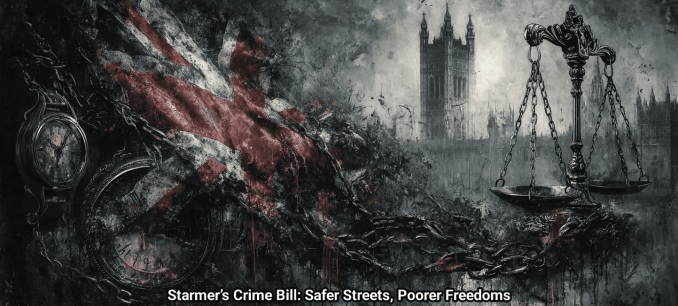
How a former human-rights QC is quietly handing police warrantless powers, taxpayers a £48 million annual bill, and ordinary Britons fewer liberties than ever.
THE RATIONALS
Imagine footing a £186 million transition bill, your taxes at work, while police gain warrantless entry to your home over a stolen phone tracked by an app, all amid 375,000 vehicle thefts last year that already strain household budgets with higher insurance premiums. Or picture joining a protest, only to face a £1,000 fine or month in jail for wearing a mask against the cold, in a nation where 1.5 million adults endured stalking in the past year alone. Welcome to the peculiar theatre of the Crime and Policing Bill 2025, a sprawling piece of legislation that promises safer streets but delivers a masterclass in overreach, courtesy of a government led by a former human rights lawyer.
Introduced in the House of Commons on 25 February 2025, this Bill is no modest tweak to the criminal justice system, it is an ambitious overhaul, spanning 15 parts and numerous schedules, aimed at tackling everything from knife crime to child exploitation. Yet, as it wends its way through Parliament, with debates in the Lords as recent as 15 December exposing deep fissures, one cannot help but detect a whiff of irony, a measure billed as protective that risks smothering the liberties it purports to defend, all while saddling everyday Britons with £48.65 million in annual costs and curtailed rights.
At its core, the Bill builds on the Government’s “Safer Streets Mission,” a manifesto pledge to halve knife crime—now at 50,973 offences, up 4%—and violence against women and girls within a decade. It amends a litany of existing laws, from the Anti-social Behaviour, Crime and Policing Act 2014 to the Sexual Offences Act 2003, introducing new offences and bolstering police tools in a bid to restore public confidence in law enforcement. For the ordinary taxpayer, this means funding an expanded system that could divert resources from schools or healthcare, even as it promises vague societal benefits against grim realities like 492,914 shop thefts and 737,000 assaults on retail workers last year.
Part 1, for instance, revives the spirit of the old Anti-Social Behaviour Orders (ASBOs) through “Respect Orders,” civil injunctions applicable to those aged 18 and over who engage in conduct causing harassment, alarm, or distress. These orders can prohibit actions, require positive steps like attending programs, and even exclude individuals from their homes if violence or significant harm is involved—all on the balance of probabilities, without the need for a criminal conviction. Eligible applicants include police chiefs, local authorities, and housing providers, with courts able to impose indefinite durations or fixed terms up to two years or more.
Breaches without reasonable excuse become criminal offences, punishable by up to two years’ imprisonment or fines. Mandatory risk assessments consider vulnerabilities, and guidance ensures proportionality, aligning with human rights standards like avoiding interference with work or education. The irony here is subtle but sharp, a government that decries social division now empowers magistrates to micromanage lives, potentially banishing people from public spaces or imposing indefinite restrictions, all while claiming to foster respect.
Transitioning from these behavioural controls, the Bill extends its gaze to offensive weapons and retail crime, areas fuelling public anxiety. Part 2 criminalizes possession of bladed articles with intent for unlawful violence (pp. 60–62), imposing penalties up to four years’ imprisonment and granting police warrantless seizure powers from private premises if suspected for criminal use. These arise from a 2023 Home Office consultation amid a 4% increase in knife offences to 50,973.
Part 3 targets shoplifting and assaults on retail workers, mandating Criminal Behaviour Orders for offenders and removing the summary-only status for low-value thefts, allowing them to be tried in higher courts with stiffer sentences. These provisions stem from consultations highlighting rising retail crime, including 492,914 shop theft offences in 2024 and 737,000 assaults on workers.
Yet they reveal a curious hypocrisy, while the Bill toughens penalties for petty thieves, it does little to address the economic pressures—poverty, addiction—that often drive such acts, as noted in critiques from human rights organizations like JUSTICE, which warn of disproportionate impacts on vulnerable groups and exacerbated court backlogs.
For ordinary shoppers and taxpayers, this means potential price hikes as retailers pass on security costs from £4.2 billion in annual crime losses, alongside delayed justice in an overburdened system where everyday cases—like a neighbour’s dispute—languish amid a 78,000-case backlog.
Delving deeper into criminal exploitation, Parts 4 and 5 (pp. 65-76) confront child grooming and sexual offences with innovation and expansion. Clause 17 (pp.65-66) introduces an offence for child criminal exploitation, punishable by up to 10 years, while Child Criminal Exploitation Prevention Orders impose notifications and restrictions to deter reoffending. Similarly, “cuckooing”—taking over homes for criminal purposes, becomes a new crime under Clause 32 (pp.74-75).
In sexual offences, the Bill mandates reporting of suspected child abuse by professionals, with professional consequences for failure and penalties up to seven years for preventing or deterring compliance, and criminalizes AI-generated child sexual abuse material.
These are laudable aims, born from the Independent Inquiry into Child Sexual Abuse, but the irony emerges in their implementation, a duty to report that could chill confidential services, or extraterritorial reach extending UK law abroad for nationals, all while assurances of data protection feel more like fig leaves than robust shields. Ordinary families might face unintended scrutiny, with taxpayer-funded enforcement straining resources meant for genuine protections against the estimated 3.75–4.25 million adults who experienced child sexual abuse in England and Wales.
The Bill’s approach to stalking and harmful substances further illustrates this tension between protection and intrusion. Part 6, (Clauses 60, 73, 74) strengthens Stalking Protection Orders, allowing them post-conviction or acquittal, with breaches carrying up to five years. Clause 73 (pp. 105-106) consolidates “spiking” offences into a single crime of administering harmful substances, up to 10 years. Encouraging self-harm becomes an offence under Clause 74, addressing online facilitation without limiting it to digital spaces.
Yet, as JUSTICE points out, these tools risk disproportionately impacting vulnerable groups, such as those with mental health issues, by criminalizing survival behaviors rather than providing support. The government’s policy background cites rising cases, but one detects a pattern, expansive powers that could ensnare the desperate, burdening taxpayers with higher prison and healthcare costs for those caught in the net, amid 6,732 spiking reports.
Nowhere is the Bill’s suppressive bent more evident than in Part 9, which targets public order with clauses tailor-made for controversy. Clause 86 (pp. 115) criminalizes identity concealment at designated protests, with penalties including imprisonment, unless for health, religious, or work reasons. Inspectors can designate areas for up to 24 hours if offences are anticipated, extendable by superintendents.
This builds on the Public Order Act 1986, allowing consideration of cumulative disruption from repeated protests. The ECHR memorandum justifies this as proportionate for preventing disorder, but critics like JUSTICE argue it chills free expression, engaging Articles 10 and 11 without adequate necessity. Protests outside officials’ homes face new restrictions if linked to their roles, protecting Article 8 privacy but at the expense of democratic dissent.
For instance, between November 18 and 29, more than 600 protesters were arrested for peacefully opposing the ban on the group Palestine Action with many facing charges under existing public order and terrorism laws that stifled assembly and free speech, foreshadowing how the Bill’s refinements could amplify such crackdowns on ordinary citizens voicing dissent.
The irony is palpable, a Labour administration, once vocal against Tory curbs on protests, now refines them, claiming to balance rights while tipping the scales toward control, and leaving ordinary citizens wary of joining rallies for fear of fines or records that could affect jobs or travel.
This pattern of expansion extends to data and surveillance powers, where Clause 95 (pp. 122-123) clarifies police access to DVLA records for broader policing purposes, including automated enforcement. Part 8 criminalizes devices for vehicle theft, like SIM farms, with warrantless searches of vehicles and judicial warrants for premises. Clause 93 (pp. 120-122) allows warrantless entry for tracked stolen goods, justified as expedient but lambasted by JUSTICE for lacking oversight, potentially leading to invasive searches of innocents.
The government’s ECHR assurances emphasize safeguards like senior authorization, yet the risk of biased application—perhaps targeting certain communities—looms large, echoing historical enforcement disparities. For the average driver, this could mean routine privacy invasions, with taxpayers footing the bill for expansive tech infrastructures that yield questionable gains against 375,048 vehicle offences.
Human rights implications weave through the Bill like a thread of cautionary tales. The ECHR memorandum addresses interferences with privacy (Article 8) in offender notifications, such as seven-day advance name changes under Clause 59 (pp. 93), or restrictions on identity documents. Debates in the Lords on 15 December highlighted controversies, with peers like Baroness Maclean criticizing loopholes allowing sex offenders to obtain Gender Recognition Certificates, potentially evading safeguards.
Ministerial responses assured risk-based management, but amendments sought bans, underscoring perceived hypocrisy in a system that prioritizes offender privacy over victim safety. Liberty decries the criminalization of poverty through Respect Orders and heightened fines, which disproportionately affect the homeless and marginalized, perpetuating cycles of disadvantage without addressing root causes.
JUSTICE warns of prison overcrowding and court backlogs, with measures inflating sentences and duplicating offences, straining a system already at breaking point—and delaying resolutions for ordinary Britons entangled in minor disputes or as victims.
Police enforcement emerges as another flashpoint of irony. The Bill raises thresholds for referring officers to prosecution, ostensibly to boost confidence, but JUSTICE argues this weakens accountability, especially in communities wary of bias.
Lords debates on Clause 106 (pp.138-139), equating reckless cycling to dangerous driving, revealed calls for consistent enforcement amid resource strains, with the government pledging funds for operations like Topaz but rejecting licensing schemes as disproportionate.
Yet, in extending drug testing to Classes B and C or polygraph conditions for murderers, the Bill amplifies discretion, risking uneven application—a subtle nod to the hypocrisy of empowering forces still reeling from scandals while diminishing checks, potentially eroding trust among everyday citizens who rely on fair policing.
A final layer of irony in the Bill’s rollout lies in its potential enactment amid glaring operational gaps, with police numbers hovering at just 146,442 officers, still below 2010 peaks, and Crown Court backlogs swelling to 79,619 cases, the government’s “tough on crime” promises risk becoming paper tigers, enforceable only through strained pilots, efficiency tweaks like warrantless powers, and phased regulations that could take years to fully activate.
Critics like JUSTICE decry this as unrealistic overreach, where new offences pile onto an overburdened system without commensurate funding boosts, leaving taxpayers to foot ballooning costs while victims endure even longer waits for justice, all under a administration that once lambasted similar unfunded mandates.
However, beneath the rhetoric lies the Bill’s fiscal shadow, a burden quietly shouldered by taxpayers that could redefine household budgets. Economic notes project net present social values dipping into the negative, with costs for anti-social behaviour measures alone at £7.7 million over 10 years, including prison setups and ongoing legal aid. Knife crime reforms add £20.96 million in present value, while retail assaults could cost £126.94 million, exacerbating a 79,619-case backlog and demanding 13-55 additional prison places annually.
In the end, the Crime and Policing Bill 2025 emerges as a towering edifice of hypocrisy, a Labour regime, captained by Keir Starmer, an erstwhile defender of human rights, hawks “safer streets” while forging a maze of warrantless home raids, bans on masked protests that could jail everyday demonstrators, and offender loopholes risking predator escapes, all funded by a £48.65 million annual taxpayer levy that inflates prison populations by 13-55 spots yearly and chokes court backlogs to 79,619 cases, consigning ordinary victims of theft or violence to endless delays.
The government’s narrative presents the bill as targeted progress, yet it invites scrutiny in light of the Prime Minister’s 2021 advocacy for pausing similar Tory expansions, citing inadequate protections for women, highlighting an evolution in approach where enhanced state powers now take precedence, reframing safety priorities in ways that constrain established freedoms.
This contentious masterpiece teeters toward authoritarian overreach, gagging dissenters fearful of fines scarring careers or freedoms, while ensnaring the vulnerable in unremedied cycles of poverty and addiction, leaving average Britons to contend with invaded privacies, like casual DVLA data sweeps for drivers, and covert tax surges draining resources from schools and hospitals, the true bulwarks against crime’s origins. As the lords fiddle with amendments against ministerial dodges, the farce lays bare society’s stark ironies, liberty traded for phantom safety, with the common taxpayer bankrolling a government impaled on its own sanctimonious history.
The Rational Forum is entirely reader-supported. If you value what we do, please share the piece, leave a comment, or consider a free or paid subscription. All contributions — whether a subscription or a one-off gift — are gratefully received and keep the lights on.
This article (Starmer’s Crime Bill: Safer Streets, Poorer Freedoms) was created and published by The Rationals and is republished here under “Fair Use”
Featured image: The Rationals

••••
The Liberty Beacon Project is now expanding at a near exponential rate, and for this we are grateful and excited! But we must also be practical. For 7 years we have not asked for any donations, and have built this project with our own funds as we grew. We are now experiencing ever increasing growing pains due to the large number of websites and projects we represent. So we have just installed donation buttons on our websites and ask that you consider this when you visit them. Nothing is too small. We thank you for all your support and your considerations … (TLB)
••••
Comment Policy: As a privately owned web site, we reserve the right to remove comments that contain spam, advertising, vulgarity, threats of violence, racism, or personal/abusive attacks on other users. This also applies to trolling, the use of more than one alias, or just intentional mischief. Enforcement of this policy is at the discretion of this websites administrators. Repeat offenders may be blocked or permanently banned without prior warning.
••••
Disclaimer: TLB websites contain copyrighted material the use of which has not always been specifically authorized by the copyright owner. We are making such material available to our readers under the provisions of “fair use” in an effort to advance a better understanding of political, health, economic and social issues. The material on this site is distributed without profit to those who have expressed a prior interest in receiving it for research and educational purposes. If you wish to use copyrighted material for purposes other than “fair use” you must request permission from the copyright owner.
••••
Disclaimer: The information and opinions shared are for informational purposes only including, but not limited to, text, graphics, images and other material are not intended as medical advice or instruction. Nothing mentioned is intended to be a substitute for professional medical advice, diagnosis or treatment.
Disclaimer: The views and opinions expressed in this article are those of the author and do not necessarily reflect the official policy or position of The Liberty Beacon Project.


Leave a Reply