

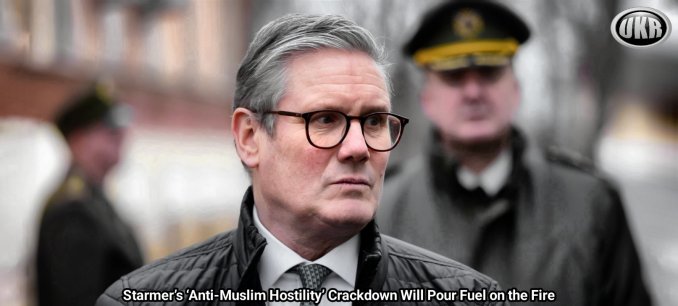
Starmer’s ‘anti-Muslim hostility’ crackdown will pour fuel on the fire
LAST year I repeatedly warned that the ruling class in the UK is moving to shut down public debate about Islam. This year it will become reality.
Why do I say this? Just look at what Keir Starmer’s authoritarian progressive Labour government is proposing, building on their suggested definition of ‘Islamophobia’ last year.
Now, under the slightly different banner of ‘tackling anti-Muslim hostility’, the Labour government is preparing to impose a new sweeping definition on public institutions, regulators, universities, local authorities and potentially the police.
On the surface, this is presented as a benign effort to protect one minority group from prejudice. In reality, it risks entrenching one of the most serious assaults on free speech and free expression Britain has ever seen.
At the heart of the problem is Labour’s decision to revive and rebrand the deeply controversial concept of ‘Islamophobia’ as ‘anti-Muslim hostility’.
This is not a cosmetic change. It is an attempt to smuggle a highly politicised and ill-defined concept into law, policy and regulation while neutralising any public resistance to it.
The proposed definition does not merely target hatred or discrimination against Muslims as people – something that is already illegal under existing laws banning stirring up racial hatred. Additionally, it blurs the line between people and ideas.
It risks treating criticism of Islam – a religion, belief system and political force – as a form of hostility toward Muslims themselves, as a form of ‘racism’.
This is a fundamental category error, and a very dangerous one that could soon have profound consequences, especially as Islam spreads rapidly in the years ahead.
In a liberal democracy, religions are not above scrutiny. They never have been. Christianity, Judaism, Hinduism, secularism, liberalism, and the new political religion of woke-ism – all are routinely criticised, debated, mocked and challenged. Islam cannot be exempted from this basic principle without abandoning free expression altogether. Yet that is precisely the direction of travel in the UK.
Under Labour’s approach, public bodies will now inevitably be pressured to interpret discussion of Islam – its doctrines, practices, historical record, political influence or relationship with liberal values – through the lens of ‘anti-Muslim hostility’.
And how does Labour define ‘anti-Muslim hostility’? As: ‘The prejudicial stereotyping and racialisation of Muslims, as part of a collective group with set characteristics, to stir up hatred against them, irrespective of their actual opinions, beliefs or actions as individuals.’
Note those two words: ‘racialisation’ and ‘stereotyping’.
As Conservative MP Nick Timothy points out, Labour is trying to make something that is notabout race – religious belief – explicitly about race.
Following Islam is about choosing to follow a particular set of ideas, and in a free society we must all be free to scrutinise, debate and challenge ideas. But Labour’s sloppy language, which seeks to treat any such criticism as tantamount to racism, will inevitably create a powerful chilling effect in British society. It will encourage Muslims, who are not a racial group, to shout ‘racist!’ at every turn, thereby warning people off debating or criticising their religion, much like people were warned off talking about the grooming gangs for decades because they feared being called ‘racist’ by Muslims or their allies in the Labour Party.
Officials, teachers, academics and journalists will be incentivised not to ask difficult questions, not to publish uncomfortable facts, and not to host controversial debates.
We have already seen where this leads. Universities cancel speakers. Police investigate lawful speech. Employers discipline staff for opinions that are expressed outside work. And the public square is gradually narrowed from one year to the next. The new definition will pour fuel on this fire, not extinguish it.
And look at that other word: ‘stereotyping’.
Who, exactly, will determine what is and what is not stereotyping Muslims? If I want to write a critical piece about, say, Muslim entryism in politics through organisations like Muslim Brotherhood, will I be accused of ‘stereotyping’?
What if I want to write about how grooming gang members saw Islam as legitimising their horrific actions against non-Muslims? Will that be considered stereotyping, too?
Or what if I wanted to suggest that we have a specific problem with Islam given that it has inspired the vast majority of domestic terrorists in the UK over the last 30 years?
Who draws the line here?
The same people who backed the original definition of ‘Islamophobia’ in 2018, which openly suggested that even debating things like the rape gangs or the demographic spread of Islam could all be considered ‘Islamophobic’?
Supporters of the new definition will naturally insist that safeguards will protect legitimate debate. Yet they include the likes of former Attorney General Dominic Grieve, who was so committed to free speech that he spent years trying to overturn the vote for Brexit, so forgive my scepticism.
And experience tells us otherwise.
Vague definitions empower the most censorious actors, not the most reasonable ones. Once institutions are told they have a duty to combat ‘anti-Muslim hostility’, risk-averse bureaucracies will always err on the side of suppression. Just look, for instance, at how the Blairite ‘hate laws’, non-crime hate incidents, and Online Safety Act have all been weaponised to shut down political dissent.
Furthermore, remember what kind of country we are already living in. Britain, once the home of individual liberty and free speech, is already a country in which street preachers have been arrested by police for asking questions about what Islam says about domestic violence.
Where people have been arrested for burning copies of the Koran. Where police have been so intimidated by local mobs they abandoned equality before the law and resorted to working with ‘community leaders’.
Where state authorities threw a school teacher in Batley under the bus when he angered local Muslims by daring to follow the national curriculum and teach students about free speech. Where mobs intimidate British schools about the teaching of sex and gender issues. And where radicalised activists have essentially sought to create no-go zones for Jews in some of our major cities.
What impact do Labour politicians think that emboldening these kinds of people will have on the rule of law, free speech, antisemitism, and more?
The implications of all this go far beyond Islam. If one belief system is placed beyond criticism, others will follow. The precedent matters. Today it is Islam; tomorrow it may be any worldview that the ruling class suddenly deem ‘sensitive’ or politically protected. Free speech is not eroded in one dramatic stroke. It is hollowed out, definition by definition, measure after measure.
There is also a profound democratic cost. Many of the most pressing issues facing Britain – immigration, integration, extremism, women’s rights, freedom of religion, freedom from religion – intersect with Islam in some way. If the British people feel unable to speak honestly about these topics without fear of sanction, democratic debate itself will be impoverished.
This is not about defending bigotry. It is about defending the right to argue, to analyse, to dissent and to disagree. A society that cannot openly discuss religion is not a tolerant society; it is a weak and fearful one in which its citizens are no longer free.
Labour’s proposal, lastly, reflects an even deeper pathology in politics. It is the belief that social cohesion can be engineered by suppressing speech rather than resolving underlying problems. It is classic authoritarian progressivism – an ideology that would rather try to control our minds than let us speak freely. But silencing debate does not make tensions disappear. It drives them underground, where they fester and eventually explode.
This is why, in 2026, one of the major threats to free speech in Britain will not come from populist mobs. It will come from well-intentioned lawmakers, captured institutions, and a ruling class that no longer trusts the people to speak freely about one of the most significant developments in their own country: the rise of Islam.
If we abandon the principle that ideas, including religious ideas, must be open to challenge, we abandon something far more valuable than we realise. We abandon the foundations of a free society itself.
And once that ground is lost, it is rarely regained.
This article appeared on Matt Goodwin on January 2, 2025, and is republished by kind permission. https://www.mattgoodwin.org/p/silencing-debate-about-islam-one


Leave a Reply