

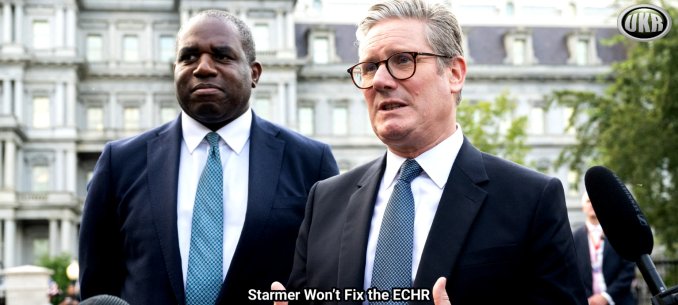
Starmer won’t fix the ECHR
Keir Starmer and David Lammy are committing themselves to incompatible ideas
ANDREW TETTENBORN
The issue of the ECHR continues to dog the Labour Party. Reform and the Tories have committed to leaving the Convention outright, correctly seeing that it interferes in too many of our internal affairs and over-complicates the running of an effective immigration policy — and, more to the point, that a goodly proportion of the electorate takes the same view.
Unfortunately this is not open to Labour under its present leadership, Keir Starmer and Lord Hermer having not so much nailed as spot-welded their colours to the ECHR mast after the election. Instead, on Wednesday David Lammy with some fanfare announced a so-called human rights “reset.” While remaining committed to membership, the UK would join about a score of other European countries in calling for a “political declaration” that the Convention’s expansive interpretations of the Convention — particularly the inhuman treatment and private and family life provisions in Arts 3 and 8 — needed to be reined in as unsuited to the days of mass migration.
The aim is to portray Labour as the party with a principled approach to human rights, but at the same time with the will to be seen to be doing something about immigration (listen up there, Reform voters). Unfortunately for Labour, it will do neither.
The first difficulty is timing. Voters want solid results on the immigration and human rights front, and they want them fast. Lammy’s plan won’t produce them. A joint political declaration sounds good: but agreeing it with numerous states will take many months if not years. Don’t forget that whatever their concerns about migration and the baneful effects of the ECHR, this is a super-sensitive issue on which many European countries have their own agendas and human rights pressures. And that’s not all. Even with the declaration in place we’d have to wait for the Strasbourg court which interprets the Convention, a court not noted for particular swiftness in decision, to play ball. This is very much an offer of hypothetical jam tomorrow to an electorate demanding the sweet stuff now, if not yesterday.
The second problem is the fond assumption that this wheeze will actually work. There are reasons to be seriously cautious here. For one thing, consider the possible reaction of the judges on the Strasbourg court. True, the court is aware of political pressures and concerns within Europe; it regards the ECHR as a “living instrument” whose interpretation can change over time even though its terms remain the same, and there have been hints from its members, including the recently-retired UK judge, that it would not dismiss a political declaration out of hand. But it is nevertheless a big step for a court to take political guidance from the very governments it is meant to be keeping in line. This is especially so when, even on the most sanguine predictions, the countries pressing for the change in direction – the UK, Denmark, and a number of western European states and others — make up only a bit over half of the member states of the Council of Europe. This is hardly what overwhelming political consensus is generally seen to be made of.
And this leaves the third problem: far from amounting to a scrupulous way of changing the direction of the Strasbourg court while upholding the worthy ideals of human rights, as the government would like you to think, the whole scheme is about as unprincipled as you can get. Transfer the locus to the UK, and suppose a minister from Westminster sends a public letter to the judges of our Supreme Court. The note says that the government does not want to change the law on a given subject, but that there is strong political feeling that the Supreme Court has got its interpretation wrong; it then proceeds to suggest that the court might care to think again. Any judge worth his salt would be outraged. He would make the obvious point that he was paid to apply the law of the land and not to take hints from government functionaries.
The very raison d’être of an independent supranational court of human rights … is that it is, well — independent
Yet this is exactly what is planned for the European Court of Human Rights. True, we will be told that this is different. Unlike a national constitution, the basic provisions of the ECHR are in effect immutable; but to balance this the Strasbourg court has sensitive political antennae and a history of adjusting its views to reflect changes in social mores; it should therefore be prepared to listen to the concerted voices of the European political establishment. But there lies the problem. The very raison d’être of an independent supranational court of human rights, and the only respectable argument for continuing to be signed up to its jurisdiction, is that it is, well — independent. To spell this out in easy words, this means not taking its cue from the politicians it is supposed to be keeping in line.
You can have the rule of human rights law, or you can have a politically pliable court to enforce that law according to present political fashions. You can’t have both. Even if David Lammy chooses not to see this, it’s a racing certainty that intelligent voters will. The English electorate has its principles; it will not be kind to any government that chooses deliberately to abandon fair play for a grubby and unprincipled political fix.
This article (Starmer won’t fix the ECHR) was created and published by The Critic and is republished here under “Fair Use” with attribution to the author Andrew Tettenborn

••••
The Liberty Beacon Project is now expanding at a near exponential rate, and for this we are grateful and excited! But we must also be practical. For 7 years we have not asked for any donations, and have built this project with our own funds as we grew. We are now experiencing ever increasing growing pains due to the large number of websites and projects we represent. So we have just installed donation buttons on our websites and ask that you consider this when you visit them. Nothing is too small. We thank you for all your support and your considerations … (TLB)
••••
Comment Policy: As a privately owned web site, we reserve the right to remove comments that contain spam, advertising, vulgarity, threats of violence, racism, or personal/abusive attacks on other users. This also applies to trolling, the use of more than one alias, or just intentional mischief. Enforcement of this policy is at the discretion of this websites administrators. Repeat offenders may be blocked or permanently banned without prior warning.
••••
Disclaimer: TLB websites contain copyrighted material the use of which has not always been specifically authorized by the copyright owner. We are making such material available to our readers under the provisions of “fair use” in an effort to advance a better understanding of political, health, economic and social issues. The material on this site is distributed without profit to those who have expressed a prior interest in receiving it for research and educational purposes. If you wish to use copyrighted material for purposes other than “fair use” you must request permission from the copyright owner.
••••
Disclaimer: The information and opinions shared are for informational purposes only including, but not limited to, text, graphics, images and other material are not intended as medical advice or instruction. Nothing mentioned is intended to be a substitute for professional medical advice, diagnosis or treatment.
Disclaimer: The views and opinions expressed in this article are those of the author and do not necessarily reflect the official policy or position of The Liberty Beacon Project.


Leave a Reply