

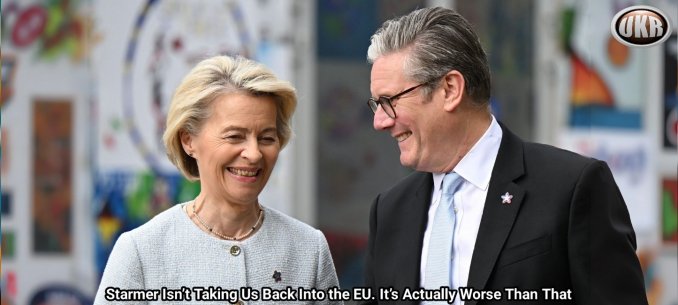
Starmer isn’t taking us back into the EU. It’s actually worse than that
The PM is desperate to make concessions to Brussels while obtaining nothing in return
In quick, furtive bursts, like a cautious crab, Labour is scuttling back to the EU. Officially, Keir Starmer says that the red lines he drew at the general election remain intact: no single market, no customs union, no free movement. But he is signing up unilaterally to initiative after initiative, evidently seeing our national subjugation as some kind of atonement for having voted Leave.
French and Spanish skippers can have our fishing grounds for another 12 years! We will apply EU food standards, whatever they become in the future! We promise not to have cheaper energy than our neighbours! Oh, and please, let us pay to defend you! Please let us educate your students at our expense!
Are we engaging in the most expensive apology in history? Does Starmer start from the proposition that Britain has done something terrible, and needs to suffer for it? Is the EU, in his eyes, another Mauritius, a convenient foil in an essentially domestic argument in which nationalist bigots must be made to pay? Or is something else going on? Is Labour preparing to fight the next election on a Rejoin platform?
In purely electoral terms, a volte-face on EU membership might make sense. The situation has changed since last year. Starmer’s red lines were slathered on to win back the red wall. Many Labour supporters who had voted Leave were disgusted by the behaviour of their MPs who, having fought the 2017 election on a promise to respect the referendum, promptly set about trying to overturn it. Those voters, concentrated in the Midlands and the North, felt scorned and overlooked and, in 2019, many defected to Boris Johnson. After that defeat, Starmer wisely dropped all talk of a second referendum and stuck to domestic matters.
But that was then. Labour is now polling in third place for the first time since the early 1980s. Party strategists want to fall back to a new wall, a tighter and more defensible wall, a wall around a core Labour vote that is more urban, younger and less white than it was last year.
To put it another way, when Labour was aiming to win an outright majority, it made sense to treat the referendum as a done deal. When it is polling at 20 per cent or less, though, aligning with the 48 per cent who voted Remain is clever niche marketing.
It is true that, even as Cabinet Ministers call openly for a return to the customs union, Starmer is still trotting out the official line. Yes, he says, he wants a closer relationship with Brussels; but he wants us to keep control of our economy, our regulatory regime and our trade policy.
Then again, he promised that there would be no tax rises beyond the three set out in his manifesto. He promised that energy bills would fall. He promised to build 1.5 million new homes. He promised to fund 6,500 new state school teachers. He promised, even as his lawyer friends were betraying the Chagos Islands, to “protect the British Overseas Territories and Crown Dependencies” and “defend their sovereignty.” He promised to “smash the gangs”.
Starmer may not have strong convictions, but he has consistently scorned British sovereignty. He led calls to overturn Brexit right up to the 2019 election. The only other explanation for Labour’s EU policy, the official explanation, is not credible. The idea that we are working on a close and businesslike partnership with our neighbours doesn’t stack up.
For the avoidance of doubt, I am all in favour of such a relationship. I argued before, during and after the referendum for a Swiss-style deal. We should collaborate as closely with our neighbours as is compatible with being an independent country. I would have no objection, for example, to a youth mobility scheme, provided the EU gave us something of value in return.
But that’s the point. There are no trade-offs here, no diplomatic gains. Approaching these talks as penitents, we see satisfying the EU as a win in itself.
The Telegraph: continue reading


Leave a Reply