
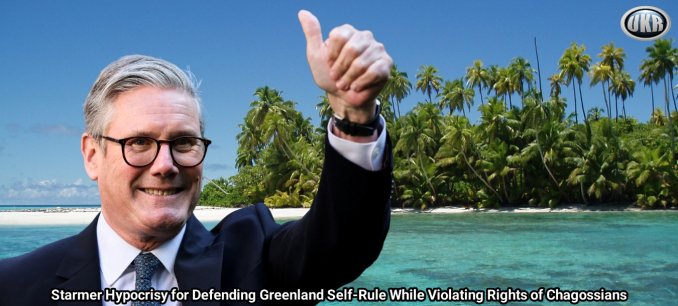
Starmer accused of hypocrisy for defending Greenland self-rule while riding roughshod over Chagossians

.
CP
Keir Starmer has been accused of a stark double standard over self-determination after he rushed to defend the rights of Greenlanders in his row with President Donald Trump, even as his own government presses ahead with a controversial settlement that rides roughshod over the wishes of the Chagossian people.
The row erupted after Trump announced that from February 1 the United States would impose a 10 per cent tariff on all goods imported from the UK, Denmark, Norway, Sweden, France, Germany, the Netherlands and Finland, rising to 25 per cent on June 1 unless Denmark agrees to negotiate the “complete and total purchase of Greenland”.
Trump says the move is necessary because Greenland is strategically vital in the face of growing Russian and Chinese activity in the Arctic, and that Europe has long benefited from favourable trade terms with Washington. European leaders have condemned the threat as coercive and destabilising.
Starmer was quick to denounce the tariffs as “completely wrong”, insisting that the future of Greenland is a matter for the Greenlanders and Denmark alone, and that security concerns should be handled collectively through NATO rather than through economic pressure.
Yet critics say Starmer’s sudden embrace of self-determination rings hollow given his handling of the Chagos Archipelago in the Indian Ocean.
The UK Labour government is currently pushing through a deal to transfer sovereignty of British Overseas Territory, the Chagos Islands to with Mauritius (a country that has no legal claim to them) while agreeing to pay for the continued operation of the important joint US-UK military base on Diego Garcia. Labour Ministers argue the agreement resolves a decades-old decolonisation dispute and safeguards a critical defence asset. However, those assurances have been widely challenged, with legal experts, human rights bodies and Chagossian representatives arguing that the deal fails both the displaced islanders and Britain’s strategic interests.
Also the Chagossians, who were forcibly removed from their homeland in the late 1960s and 1970s, say they were sidelined in the negotiations and that their right to return remains uncertain. There is currently a live Judicial Review in the courts awaiting judgement. Human rights groups and a United Nations committee have also warned that the deal risks perpetuating historic injustices and urged greater consultation with the displaced community.
Opposition MPs and campaigners now say the contrast could not be clearer. They argue that Starmer is happy to invoke the rights of Greenlanders when confronting Trump, yet appears willing to compromise those same principles when it suits British strategic interests closer to home.
A senior critic said it was “remarkable” that the prime minister could declare that only Greenlanders should decide their future while simultaneously backing a settlement that Chagossians say was done over their heads.
Claire Bullivant, CEO of the Great British PAC who has been supporting the Chagossians’ legal challenge in the courts said: “Keir Starmer’s position is breathtakingly hypocritical. He lectures Donald Trump about respecting the will of Greenlanders, yet at the same time he has pushed through a deal over Chagos that the Chagossian people were excluded from. That is not principled leadership, it is complete double standards.”
Downing Street rejects the charge of hypocrisy, insisting that the Chagos agreement balances self-determination with security, and that the base on Diego Garcia remains vital to British and allied interests.
However, the Prime Minister’s key claim has been that the treaty is needed to secure the Diego Garcia base is now untenable. On 13 January 2026, the US Department of Defense awarded a 656 million dollar contract to Amentum Mitie Pacific for base operating support services at Diego Garcia, running to 2034.
This proves the US is planning a long term presence under existing arrangements, there is no imminent legal or operational crisis forcing a sovereignty transfer, and Diego Garcia is functioning, funded and strategically valued without the treaty. In other words, the base is already secure.
The economic backdrop has only sharpened the political tension. Starmer’s Chagos giveaway is set to cost the UK £34 billion, while Trump’s tariffs threaten to hit British exporters hard, particularly in cars, machinery and pharmaceuticals, sectors that rely heavily on the US market. Economists warn that prolonged uncertainty could damage investment and growth.
For now, the dispute has placed Starmer in an uncomfortable spotlight. While he presents himself as a defender of small nations against bullying tactics, his record on Chagos continues to draw fire as it exposes a selective approach to self-determination.
As the tariff deadline looms and Europe weighs its response, the Greenland crisis has become as much a test of Starmer’s principles as it is of Trump’s diplomacy.


This government has lost all legitimacy.