

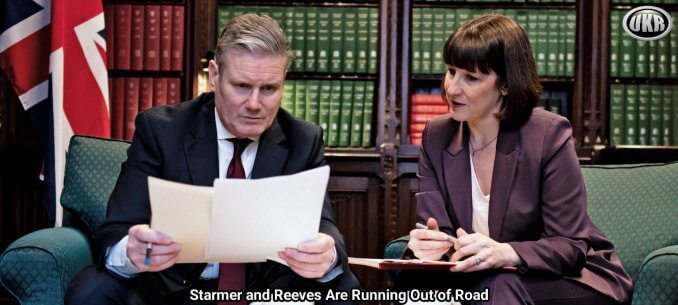
Starmer and Reeves are running out of road
ANDREW LILICO
Keir Starmer was out and about on Monday, desperately trying to save his Chancellor and his own premiership (for their fates are now inextricably intertwined) from the aftermath of the Budget. He denied Rachel Reeves had misled everyone in the run-up to the Budget and sought to convince his MPs that things will get better from here for the Government, saying they had now travelled through the ‘narrowest part of the tunnel’ on the cost of living.
Let’s remind ourselves of why he’s currently in trouble. For months, in the run-up to the Budget, Reeves gave press conferences – including a special emergency speech in early November mocked by Kemi Badenoch as her ‘I interrupt your Cheerios’ announcement – and had her officials brief the media to the effect that the Office for Budget Responsibility (OBR) was telling her that macroeconomic outlook downgrades meant the previous forecasts that she would meet her fiscal targets without additional tax rises no longer applied. So if she wasn’t to cut public spending – she suggested cuts to the NHS might be the only realistic option – then taxes would have to rise, despite her having made solemn promises after her 2024 Budget that no repeat of the heavy tax rises announced there would be required again this Parliament.
It’s worth recalling why she’d felt she had to make those undertakings. At the General Election, Labour proposed about £8.5 billion in tax rises, and said that claims it would raise taxes by much more than that were ‘lies’. As soon as they got into office, they started claiming there was a £22bn ‘black hole’ in the finances that meant taxes would have to be raised by more than that – a claim that the OBR subsequently said was nothing to do with it. Then, at the 2024 Budget, they raised taxes by some £30-£40bn and raised spending by about £70bn, as well as relaxing the ‘fiscal rules’ so that they could borrow more without violating their own commitments. Everyone felt that massively raising taxes so you could massively raise spending was quite a long way from what Labour had promised at the General Election – indeed was pretty much exactly what their opponents had predicted they’d do and been called ‘liars’ for saying so.
To mollify this discontent about being deceived, Reeves swore – in the political equivalent of writing one’s own name in blood – that she’d never do it again. That left her in an awkward bind in the run-up to the 2025 Budget, when it became clear she absolutely did want to raise both spending and taxes again.
This time around, Reeves couldn’t re-claim a ‘black hole’ in precisely the same way. So instead she started claiming that she was going to have to raise taxes again because Brexit and ‘austerity’ had caused more long-term damage to the economy than previously thought – damage that continued to accelerate even now. So it wasn’t her fault your taxes were going up – no siree. It was Nigel Farage’s and George Osborne’s. If she could have found a way to blame the Poor Laws, slavery and the Norman Conquest, perhaps she would have done so, but other matters started mercifully distracting people before she got around to those options.
At the same time, it appears the Chancellor was trying to engineer a classic ‘rabbit out of the hat’ moment for her Budget speech. Reeves tried to make everyone think she was going to raise income tax rates, but wanted to announce in her speech itself ‘Aha! I’m not!!’ [Cue delirious cheers and jeers from the Labour backbenches.] Alas, her plan not to raise got leaked so the whole elaborate plot collapsed.
Of course, as we now know, none of this was true. The OBR was indeed predicting slower growth, but because inflation was higher, tax receipts were coming in ahead of expectations and so the Chancellor’s fiscal rules were not broken. Rather, Reeves raised taxes a further £26bn in the 2025 Budget because she wanted to raise spending even further and to build a war chest for later in the Parliament.
Hopefully this whole episode is the nadir of the style of Budget build-ups we’ve come to expect over the past decade. Instead of older ideas of Budget purdah and the concept of strict confidentiality with market-sensitive data and thinking, for a decade or so now Budgets have been preceded by leak after leak, so that by Budget Day itself almost everything is already known. If I leaked data and thinking on market-sensitive economic analysis and advice I offer to regulators and competition authorities I’d not only lose my job but be investigated by the police. Opposition parties are trying to force a Financial Conduct Authority probe into Reeves’s conduct this time. But in truth, Budgets have been this way for years now. It’s outrageous, really, creating huge market unfairness – if you happen to be following the journalist who got the latest leak, then you get a head-start on other financial traders – not to mention the risk of corruption. The whole business stinks.
In the meantime, things have got even worse for Reeves and Starmer as other Cabinet ministers have now started briefing that they felt misled and lied to as well, having been led to believe tax rises were required by the OBR report.
At the General Election, everyone probably believed Labour would put up taxes and spending. So maybe their comments then were like saying ‘Santa’s coming’ – an untruth that isn’t really a lie because no one is actually deceived. But this year’s events look very deceptive. And once you are seen as lying not only to the public and the media, but also to your fellow Cabinet ministers, the clock must really be ticking on your political careers. It can only be a matter of time now before Starmer and Reeves go.
The disturbing thing is that whoever follows them will probably be even worse.
Click here to subscribe to our daily briefing – the best pieces from CapX and across the web.
CapX depends on the generosity of its readers. If you value what we do, please consider making a donation.
This article (Starmer and Reeves are running out of road) was created and published by CapX and is republished here under “Fair Use” with attribution to the author Andrew Lilico
See Related Article Below
Is it all OBR now for the Chancellor?
TALI FRASER
Finally, a resignation over the Budget which saw £26bn of tax rises paired with a £16bn increase in welfare spending. The highest tax burden as a proportion of GDP since British records began – all for a black hole in the public finances that didn’t actually exist and which even Rachel Reeves’ own cabinet colleagues were annoyed and briefing the media about. But before you get too excited …
No, it is not the woman who presided over this mishandled, misleading Budget. “Asking” us to pay more in taxes, like we have a choice in the matter when she was the one that had the choice, and then complaining about feeling “uncomfortable” with the responses, including that of the Leader of the Opposition Kemi Badenoch when she branded the Chancellor “spineless, shameless and completely aimless”, adding: “People out there aren’t complaining because she’s female, they’re complaining because she is utterly incompetent.”
Instead, it is the chair of the budget watchdog, the Office for Budget Responsibility (OBR), Richard Hughes who has so far taken the bullet over the fiscal fiasco. This is not to say that the accidental early OBR publication of the Budget was not astonishing (it was), but Hughes is now rightly paying for a major administrative error, while the person who wilfully created a Budget shambles remains in post as Chancellor.
His resignation came after a swift investigation found sharp market movements caused by the security oversight – the “worst failure in the 15-year history of the OBR”. So an investigation launched, a resignation followed, all after an accidental leak of the Budget 45 minutes ahead of schedule.
But what of the politicians who drip drip drip leaked from the Budget weeks before, leading to accusations that Reeves manipulated both public expectations and the markets to pave the way for higher taxation? Why should there be no investigation into that? The Prime Minister and Rachel Reeves continue to claim it is unnecessary. I’m sure they think so.
The breaking of promises and the misleading of the public surely warrants its own investigation. You might say Reeves has been economical with the truth, but are we sure she could be economical about anything?
As Badenoch put it last night: “If leaks are a resignation matter, then the chancellor should be at the front of the queue to resign. She has been leaking her budget throughout the summer.”
If Labour imagines Hughes’ resignation will sufficiently draw attention from the Chancellor, they are likely to be disappointed. The Financial Times last night was even reporting one Reeves ally cheered: “I expect you’ll be writing about something else tomorrow.” Sure, Hughes stepping down means he will not appear at the Treasury Select Committee today to answer questions and reveal more on the Chancellor’s misleading economics. But other representatives of the OBR will still be there – and, if anything, Hughes’ resignation will only further add pressure on Reeves’ precarious situation.
He took responsibility for the premature publication and stood down. This only sheds more light on the fact that even while Reeves’ own colleagues accuse her Treasury of creating a misleading impression of the public finances in the weeks ahead of the budget, no one has faced the consequences.
And now it is being reported that the OBR chair was “forced out” by the Treasury after he contradicted the Chancellor’s claims over the size of the fiscal black hole. That is the chair of what is meant to be the politically independent Budget watchdog being knocked out of the way because of Labour’s political choices.
While the Tories have been on top of Labour’s fiscal woes since they entered government, and are now leading the way in keeping the spotlight on Reeves, Reform UK’s leader Nigel Faragehas decided to circle back and launch a new wave of attack on Badenoch, urging voters not to trust the party, having previously overseen tax rises, increased welfare spending and net zero rules.
He has got three former Tory MPs to defect in the tide, including Jonathan Gullis, Lia Nici and Chris Green. But with each name, while there is a modicum of sadness from their old parliamentary colleagues (especially for Gullis, a former party deputy chairman), their prioritisation of the politics of convenience rather than conviction shines through. Just look back to previous comments about possible defections, including from Gullis on PoliticsLive: “Absolutely not a cats hell in chance will I be defecting… for me it takes courage of conviction and belief to stay within something like a political party where you have very different views within that and fight for what you believe in.” What happened? He has now joined a party where its former leader, now MP, Richard Tice posted last year on X: “With a special Easter message to Tory MP Jonathan Gullis: Given the multiple bits of embarrassing personal information we have on you, I suggest you pipe down on your attacks against me.”
The arguments that Gullis makes for leaving – “from failing to control both legal and illegal migration to pursuing a net zero agenda” – and Farage trys to convince others of, have been a policy focus in Badenoch’s Tory world. With stronger rules on ILR, a new ‘golden rule’ to cut taxes with a marked £47bn cut in state spending, including £23bn of welfare – and net zero being one of the first issues tackled under the new leadership.
But there is a reason that attacks from Farage are coming after the Tories’ renewed focus on the economy, because it is their best platform. Badenoch should keep pushing on it and only go further in delivering a distinct offering for voters, especially those looking for aspiration. It is a form of positive politics, and one that can both get voters back but earn the party new supporters.
This article (Is it all OBR now for the Chancellor?) was created and published by Conservative Home and is republished here under “Fair Use” with attribution to the author Tali Fraser

••••
The Liberty Beacon Project is now expanding at a near exponential rate, and for this we are grateful and excited! But we must also be practical. For 7 years we have not asked for any donations, and have built this project with our own funds as we grew. We are now experiencing ever increasing growing pains due to the large number of websites and projects we represent. So we have just installed donation buttons on our websites and ask that you consider this when you visit them. Nothing is too small. We thank you for all your support and your considerations … (TLB)
••••
Comment Policy: As a privately owned web site, we reserve the right to remove comments that contain spam, advertising, vulgarity, threats of violence, racism, or personal/abusive attacks on other users. This also applies to trolling, the use of more than one alias, or just intentional mischief. Enforcement of this policy is at the discretion of this websites administrators. Repeat offenders may be blocked or permanently banned without prior warning.
••••
Disclaimer: TLB websites contain copyrighted material the use of which has not always been specifically authorized by the copyright owner. We are making such material available to our readers under the provisions of “fair use” in an effort to advance a better understanding of political, health, economic and social issues. The material on this site is distributed without profit to those who have expressed a prior interest in receiving it for research and educational purposes. If you wish to use copyrighted material for purposes other than “fair use” you must request permission from the copyright owner.
••••
Disclaimer: The information and opinions shared are for informational purposes only including, but not limited to, text, graphics, images and other material are not intended as medical advice or instruction. Nothing mentioned is intended to be a substitute for professional medical advice, diagnosis or treatment.
Disclaimer: The views and opinions expressed in this article are those of the author and do not necessarily reflect the official policy or position of The Liberty Beacon Project.


Leave a Reply