

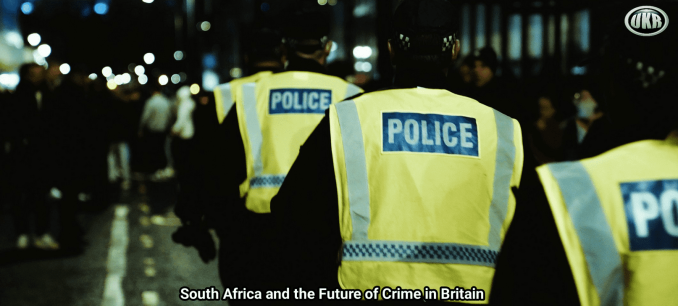
South Africa and the future of crime in Britain
When the police and politicians fail to act, crime can get out of control
SIMON READER
The murder of a young father in Knightsbridge, ostensibly for attempting to stop the theft of his watch, is not simply another statistic or another indication — despite the Mayor’s feeble denials — that crime is out of control in the capital. It is transitional symbolism and an expression of intent; when organised Rolex gangs or rippers emerge to torment mainstream patches of society, including tourists, it reveals that a darkness has come, because it has been allowed to.
The same happened in Johannesburg in the mid 2000s. By that time South African police had been severely weakened from within — a strategy initiated by Nelson Mandela who, spooked by coups in other African countries, deliberately emasculated the nation’s security apparatus, transforming the police force into a “service”. This was augmented by his successor, Thabo Mbeki, who appeared content to appoint one of the most corrupt African National Congress (ANC) members, Jackie Selebi, as his national commissioner (in 2010, Selebi was convicted of fraud and sentenced to 15 years. He died in 2015).
In 2005, Johannesburg was in chaos. With the city surrounded almost entirely by poverty, marauding gangs featuring fatherless, unemployed young men from the townships would enter its prosperous northern suburbs at night. First came the car hijackings, and when the gangs learned of police ineptitude in both responding to and investigating their crimes, they followed with home invasions. These were notoriously violent, often resulting in the execution or maiming of the homeowner. Only when a former IDF commander was summoned by the country’s Chief Rabbi to design a strategy (the highly successful Community Action Program — or CAP) to protect orthodox Jews walking the city’s streets on weekends, were residents in Johannesburg’s north — those who had not yet fled — able to breathe again.
One of the worst events occurred in 2006. Following a heist at a supermarket on the West Rand, police followed 12 suspected gangsters back to a house in a ghetto on the city’s edge. In what became known as the Jeppestown Massacre, four policemen were killed along with eight of the gang’s members.
Into the chaos came the first Rolex gangs. Around 2007, reports started emerging that people were being followed home from shopping malls, restaurants or even the airport; waiting at their gates to enter their properties, they were accosted by two or three gangsters at the driver’s window who would hold firearms to their temples and remove their watches. If the victim was a woman, her rings would go too. Sometimes the assailant would put her fingers in his mouth and try suck and bite them off.
The thugs scooped a number of scalps. Celebrity lawyers, wives of ANC politicians, bankers and sports personalities all fell victim to their armed robberies, and not even the extensive security detail belonging to one of the city’s most popular philanthropists — whose cousin was Keir Starmer’s biggest donor in 2024’s election cycle — prevented his watch being lifted.
It was easy to get lost in the darkness. Whilst the Rolex gangs were wreaking havoc, musicians such as Lucky Dune, and sportspeople such as the soccer player Eudy Simelane, were being slain in brutal fashion, and the ANC was unprepared to act assertively. I learned of this through the late Prince Mangosuthu Buthelezi whom I sat next to at the funeral of murdered battlefield historian David Rattray in 2007. Buthulezi, a former leader of the Inkatha Freedom Party IFP), was a lifelong friend to Rattray and deeply troubled by his senseless killing: “The ANC don’t want to compromise their support base,” he said, “and this is what is happening”.
It took conviction to finally confront the Rolex gangs. It involved parties like CAP, who were able to provide intelligence, former military operators, marksmen and the elite division of the police, the Special Taskforce, whose members were seen as incorruptible. From this arrangement a tracing unit was formed and armed with hollow tip bullets designed to paralyse the brainstem. By this point the group also had identified its primary target: a ruthless thug called Kelvin Ludidi, whose gang was linked to 60 violent murders, assaults and robberies.
Ludidi had been active since 1995. Considered a gifted strategist, he was also notoriously violent, but had bizarrely been afforded bail on 16 different occasions. In 2009, members of a response unit had spotted him in the upmarket suburb of Sandton. A high-speed chase ensued, and Ludidi was shot in the arm. Unsurprisingly, he was soon out on the street soon after.
If Ludidi’s slipperiness wasn’t perplexing enough, rumours started circulating that high level officials were linked to Ludidi via chain of custody. The stolen Rolex would be sold to a Johannesburg businessman for cents in the Rand, who would then ship the item to Greece or Turkey. One theory suggested that watches in Bodrum being sold as meticulous replicas for half the shelf price of originals were actually the real thing taken from the wrists of Johannesburg’s victims. The businessman, of Greek extraction, was said to have paid for the engagement band of one of South Africa’s most renowned detectives (since deceased).
The attitude of South African officials then matched the attitudes of Britain’s policing now. A sneering emphasis on “law” (or a projection of its more right-on interpretations), policing being ordered to “change” (even more), a procession of pseudo-academic theories into the origins of violent crime, and equally ludicrous recommendations to victims of rape and serious assault, such as “restorative justice”. The willingness of the courts to bail Ludidi weighed on the confidence of the tracing unit and its associates, who were drafted into dealing with other crises.
In 2012, two policemen patrolling a suburb adjacent to Sandton noticed a car with two occupants behaving curiously. They approached the vehicle only to be fired upon. One of the constables drew his sidearm and fired multiple rounds back, hitting one of the occupants in his neck and chest. He died shortly thereafter, but by then both constables had already recognised him and were radioing in for support. It was Kelvin Ludidi.
Rolex gangs thrived because of weak enforcement conditions, low morale among police and a pathological obsession with irrelevances
Now, London’s chances to erect the necessary preventative infrastructure have been slipping away. The fault doesn’t belong to Sir Sadiq Khan’s meaningless platitudes alone, but this generation of woefully aloof politicians, one of the worst being Ed Davey, whose only acknowledgement to date that something is profoundly wrong with society has been to soft-scold people (indirectly, of course), for playing music loudly on trains. Coupled to the sliding priorities of police, London has become possibly the most fertile ground in Western Europe for violent armed robberies. And now, resistance can mean death.
Johannesburg’s Rolex gangs thrived because of weak enforcement conditions, low morale among police and a pathological obsession with irrelevances inside of the political and criminal justice apparatus. One victim to whom I spoke in 2009 confessed that he’d found himself asking a question to a gangster whose gun was in his ear. “Why are you doing this?” The gangster placed the man’s watch in his pocket and looked at him as if he was crazy. “Because we can.” He then walked unbothered back to the getaway car, and drove off.
The South Africanisation of Britain
The scaffolding of Britain’s state is buckling
This article was first published in The Critic. Everything I publish elsewhere is shared here for free, as a gift to the nation. But if you want the full picture, become a paid subscriber. It’s just a few quid a month; such is the price genius is reduced to.
Hampstead at dusk, dismal and soundless. The iron gates of your compound yawn open to reveal the urban warscape of Neo-Pretoria. Your armoured Tesla tracks its lane as you head to the inhab bar. The sound of gunfire, off in the distance; you’re getting used to it now. You check the data on your neurosurgical Russian military detector sleeve and see it’s the Latinarcos flaring up again. They iced three of your SynSec guards last week.
You look out at the needle galleries on Heath Street and turn on the radio. Prime Minister Tapp is holding a press conference on the border clashes with the Autonomous Calais Enclave neo-Kurdan guerrilla mesh-units. He says he understands their “excess of legitimate anger” and announces he has a twelve-point conciliation plan.
Fiction, perhaps. But for how long?
Britain is not South Africa — yet. But there is a sense that the scaffolding of a once-functional state is buckling, and the grand edifice it supports is gradually tumbling down with it, brick by brick. For those with a doomerist bent, comparisons to the Rainbow Nation’s dysfunction, division and decay feel grimly inevitable — and the parallels harder to ignore.
South Africanisation is not just a metaphor. It is a process, and it has already begun. But what does it entail? Practically speaking, South Africanisation can be broken down into these sub-processes:
- Collapse of public infrastructure and services — often due to corruption or managerial incompetence
- The retreat of the state in face of growing criminality, prompting a rise in private security, gated communities and parallel, informal systems of governance
- Communalist politics, drawn along ethnic, racial or religious lines
- Increased social stratification, with an increasingly detached elite able to escape the inexorable collapse of baseline quality of life
- Disillusionment with formal politics and the development of radical political apathy
Rolling blackouts have become a totemic example of South Africa’s failure. “Loadshedding”, the euphemised term, sees the state power utility company Escom deliberately cutting power to different regions.
The only other viable alternative is a catastrophic nationwide grid failure. This is because the power infrastructure is zombified, surviving on the remnants of 20th century coal-fired plants. Rusting, obsolete, unmaintained and molested by decades of political interference, they break down with astonishing regularity. The country’s only nuclear facility, Koeberg, a Cold War relic brought online in the 1980s, tripped offline in March.
But power is only the most visible case. South Africa’s entire infrastructural system is collapsing. Roads, railways, ports and even the water supply are falling apart. Parts of Joburg were without running water for almost two weeks last year. The rail system, Africa’s largest, has dropped a third of its freight capacity in five years. The rolling stock gradually rusts, rails and signals are looted by gangs, and procurement is log-jammed by systematic corruption.
South Africa can no longer maintain what it has, but the extreme planning and legislative processes for building new infrastructure mean it cannot build what it needs, either. Even where infrastructure is built, it is designed for political ribbon-cutting: inauguration rather than operation. Maintenance, it seems, is nobody’s job.
Another critical factor in the breakdown of South African infrastructure is crime — not as a side effect but as a driver. Criminal syndicates known as the “construction mafia”, often operating under the cover of community development forums, use extortion, sabotage and violence to hijack public projects. More than 180 have been targeted at a cost estimated at R63 billion, according to the National Treasury. A wave of copper theft is sweeping the nation, further hobbling the infrastructure network.
Crime is not limited to theft. Over the past 13 years, the murder rate in South Africa has surged by more than 50 per cent, placing the country amongst the most homicidal on Earth. Six of Africa’s most dangerous cities are in South Africa. Local crime gangs now act as something approaching a government, dispensing illicit goods, weapons and protection in areas they control. A 2024 Institute for Security Studies report found that the widespread circulation of illegal firearms is fuelling a feedback loop of escalating violence.
Faced with increased crime, more heavily armed suspects and the establishment of no-go zones, the police are increasingly powerless. They, too, are hamstrung by institutional corruption — there are many cases of officers having to buy their own ammunition and uniforms. Since 2012, the South African Police Service’s ability to detect murders has dropped by 65 per cent. The national conviction rate for murder stands at just 13 per cent. Recidivism is endemic: around 90 per cent of released prisoners reoffend.
Opting out is, for those who can afford it, less a choice and more an imperative. The country has seen explosive growth in private security; South Africa now has more private security personnel than police and military combined. Increasing numbers of people are withdrawing into fortified compounds.
The spectre of racial politics, of course, underlines all of this. South Africa’s official ideology remains “non-racialism”. But the real currency of the country’s politics is what the former editor of South Africa’s Sunday Times, Brian Pottinger, calls “reverse racism”. What began as a moral project of redress and equity has metastasised into racial preferment.
The rampant corruption and incompetence of the ANC has failed to build broad-based prosperity, and the party has doubled down on a politics of racial redistribution. Wealth, jobs and contracts flow not through meritocratic competition but through racial quotas, political connection and cronyist enrichment.
May’s elections suggest that ethnic communalism is now hardwired into political behaviour: the ANC drew 98 per cent of its support from black Africans, whilst the EFF and MK received similarly ethnically homogenous votes. The Democratic Alliance is the only major party with a multiracial base, and it remains stuck below 25 per cent support.
Political apathy is an entirely rational response to such conditions. South Africans, particularly the young, are losing interest in a system that appears incapable of delivery. Just 66 per cent of adults are registered to vote, and turnout has declined steadily since 1999. Amongst the youngest cohort, registration is lowest. Surveys conducted by the Centre for Risk Analysis show that whilst many still believe in the idea of democracy, they no longer believe in any of the parties.
To Britons, rolling blackouts, crumbling infrastructure, the rise of private security in place of a hollowed-out police force, brazen communalism and a collapse of faith in the political system were once unimaginable. But many of these will fast become familiar. Recent blackouts in Spain and Portugal have raised fears that hostile actors might target Britain’s grid. In truth, sabotage may be unnecessary; our own energy policy is doing the job already.
In January, Britain came “within a whisper” of blackouts when the wind failed to blow during a cold snap. In previous years we’ve burned coal and bought power from now-decommissioned Belgian nuclear plants to keep the lights on.
But under Net Zero, the UK has been decommissioning reliable gas and coal capacity and replacing it with renewables that are abundant when not needed and absent when required. Dispatchable generation (electricity we can summon on demand) has now fallen below peak demand and is projected to fall further. By 2027, we may have just 85 per cent of the power we need.
Britain’s infrastructure crisis isn’t one of neglect but of overload: it was not built for a population approaching 70 million. We are similarly unable to build new capacity, hampered not by entrenched criminal gangs but by bureaucracy — although the difference between criminal sabotage and regulatory paralysis is tone rather than outcome. Every year we fail to build whilst the population grows larger, the problem compounds.
Whilst violent crime is on the decline in Britain, it must be considered a matter of miracle rather than solid policing policy. Overly lenient judges, a prison system at least a decade beyond its capacity staffed by officers desperate to start relationships with prisoners, a police force that seems at best overwhelmed and at worst uninterested in the small matter of physically real crime — but frothing to deal with “non-hate crime incidents” — give little reassurance that the decline will be reversed.
The development of communal politics, too, is more advanced in Britain than politeness would allow us to admit. Riots after Black Lives Matter, Gaza and the Southport murders can all be seen as expressions of the slow intensification of ethnic identification — accompanied, inevitably, by political factionalism. The Gaza Independents now have candidates vowing to end free mixing between the sexes, Sikhs have threatened to “no-platform” Labour MPs over the lack of a public inquiry into UK complicity in the 1984 Golden Temple massacre and Bob Blackman hangs on gamely in Harrow thanks to his open expressions of Indian nationalism.
Faced with all this, faith in the system is fading. Last year’s British Social Attitudes survey painted a bleak picture: just 40 per cent believed the government delivers effectively, whilst a record 45 per cent said they “almost never” trust those in power to put the country’s needs first. Fully 79 per cent thought Britain’s system of governance needs major reform.
A member of a More In Common focus group — Gary, a sales manager — summed up the discontent with the clarity that often escapes those inside the system: “I’ve given up on the system. The country almost needs a coup d’état.”
It may be grim, but we are not yet in a South Africa-style dystopia. What is more likely is a slower and murkier slide backwards; perhaps Birmingham, rather than Pretoria may prove to be the blueprint for Britain’s cities in future.
This article (The South Africanisation of Britain) was created and published by Tom Jones and is republished here under “Fair Use”
Featured image: Getty Images

••••
The Liberty Beacon Project is now expanding at a near exponential rate, and for this we are grateful and excited! But we must also be practical. For 7 years we have not asked for any donations, and have built this project with our own funds as we grew. We are now experiencing ever increasing growing pains due to the large number of websites and projects we represent. So we have just installed donation buttons on our websites and ask that you consider this when you visit them. Nothing is too small. We thank you for all your support and your considerations … (TLB)
••••
Comment Policy: As a privately owned web site, we reserve the right to remove comments that contain spam, advertising, vulgarity, threats of violence, racism, or personal/abusive attacks on other users. This also applies to trolling, the use of more than one alias, or just intentional mischief. Enforcement of this policy is at the discretion of this websites administrators. Repeat offenders may be blocked or permanently banned without prior warning.
••••
Disclaimer: TLB websites contain copyrighted material the use of which has not always been specifically authorized by the copyright owner. We are making such material available to our readers under the provisions of “fair use” in an effort to advance a better understanding of political, health, economic and social issues. The material on this site is distributed without profit to those who have expressed a prior interest in receiving it for research and educational purposes. If you wish to use copyrighted material for purposes other than “fair use” you must request permission from the copyright owner.
••••
Disclaimer: The information and opinions shared are for informational purposes only including, but not limited to, text, graphics, images and other material are not intended as medical advice or instruction. Nothing mentioned is intended to be a substitute for professional medical advice, diagnosis or treatment.
Disclaimer: The views and opinions expressed in this article are those of the author and do not necessarily reflect the official policy or position of The Liberty Beacon Project.


Leave a Reply