

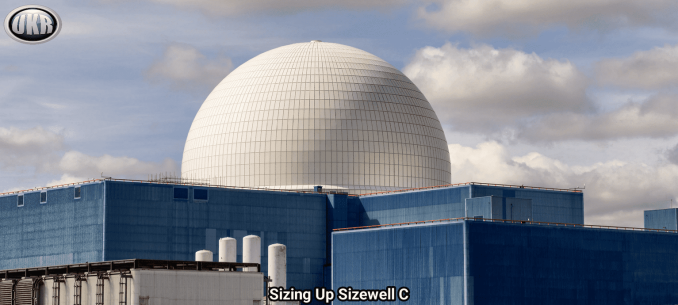
Sizing up Sizewell C
The British approach to nuclear power has been a disaster of nuclear proportions
MATTHEW KIRTLEY
As part of last week’s spending review, the government announced a further investment of £14.2bn for the Sizewell C nuclear power station. This puts the state’s total commitment into the project at £17.8bn.
Despite the scale of these numbers, the government’s pledges for Sizewell C seem to only cover a minority of the plant’s construction costs. That’s because, per leaks to the FT, Sizewell C’s construction budget is likely to balloon to over £40bn.
Government spokespeople have defended these costs by pointing out that Sizewell C is set to be significantly cheaper than the Hinkley Point C plant — conservatively, using CPI inflation, the latter’s construction costs are set to run up to £46.8bn in 2025 prices. The lessons from Hinkley Point C, which is a virtually identical facility that also uses the European Pressurised Reactor (EPR) architecture, are apparently being realised into cost savings.
However, this does conceal the big point: the EPR plants are both grossly expensive, relative to Britain’s historic plants. Sizewell B, the last new nuclear plant built in Britain, came online in 1995 and cost £2,030mn in 1987 prices — £5.85bn in 2025, using CPI inflation.
Even accounting for the fact that Sizewell B’s nameplate capacity is 1,250MW compared to the 3,260 MW of the two EPRs, the capital costs per MW are far more expensive. The construction costs of the cheaper EPR, Sizewell C, are set to stand at £12.3mn per MW. By comparison, Sizewell B’s construction costs amount to £4.7mn per MW. So even adjusting for inflation and plant size — which should nominally reduce the cost per MW via economies of scale — the EPR reactors are nearly three times more expensive than their predecessors.
So why has nuclear become so much more expensive?
One elephant in the room is the EPR architecture. The system was designed with the ethos of risk minimisation at all costs, employing countless redundancies. Whereas many contemporary pressurised water reactors minimise risk through passive safety systems, EPRs build in countless new pumps and active countermeasures to avert a disaster. The result is an orders of magnitude increase in plant complexity, and thus cost.
However, while there’s much to be said about the faults of EPR, it probably takes a backseat to a more pressing structural problem: the way that Britain funds nuclear projects.
Unlike most “non-renewable” energy sources, capital expenses make up the overwhelming majority of the cost of nuclear energy. Depending on the project, between 60-80 per cent of the plant’s lifetime costs will come from capital and up-front construction. Fuel and operational costs (including decommissioning) are comparatively small.
Until the mid-1990s, these high fixed costs were not a deterrent for the growth of nuclear. The plants were financed, constructed, and operated under the remit of the government’s Central Electricity Generating Board (CEGB). Critically, that meant that plants could be financed through the cheapest source of borrowing possible: government bonds.
Then privatisation happened. The last part of the CEGB to be privatised were its nuclear assets in 1995, with the state abandoning its role in building new plants. Now, in private hands, any new plant was dependent on begging for a mix of subsidies and private financing. To compensate for risk and the sheer amount of time required to break even, private debt for a new nuclear plant is much more expensive than a government gilt.
These heightened financing costs are the biggest reasons for nuclear’ s cost inflation. To understand this, we can look at the Hinkley Point C project. Midway through its purchase of Britain’s nuclear industry in the late 2000s, France’s state-owned EDF Energy and the government began negotiating over the new plant – to proceed, EDF demanded a guaranteed 9 per cent rate of return.
By comparison, the state could have borrowed the money for the plant using government bonds at a 2 per cent return. In 2017, the National Audit Office explained the result:
… if we assume the government financed the project and required a 2% return (nominal, equivalent to its borrowing cost), construction costs could overrun by between 400% and 600% to equate to the total cost of the HPC deal. If we assume government needed a 6% return (nominal), costs could overrun by between 75% and 100%.”
Or, in short, if the plant had been financed directly by the state, then the government could have theoretically paid for up to six plants for the same cost.
The result? No new nuclear plants in three decades, exploding energy prices, and ongoing deindustrialisation
These heightened costs are felt by consumers — Hinkley Point C’s energy via exceptionally high energy prices through a pre-agreed Contract for Difference (CfD) price, and Sizewell C’s via increased energy bills during construction via a Regulated Asset Base (RAB) price hike. While in the long-run RAB is a better model than CfD for cost-minimisation, both still push up energy prices by forcing consumers to cover the far more expensive private debts of investors.
In the end, all privatisation of nuclear has traded out one state actor for another — our CEGB was replaced with France’s EDF. Rather than innovation and competition, the sheer fixed costs, long time horizons, and low margins of nuclear inevitably force consolidation of supply. Rather than accept this, the government has buried its head in the sand for decades and tried to maintain the kayfabe of a privatised electricity system powered by private capital.
The result? No new nuclear plants in three decades, exploding energy prices, and ongoing deindustrialisation. The ideological commitment to privatised energy — particularly nuclear — has beggared us all.
This article (Sizing up Sizewell C) was created and published by The Critic and is republished here under “Fair Use” with attribution to the author Matthew Kirtley
See Related Article Below
Sizewell C looks like an expensive mistake
DAVID ROSE
Prime Minister Keir Starmer and Energy Secretary Ed Miliband maintain that their decision to commit a further £14 billion to Sizewell C, a new nuclear power station in Suffolk, does not represent a “blank cheque” from the taxpayer. Yet the evidence suggests this may be overly optimistic.
For a government that wants to achieve a Net Zero energy system by 2050, the attractions of Sizewell C are obvious. Unlike intermittent renewables, which are dependent on the weather, nuclear plants — in theory, at least — provide stable and reliable low carbon power. However, most of Britain’s existing nuclear fleet is ageing fast and, despite repeated extensions of its operating licences, will be offline by 2030. Meanwhile, back in 2020 the Office for Nuclear Regulation (ONR) granted a licence to build and operate two reactors at Sizewell with a total capacity of 3.2 gigawatts — enough to power some 6 million homes.
Sizewell’s licence was granted on the basis that the new plant would be largely identical to Hinckley Point C, another two-reactor plant which is still being built by EDF in Gloucestershire. Though this was originally supposed to be supplying power to the grid by now, current projections suggest such an outcome is unlikely before 2031. When construction started in 2017, EDF said it would cost £18 billion at 2015 prices. Last year, following several earlier increases, the firm revised this figure to £34 billion at 2015 prices — or £46 billion now. Most energy experts consider it unlikely that Sizewell C will end up costing much less.
The operational record of the European Pressurised Reactor (EPR) design of the Sizewell and Hinckley Point plants is no happier. In 2021, the world’s first EPR to come online, Taishan 1 in China, had to be shut down for more than a year because unexpected vibrations had damaged its fuel rods. The same problem has afflicted the EPR at Flamanville in France, which has also experienced shutdowns. Other expensive technical issues there mean that EDF has decided to concentrate in future on selling a very different new design known as the EPR2.
However, the organisation can’t do that at Sizewell C because this would not comply with the terms of the ONR licence. Seeking approval for a British EPR2 would mean repeating the entire regulatory process, which would take several years.
This isn’t the only questionable feature of the Government’s decision. While EDF has clearly struggled to build nuclear plants on budget and on time, its Korean rival Kepco has to date built eight of its Advance Power Reactor (APR) 1400 plants without significant overruns. In 2023, Kepco submitted a bid to Turkey to build four reactors for a total cost of around £26 billion. On that basis, building two at Sizewell might be expected to cost £13 billion, less than a third of the likely cost of the EPRs.
What’s more, the APR 1400 has already been approved by the US Nuclear Regulatory Commission and by the European Union: its safety standards are no less stringent than those of Britain’s ONR.
“It would make an awful lot of sense if we junked the EPR and just went for Kepco,” independent energy consultant Kathryn Porter says. “If the APR is good enough for Europe and America, it’s good enough for us — and unlike the Americans, we don’t have to worry about hurricanes and tornadoes. We could literally just pass a law saying we’re going to build APR 1400s at Sizewell. And because they’re so much cheaper, they would attract investment — and make a profit.” Other sites where old reactors have already closed or are due to do so, such as Wylfa on Anglesey, would also be suitable, Porter says.
Starmer and Miliband claim that throwing another £14 billion at Sizewell C shows we are entering a new “golden age” of nuclear investment. Some may feel that opting for a technology known to be fraught with problems, and prone to vast increases in construction costs, is a peculiar way to go about this mission.
This article (Sizewell C looks like an expensive mistake) was created and published by UnHerd and is republished here under “Fair Use” with attribution to the author David Rose
Featured image: Alamy

••••
The Liberty Beacon Project is now expanding at a near exponential rate, and for this we are grateful and excited! But we must also be practical. For 7 years we have not asked for any donations, and have built this project with our own funds as we grew. We are now experiencing ever increasing growing pains due to the large number of websites and projects we represent. So we have just installed donation buttons on our websites and ask that you consider this when you visit them. Nothing is too small. We thank you for all your support and your considerations … (TLB)
••••
Comment Policy: As a privately owned web site, we reserve the right to remove comments that contain spam, advertising, vulgarity, threats of violence, racism, or personal/abusive attacks on other users. This also applies to trolling, the use of more than one alias, or just intentional mischief. Enforcement of this policy is at the discretion of this websites administrators. Repeat offenders may be blocked or permanently banned without prior warning.
••••
Disclaimer: TLB websites contain copyrighted material the use of which has not always been specifically authorized by the copyright owner. We are making such material available to our readers under the provisions of “fair use” in an effort to advance a better understanding of political, health, economic and social issues. The material on this site is distributed without profit to those who have expressed a prior interest in receiving it for research and educational purposes. If you wish to use copyrighted material for purposes other than “fair use” you must request permission from the copyright owner.
••••
Disclaimer: The information and opinions shared are for informational purposes only including, but not limited to, text, graphics, images and other material are not intended as medical advice or instruction. Nothing mentioned is intended to be a substitute for professional medical advice, diagnosis or treatment.
Disclaimer: The views and opinions expressed in this article are those of the author and do not necessarily reflect the official policy or position of The Liberty Beacon Project.


Leave a Reply