

G. CALDER
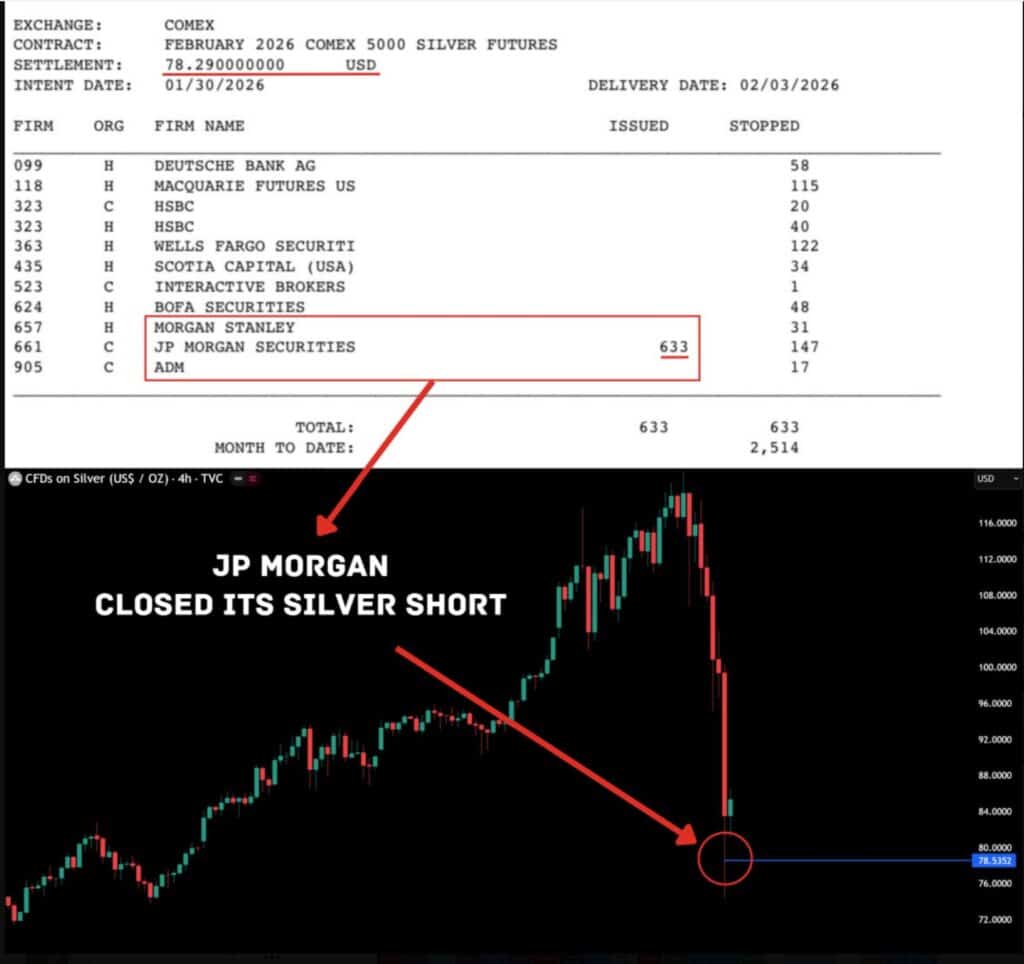
On Friday, the global silver market experienced its most severe single-day collapse since 1980. Prices fell from roughly $120 to near $78 in the space of hours, representing a decline of almost 35 percent. Gold followed with a drop of approximately 12 percent, while mining equities and precious metals exchange-traded funds were heavily sold across the board. By conservative estimates, close to three trillion dollars in market value linked to precious metals was erased in a single trading session.
The speed and magnitude of the decline immediately drew comparisons to past market dislocations. For many investors, the scale of the losses was not merely surprising but destabilising. What had appeared to be a strong and widely supported rally in precious metals unraveled in a matter of hours, leaving little time for reassessment or orderly exit.
Initial coverage framed the event as a sharp but rational reaction to shifting macroeconomic expectations. According to the prevailing narrative, markets were responding to political developments in the United States that implied tighter monetary policy and a stronger dollar. That explanation, while superficially plausible, is deliberately misleading.
.
The Official Explanation is Wrong
Most mainstream financial outlets attributed the crash to the nomination of a more hawkish Federal Reserve chair. Investors, readers were told, were reassessing the outlook for liquidity, inflation, and interest rates. In that context, selling in gold and silver was portrayed as a natural and proportionate response.
Such explanations rely on the assumption that markets move primarily on sentiment and expectations. While that is often true at the margin, it fails to account for the extreme precision and sequencing observed in this specific case. Political news rarely produces collapses of this magnitude without underlying structural triggers.
The timing of the sell-off, its concentration during periods of thin liquidity, and the rapid exhaustion of selling pressure all suggest that the official narrative captures only a small part of the picture. What it does not explain is how the market reached “the bottom” so efficiently, or who was positioned to benefit when it did.
The Perfectly Timed Exit – JPMorgan Wins
At approximately $78.29, the lowest point of the trading session, JPMorgan closed its silver short position. The exit was not gradual, nor did it occur during a rebound. It coincided precisely with the point of maximum selling pressure.
Closing a large short position requires an abundance of sellers and an absence of competing buyers. That environment does not typically arise from cautious repositioning or mild disappointment. It arises when market participants are being forced to sell regardless of price, often to meet external requirements rather than personal conviction.
The fact that such liquidity was available at the exact bottom invites scrutiny. While it does not establish intent, it does raise the question of how certain participants are able to navigate extreme volatility with such consistency, while others are caught in cascades they cannot escape.
Price Discovery Conveniently Went Offline
As silver prices were collapsing, the London Metal Exchange experienced a systems outage that disrupted trading during a critical window. The exchange is a central hub for global metals pricing, and any interruption during periods of stress carries significant implications for transparency and execution.
At the same time, HSBC, one of the largest holders of short positions in the London bullion market, also reported technical difficulties affecting its systems. These issues occurred while prices were falling rapidly and liquidity was deteriorating.
Whether or not these outages were related, their impact was structural. When access to markets is impaired, price discovery becomes uneven. Those who retain connectivity gain a decisive informational and operational advantage at precisely the moment when others are most vulnerable.
Margin Requirements Force Liquidation (Again)
While attention remained fixed on political headlines, the most consequential development occurred within the market’s own infrastructure. The COMEX exchange raised margin requirements on silver futures during a period of elevated leverage and heightened volatility. This is the same tactic that caused the previous silver crash, which we covered in the following article: Silver Priced Crashed on Purpose (Again) – What Really Happened?
Margin requirements determine how much capital traders must post to maintain leveraged positions. When these requirements are increased abruptly, traders must either supply additional funds immediately or liquidate their holdings. In a market where leverage is widespread, such changes can force selling on a massive scale.
That is exactly what occurred. As margin calls were issued, traders liquidated positions to meet new requirements. Falling prices triggered further margin calls and stop-loss orders, while algorithmic trading systems accelerated the decline. The result was a self-reinforcing cascade driven by policy rather than sentiment.
Timing the Collapse
The effectiveness of the liquidation was amplified by timing. The most aggressive selling occurred after Asian markets had closed for the weekend, when global participation was at its lowest. With fewer buyers available, price movements became more extreme and less orderly.
Thin liquidity magnifies volatility, particularly in leveraged markets. Each forced sale pushed prices lower, triggering additional selling in a feedback loop that fed on itself. By the time Asian markets reopened, the market had already established a new, dramatically lower equilibrium.
This sequencing raises an uncomfortable question about whether market stress was merely observed, or actively allowed to intensify. At the very least, it suggests that structural decisions were made with little regard for orderly price discovery.
Media Narratives Miss Out the Real Mechanics
In the aftermath, media coverage largely reinforced the political explanation. Reports focused on central bank expectations, currency movements, and investor psychology. Far less attention was paid to the mechanical drivers that actually forced liquidation across the market.
Some reports circulated claims about changes in government policy on strategic metals, which were later contradicted by official statements. However, in markets dominated by algorithmic trading, initial headlines matter far more than subsequent corrections.
The near absence of coverage on margin hikes and exchange mechanics is striking. These factors are not obscure or speculative. They are well-documented tools with a long history of producing precisely the outcomes observed on Friday.
Paper Markets vs Physical Reality
Silver trades in both paper and physical markets, but the vast majority of volume occurs in paper instruments such as futures contracts and leveraged exchange-traded products. These markets are characterised by high leverage and complex derivatives, with claims on silver far exceeding the amount of metal available for delivery. Currently, there is approximately 300x more silver being traded in paper contracts than is physically available.
The physical market operates under different constraints. Supply is finite, production is slow to respond to price changes, and demand from industrial users remains strong. None of these fundamentals changed during the crash.
In fact, physical premiums in parts of Asia remained elevated even as paper prices collapsed, underscoring the disconnect between financial instruments and physical availability. The sell-off resolved nothing about underlying supply constraints.
Yes, We’ve Seen This Exact Play Before
History offers several clear precedents. In 1980, rule changes following the Hunt brothers’ accumulation of silver led to a dramatic collapse. In 2011, repeated margin hikes during a strong rally produced a sharp and lasting decline. More recently, similar interventions during periods of thin liquidity have triggered rapid sell-offs.
In each case, leverage was allowed to build before being withdrawn abruptly. Each time, forced liquidation reset prices and sentiment, often to the benefit of those positioned to absorb selling pressure.
The recurrence of this pattern makes it difficult to dismiss the latest episode as an aberration. The tools are well known, and their effects are predictable.
Who Pays the Price?
The losses were concentrated among retail traders and holders of leveraged products, many of whom were unable to respond in time. Mining companies saw significant portions of their market value erased despite no change in their operations or reserves.
Long-term investors were shaken out of positions by volatility rather than fundamentals. Confidence was damaged, participation was reduced, and the market emerged thinner and more fragile than before.
Meanwhile, institutional investors with the balance sheets to withstand forced selling were able to exit positions or reposition at favourable prices. The redistribution of risk and reward was stark.
Final Thought
What Friday’s crash ultimately achieved was not a correction of excess or a reassessment of value. It removed leverage, punished participation, and reset sentiment through structural force rather than collective judgment.
Markets are volatile by nature, and losses are an accepted part of investment. However, when exchanges can alter requirements mid-stream, when access disappears during periods of stress, and when public narratives obscure the mechanisms at work, volatility begins to resemble discipline rather than discovery.
Friday’s silver collapse did not emerge from confusion or panic alone. It followed a familiar sequence, using familiar tools, with familiar results. What’s troubling about the crash is not how sharply prices fell, but how the system that allows such manipulation continues to run without scrutiny. Three trillion dollars left the market on Friday, and almost all of it went from retail investors’ savings into institutional pockets.
This article (Silver Manipulated AGAIN: The Truth Behind the Worst Day Since 1980) was created and published by The Expose and is republished here under “Fair Use” with attribution to the author G. Calder


Leave a Reply