

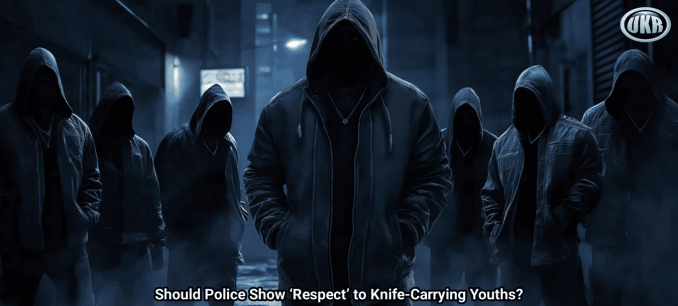
Should police show ‘respect’ to knife-carrying youths?
The dismissal of PC Lorne Castle exposes a culture of backstabbing, mistrust and unbridled wokery.

PAUL BIRCH
The case of ex-police officer Lorne Castle is a distressing one. An officer twice decorated for bravery at national level, he was dismissed by Dorset Constabulary last month for behaving ‘aggressively’ and using ‘unreasonable force while arresting a 15-year-old boy in Bournemouth town centre’. This week, he said he would appeal the decision.
The police’s description of the arrest, which took place in January 2024, is disingenuous. PC Castle was unaware of the suspect’s age at the time of the arrest, and his behaviour reflected his experience of encounters with potentially violent young men. In this case, Castle was arresting the boy in question because he was suspected of having brawled with another teen and of having assaulted an elderly man, both on the same day. During the arrest, the boy was found to be in possession of a knife. Nevertheless, higher-ups concluded he had ‘failed to treat [the suspect] with courtesy and respect’.
Sensing a potential backlash to Castle’s dismissal after the circumstances of the arrest became known, Dorset Constabulary released bodycam footage of the incident. The police clearly hoped the public would support the verdict against Castle. This came back to bite them when, having seen the footage, many began questioning the legitimacy of his dismissal.
Although several aspects of this case are troubling, as an ex-officer, I am particularly disturbed (though not altogether surprised) that Castle was originally informed on by one of his own colleagues. In light of the case of former policeman and serial rapist David Carrick, where those aware of his misconduct remained inexcusably silent, there will undoubtedly be public support for cops turning in their teammates should they have doubts as to their actions. Indeed, no reasonable person would argue against that if there are serious allegations at play. But we need to consider whether that should apply to failing to treat a suspect ‘with respect’ – particularly when said suspect is carrying an illegal weapon in a city that endured violent gang clashes the previous night.
At its heart, the Castle affair exposes the impact of ‘progressive’ ideology on the modern police force. Indeed, during my time in the police, I noticed a distinct deterioration in the working atmosphere, which was directly correlated to the degree to which the organisation had been captured by wokeism. Top-down political correctness began to overshadow the core values that initially drew me to the profession.
The modern police operate in an environment in which honest discussions are suppressed, and dissenting opinions may only be uttered in hushed tones with trusted co-workers. This not only affects morale – it also hinders the ability of officers to perform their duties. They fear that even the slightest misstep or violation of ‘inclusivity and diversity’ protocol might provoke a backlash.
And this is where the Castle case is particularly relevant. Not only are officers encouraged to police their own behaviour, they are also intimidated into policing and informing on their colleagues. The Metropolitan Police recently introduced Signa, an ‘everyday sexism reporting tool’ through which staff can ‘raise awareness within the workforce [of] all forms of discrimination’. Signa is an anonymous reporting system, meaning you can say anything about anyone, without fear of repercussion, even if your claim is malicious. Resultant figures will inevitably be skewed. This might be worth remembering when the next review into the Met paints a bleak picture of internal police culture.
Equally as discouraging, misconduct allegations are now rife. These range from the serious to the trivial, including claims a colleague once shared a mildly sexist meme of the England Lionesses.
The current working environment in the police force is not healthy. It fosters anxiety and mistrust, as officers work in fear of the denunciation of their colleagues. I sympathise with Lorne Castle and all that he and his family have been through, and I wish him luck with his appeal. However, given the current state of the police, you have to wonder why he would want his job back at all.
Paul Birch is a retired police officer.
This article (Should police show ‘respect’ to knife-carrying youths?) was created and published by Spiked Online and is republished here under “Fair Use” with attribution to the author Paul Birch
Featured image: Adobe Stock

••••
The Liberty Beacon Project is now expanding at a near exponential rate, and for this we are grateful and excited! But we must also be practical. For 7 years we have not asked for any donations, and have built this project with our own funds as we grew. We are now experiencing ever increasing growing pains due to the large number of websites and projects we represent. So we have just installed donation buttons on our websites and ask that you consider this when you visit them. Nothing is too small. We thank you for all your support and your considerations … (TLB)
••••
Comment Policy: As a privately owned web site, we reserve the right to remove comments that contain spam, advertising, vulgarity, threats of violence, racism, or personal/abusive attacks on other users. This also applies to trolling, the use of more than one alias, or just intentional mischief. Enforcement of this policy is at the discretion of this websites administrators. Repeat offenders may be blocked or permanently banned without prior warning.
••••
Disclaimer: TLB websites contain copyrighted material the use of which has not always been specifically authorized by the copyright owner. We are making such material available to our readers under the provisions of “fair use” in an effort to advance a better understanding of political, health, economic and social issues. The material on this site is distributed without profit to those who have expressed a prior interest in receiving it for research and educational purposes. If you wish to use copyrighted material for purposes other than “fair use” you must request permission from the copyright owner.
••••
Disclaimer: The information and opinions shared are for informational purposes only including, but not limited to, text, graphics, images and other material are not intended as medical advice or instruction. Nothing mentioned is intended to be a substitute for professional medical advice, diagnosis or treatment.
Disclaimer: The views and opinions expressed in this article are those of the author and do not necessarily reflect the official policy or position of The Liberty Beacon Project.


Leave a Reply