

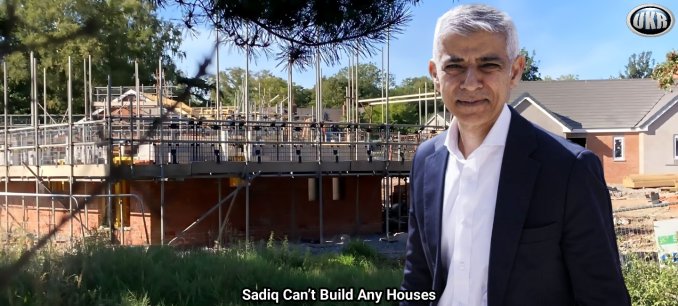
Sadiq can’t build any houses
BEN HOPKINSON
There are few things that are consistent in housing policy. The Housing Secretary has changed 10 times in the past decade. We’ve seen multiple National Planning Policy Frameworks in the past few years. Since the Housing, Town Planning, etc. Act 1909 first introduced town planning to the statute books, almost every single Parliament has passed a significant act changing how the planning system works.
Yet one thing that has remained consistent is that London has always built more than 10,000 homes each year since the Second World War. However, that too is about to change. London started just 4,170 homes in the past financial year and the consultancy Molior projects that only 4,550 homes will be completed in both 2027 and 2028.
Failing to build even 10,000 homes in a year for the first time since 1946 is a disaster. The worst thing is that 10,000 homes is such a low bar, that failing to clear it is humiliating. London housing target is 88,000 homes a year and we’re on track to build just 5% of that.
The causes for such a slowdown are varied, and I’ve laid them out in a the Centre for Policy Studies briefing, ‘The City That Doesn’t Build’. There are some wider economic challenges that are outside the scope of policy changes such as high interest rates impacting the cost of capital and high construction inflation at a time when the housing market is flat. But there are other causes that are well within the policy realm where Labour have failed to go far enough.
Steve Reed, the Housing Secretary, recognised that the housebuilding figures in London were so bad that they warranted an emergency response in the autumn. Yet the substance of this response was mixed. It did deal with viability wrecking dual aspect rules, which require new homes to have windows on multiple exterior walls that in turn effectively banned a lot of development layouts like long corridors.
The emergency response also included a recognition that Sadiq Khan’s affordable housing requirements were making building unfeasible across wide swaths of London. Yet the fix, a temporary decrease in the affordability percentages, likely won’t have much of an impact given that it takes several years to acquire land, go through planning, get approval from the Building Safety Regulator, and then actually start construction. And if construction isn’t well underway by March 2030, a profit-wrecking ‘gain share’ mechanism will apply, which defeats the purpose of the change.
Furthermore, there has been no attempt to remove the second staircase rules or substantively improve the performance of the dismal Building Safety Regulator, which can delay projects for a year or more. Instead, Labour recently handed the head of the regulator, Andy Roe, a peerage.
The situation in London is dismal, and the situation across the country isn’t much better. Every region in England has seen housing starts fall over the past financial year. Just 140,860 homes were completed in Labour’s first year in office, only 47% of the 300,000 homes a year ministers need to hit their 1.5 million home target for the Parliament. And housing starts are worsening, with only 115,770 homes started in their first year in office, just 39% of 300,000 that ministers need.
So despite the words ‘planning reform’ being said 520 times in Parliament, the most on record, the Government’s reforms have failed to lead to more housing.
That’s why the Government’s new draft National Planning Policy Framework is so important. These reforms, if they survive consultation, will make building around train stations, especially those in the green belt, significantly easier, and give stronger weight to building within towns and cities. While there are still challenges in the draft framework, notably the high affordability requirements in the green belt which threaten viability, and tightened rules around flooding, heritage and transport, the reforms could be transformative.
If the Government can survive the inevitable backlash from environmental charities and campaign groups like the Campaign to Protect Rural England, there’s potential that 2026 will be a year where the Government turned a corner on housing.
Click here to subscribe to our daily briefing – the best pieces from CapX and across the web.
This article (Sadiq can’t build any houses) was created and published by CapX and is republished here under “Fair Use” with attribution to the author Ben Hopkinson


Leave a Reply