

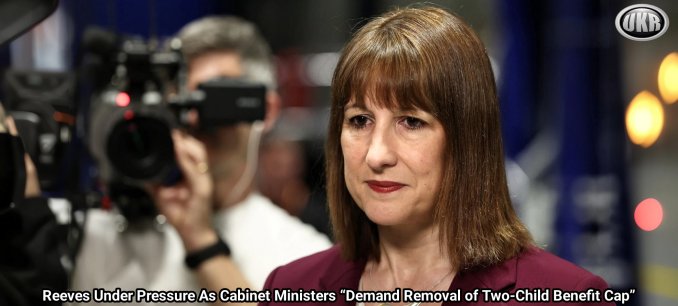
Cabinet Ministers are ramping up the pressure on Rachel Reeves to spend even more on welfare with a reported demand to lift the two-child benefit cap, as the Tories warn that the Chancellor is condemning Britain to an “economic doom loop”. The Mail has more.
Rachel Reeves is condemning Britain to an “economic doom loop” a senior Tory warned today, as the Chancellor reportedly faced another Labour demand to spend more on benefits.
Robert Jenrick warned the Chancellor would have to put up taxes in November’s Budget to fund plans for “crazy spending”.
The Shadow Justice Secretary made the warning amid reports that Cabinet Ministers will recommend Ms Reeves lifts the two-child benefit cap before the Budget on November 26th.
A child poverty taskforce, co-led by deputy Labour leadership contender Bridget Phillipson, will say that lifting the cap hated by backbench Labour MPs is the best way to improve lives, the Times reported.
However, it would come at a cost of around £3 billion to the Treasury, the Times reported, at a time when Ms Reeves is under pressure to balance the books.
It could be particularly controversial as Ms Reeves is said to be drawing up £30 billion of tax increases for the Budget.
Mr Jenrick said: “To fund this crazy spending, they have to break their promises and raise taxes and also borrow more.
“Rachel Reeves has hiked borrowing by £200 billion. So what is the result of this? Fewer jobs, higher inflation, more debt, the wealthy leaving, which all means lower economic growth.
Government sources said that no decisions had yet been made but said an announcement could be made either at or alongside the Budget, or even before.
Yesterday Ms Phillipson said the Government must go into the next General Election “having made serious strides in lifting children out of poverty”.
Asked whether she has been making the case behind the scenes on scrapping the two-child benefit cap, the Education Secretary told BBC Radio 5 Live: “You’ll appreciate, I’m not going to share private conversations, but I’ve been absolutely crystal clear that tackling child poverty is my number one priority in this contest.”
Ms Reeves on Monday also said the changes were “on the table”. But the Tories under Kemi Badenoch have vowed to keep the cap in place, arguing that lifting it is unaffordable.
Worth reading in full.
Farage, of course, has said Reform would also remove the two-child benefit cap – one of its most Left-wing policies to date, though in its case largely with an eye on the demographic crisis rather than child poverty.
If demographics is your worry though, the policy may backfire, at least from a defending British culture point of view, as welfare recipients with larger families are often more recent immigrants with stronger attachments to non-British cultures.
But what about child poverty – will it address that? Probably not – at least, not if you define it in terms of children having enough to eat.
The problem is, as the Spectator‘s Michael Simmons points out, the Government uses a relative measure of poverty, meaning what it means by ‘child poverty’ is not starving children, but economic inequality. This is why, according to the metric, “child poverty is now three times worse than it was in the 1970s, when three million lived in actual slums”. It’s also why this ‘child poverty’ would be largely ‘solved’ overnight if the wealthier half of the country just burned a chunk of their money. The ‘poor’ children would not actually be any better off, of course, but they’d no longer be in ‘child poverty’ as defined by the Government. Michael explains:
Relative poverty is defined as household income below 60% of the median. You might say that’s still something worth pointing out, but its effect is labelling more people poor whenever others get richer. To illustrate how flawed that metric is for measuring actual poverty, look to this example from the Times’s Tom Calver: the relative poverty metric would have us believe that child poverty is now three times worse than it was in the 1970s, when three million lived in actual slums.
The same reliance on this metric helps explain why the Government couldn’t get its welfare cuts through in the summer either. The Department for Work and Pensions impact assessment said the cuts would plunge 250,000 people into relative poverty. What Labour MP would vote for that? A metric that measures income inequality is going to block any reform that isn’t full-scale income redistribution.
If we use a more reliable metric for child poverty, ‘absolute poverty’, which sets the poverty point at 60% of incomes in 2010, we see that child poverty is down by around 75% over the same time period [since the 1970s]. That metric doesn’t provide much evidence that two child cap has made anything that much worse.

••••
The Liberty Beacon Project is now expanding at a near exponential rate, and for this we are grateful and excited! But we must also be practical. For 7 years we have not asked for any donations, and have built this project with our own funds as we grew. We are now experiencing ever increasing growing pains due to the large number of websites and projects we represent. So we have just installed donation buttons on our websites and ask that you consider this when you visit them. Nothing is too small. We thank you for all your support and your considerations … (TLB)
••••
Comment Policy: As a privately owned web site, we reserve the right to remove comments that contain spam, advertising, vulgarity, threats of violence, racism, or personal/abusive attacks on other users. This also applies to trolling, the use of more than one alias, or just intentional mischief. Enforcement of this policy is at the discretion of this websites administrators. Repeat offenders may be blocked or permanently banned without prior warning.
••••
Disclaimer: TLB websites contain copyrighted material the use of which has not always been specifically authorized by the copyright owner. We are making such material available to our readers under the provisions of “fair use” in an effort to advance a better understanding of political, health, economic and social issues. The material on this site is distributed without profit to those who have expressed a prior interest in receiving it for research and educational purposes. If you wish to use copyrighted material for purposes other than “fair use” you must request permission from the copyright owner.
••••
Disclaimer: The information and opinions shared are for informational purposes only including, but not limited to, text, graphics, images and other material are not intended as medical advice or instruction. Nothing mentioned is intended to be a substitute for professional medical advice, diagnosis or treatment.
Disclaimer: The views and opinions expressed in this article are those of the author and do not necessarily reflect the official policy or position of The Liberty Beacon Project.


Leave a Reply