

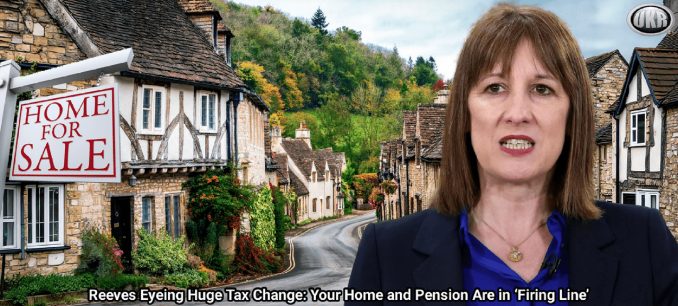
Rachel Reeves eyeing huge tax change and your home is in ‘firing line’
The Chancellor is reaching for any ideas that could help her fill her new £50 billion black hole – and Britons will pay the price.
Rachel Reeves has been accused of planning a new punishment tax on homeowners as she scrambles to fill a mega £50 billion black hole of her own creation. According to bombshell reports, the Chancellor is eyeing up two massive tax overhauls to both Stamp Duty and Council Tax, in an effort to rake in billions more for her spending priorities.
The Treasury is now looking at a major change to Britain’s property taxes, ahead of the Budget, which many argue are flawed as they reduce house sales and provide a highly inconsistent revenue stream for the government. However the Conservatives are warning that “the family home is next in the firing line” of tax-loving Labour. Shadow Chancellor Mel Stride blasted: “This tax grab would punish families for aspiring to own their own home. Under Labour nothing is safe. Your home, your job, your pension – the Chancellor has all of it in her sights.
Read more: Angela Rayner’s plan threatens millions of households with council tax hikes
“Rachel Reeves will tax your future to pay for her failure.”
The current Stamp Duty levy is paid by house buyers when purchasing a property over £125,000, or £500,000 for first-time buyers. From there, rates begin at 2% up to £250,00, 5% up to £925,000, 10% up to £1.5 million and 12% on anything beyond that.
Ms Reeves is instead looking at replacing this with a new simpler system, that would be paid by the property owners upon selling their house.
The national property tax would be paid by owner-occupiers on houses worth more than £500,000, directly collected by HMRC, while stamp duty would remain for purchases of second homes.
The Treasury believes that while this new system would raise similar amounts to Stamp Duty, it would be a more reliable and consistent source of revenue.
It would only affect around one in five house sales, compared to Stamp Duty applying to 60% of sales.
According to the Guardian Ms Reeves is also examining proposals for a radical overhaul of Council Tax, which could be replaced with an annual local property tax following the introduction of her proposed property tax.
Continue reading: The Express
See Related Video Below
Reeves’ rumoured property levy could add up to merely yet another tax on younger people
HENRY HILL
There is an interesting journalistic technique which is to place in close proximity to each other two facts or arguments which address related issues, and which the reader might assume to be connected, and then do nothing to dispel that illusion if it isn’t true. It seems to happen quite a lot in pieces about housing.
Last year I wrote a piece for CapX about one standout example of the form. The first six paragraphs of this Guardian piece talk about a sharp reduction in private-rented housing ahead of the passage of what was then the Renters’ Reform Bill causing uncertainty for tenants and, indeed, making people homeless; the rest of it is lambasting the delay and various quotes from campaign groups calling for an even tougher bill.
Any reader not intimately familiar with the economics of housing could be forgiven for thinking that passing the bill would solve the problem described in the headline (‘Landlords selling up leaving 2,000 households a month in England facing homelessness’), rather than it being the very prospect of the bill causing the problem in the first place.
It looks as if we might have another example in today’s Times. Today’s topic is a rumour that Rachel Reeves might be planning to scrap stamp duty (and possibly also council tax) and replace it with a house value tax, apparently inspired by a proposal from Onward:
“There are no firm details to the proposal, but it was reported that the Treasury was looking at suggestions from the centre-right think tank Onward, which would involve homeowners with properties worth more than £500,000 paying a 0.54 per cent annual tax on any value above £500,000.”
Furthermore:
“Any home worth more than £1 million would pay 0.81 per cent on the portion of its value over that threshold.”
So far, so fine. I dislike property taxation of this sort conceptually, and so will many other conservatives. But I dislike our current tax mix (grossly over-skewed towards working-age people and incomes) even more – and I did actually once make the case for one myself, albeit mostly as a stick with which to bludgeon people into voting for planning reform instead. But then we get to this bit:
“Onward’s proposals were that the new tax would not be applied retrospectively but would be paid by anyone who bought a home after it was introduced. The 5 per cent stamp duty surcharge for additional homes would remain and those owners would not pay annual levies.”
Can you detect the problem yet? If not, let’s skip a little further down to our present-but-not-involved argument:
“Some 85 per cent of homeowners in England and Wales were “under-occupiers” with one or more spare bedrooms, according to a survey of more than 4,300 by Barclays. Of those, 73 per cent were over 45, and 37 per cent were over 65. The proportion of homebuyers who were 45 or older has fallen from 45 per cent in the 2015-16 tax year to 39 per cent in 2023-24, according to the estate agency Savills.”
The presence of this is justified by the claim that abolishing stamp duty would encourage people to downsize. It is certainly true that abolishing or setting a high minimum threshold for stamp duty would help un-gum the market, to an extent; it has been a drag on moving since George Osborne turned it into a revenue measure.
But doing that doesn’t require a new value tax. It simply requires changing or abolishing stamp duty. The value tax itself isn’t going to do anything to under-occupiers, so-called, because it isn’t retroactive. (In fact, it could have itself a counter-productive effect in those parts of the country where the housing market is most acute, because anyone who sold up after the new regime was introduced would, unless their new home was worth less than £500,000, be trading a value-tax-exempt home for a taxed one.)
So what we end up with is a tax which falls not at all on those who have already reached the top of the housing ladder, but entirely on those currently climbing it (average age of a first-time buyer: 32) or who wish to climb it in future. It will also fall most heavily on places where housing is most expensive, such as London, where the average cost of a first-time purchase is now north of £500,000. (I say expensive, as opposed to valuable, because again: all existing housing wealth would be grandfathered in.)
One bit of good news is that Tim Leunig, the author of the original A Fairer Property Tax report, has at least remembered that inflation exists and thus to index-link the original £500,000 threshold; in his joint proposal this doubles as an index-link for local taxation levels, which would probably be unpopular but is more sensible than having council tax bands based on valuations from 1991.
This puts him ahead of whoever designed the Lifetime ISA, the thresholds of which were fixed in 2016; it has since lost more than a quarter of its buying power and become basically a bear-trap for young savers. (Seriously, the current design of that policy is evil and the Conservatives’ repeated failure to fix it indefensible.)
Yet there are some longer-term dangers we should note. The one merit of stamp duty, as a form of capital gains tax, is that it is a tax on realised gains; i.e. you only pay it when you sell, and you pay it proportionately to what you actually make in the sale. A house value tax, on the other hand, is a tax on unrealised gains: i.e. on what you would make, in theory, if you sold it. That is, generally, a bad idea.
There are mitigating circumstances in this case, namely that a) the percentage rate is (at least initially) very low and b) the asset in question, primary residences, is exempt from actual capital gains tax. Leunig’s proposals also avoid another obvious pitfall – disincentivising improvements which would increase value – by proposing simply that the levy “would rise annually by inflation”, rather than by any updated assessment on a home’s value, until it was sold.
Yet it does leave open the prospect of people being slowly squeezed for a ‘value tax’ which rises with inflation even if the actual value of their property goes down. That doesn’t currently happen much in England, but there are a few cases (e.g. people who bought shared-ownership properties).
But switching from taxing realised to unrealised gains also turns the housing tax into a general, annual revenue tax – and we all know the only trajectory those are heading in. There is nothing fixing those initial rates of 0.54 and 0.81 per cent, beyond the will of the government of the day. That might be fine if it was a universal property tax, but it could end up being perverse if it ends up being yet another way to raid the incomes of younger generations – as older voters’ homes would be exempt, making it easier to hike – and a policy spun as targeting ‘under-occupiers’ ended up as yet another impediment, amongst many, to working-age people getting the home they want.
This article (Reeves’ rumoured property levy could add up to merely yet another tax on younger people) was created and published by Conservative Home and is republished here under “Fair Use” with attribution to the author Henry Hill
*****
Brace Yourself… They’re Coming for Everything You’ve Got
HUGE new taxes coming soon
WATCH:

••••
The Liberty Beacon Project is now expanding at a near exponential rate, and for this we are grateful and excited! But we must also be practical. For 7 years we have not asked for any donations, and have built this project with our own funds as we grew. We are now experiencing ever increasing growing pains due to the large number of websites and projects we represent. So we have just installed donation buttons on our websites and ask that you consider this when you visit them. Nothing is too small. We thank you for all your support and your considerations … (TLB)
••••
Comment Policy: As a privately owned web site, we reserve the right to remove comments that contain spam, advertising, vulgarity, threats of violence, racism, or personal/abusive attacks on other users. This also applies to trolling, the use of more than one alias, or just intentional mischief. Enforcement of this policy is at the discretion of this websites administrators. Repeat offenders may be blocked or permanently banned without prior warning.
••••
Disclaimer: TLB websites contain copyrighted material the use of which has not always been specifically authorized by the copyright owner. We are making such material available to our readers under the provisions of “fair use” in an effort to advance a better understanding of political, health, economic and social issues. The material on this site is distributed without profit to those who have expressed a prior interest in receiving it for research and educational purposes. If you wish to use copyrighted material for purposes other than “fair use” you must request permission from the copyright owner.
••••
Disclaimer: The information and opinions shared are for informational purposes only including, but not limited to, text, graphics, images and other material are not intended as medical advice or instruction. Nothing mentioned is intended to be a substitute for professional medical advice, diagnosis or treatment.
Disclaimer: The views and opinions expressed in this article are those of the author and do not necessarily reflect the official policy or position of The Liberty Beacon Project.


Leave a Reply