

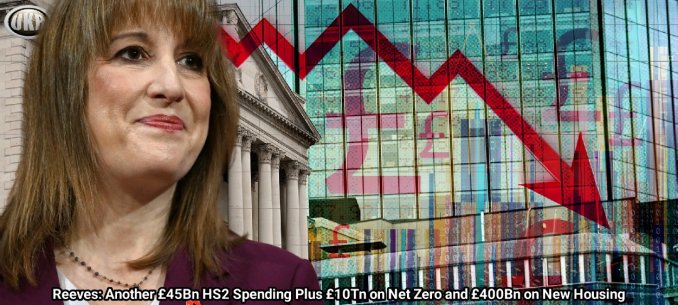
UK – “Rachel from accounts” -creates another £45 billion HS2 SPENDING by 2035 on top of £10 trillion of “net zero” spending by 2050, and £400 billion on a million new “green houses”
Don’t forget that the UK now spends £100-150 billion pounds a year just on the interest on its national debt, before any of these spending plans are engaged – another trillion very ten years!
PETER HALLIGAN
Reeves is resurrecting plans for a high-speed rail link across the north of England.
The concept of “opportunity cost continues to by-pass the mental midgets in government that develop policies via juvenile left-wing focus groups.
HS2 (high speed 2) is described thus by Brave AI “… It is a major infrastructure project in the United Kingdom aimed at building a new high-speed railway to connect London with major cities in the Midlands and the North of England, including Birmingham, Manchester, and Leeds. The project was originally planned as a Y-shaped network but has been significantly scaled down. As of 2026, only the London to Birmingham section (Phase 1) remains active, with construction ongoing.
The planned extension to Manchester and Leeds (Phase 2) was cancelled in 2023. Despite delays and cost overruns, the project is still progressing. However, no trains are expected to run on the route before 2029, with the current target for Phase 1 completion now between 2029 and 2033. The northern extensions to Manchester and Leeds were scrapped in October 2023, leaving only the London–Birmingham section in active development.
“HS2 cost overruns have escalated dramatically since the project’s inception, with estimates now reaching £100 billion or more, far exceeding the original 2012 forecast of £20 billion. The current cost for the London–Birmingham phase alone is projected between £67 billion and £83 billion in 2025 prices, with completion delayed beyond 2033 and now expected in the mid-2030s.
“Key Reasons for Cost Overruns:
· Build-first, design-later culture: Contracts were issued before final designs were complete, leading to costly revisions and rework. This was confirmed by Mark Wild, CEO of HS2 Ltd, before the Transport Select Committee in July 2025.
· Scope creep and repeated redesigns: Changes in route, increased tunneling, and major upgrades at Euston station significantly inflated costs.
· Inflation and rising material costs: Construction costs rose by 27% over three years, driven by increases in steel, concrete, and labor.
· Poor contract structures: The use of cost-plus contracts removed incentives for contractors to control costs, as the government guaranteed most unforeseen expenses.
· Inadequate oversight and governance: A “litany of failure” was identified in reports by James Stewart and Mark Wild, citing weak project control, poor supply chain performance, and misaligned incentives.
· Planning delays and political interference: Local opposition and slow planning approvals caused delays, while government funding constraints forced schedule slowdowns, increasing costs.
Al sounds so familiar – bad planning and poor oversight.
Labour now intends to resurrect the northern part of the HS2 project “capping” costs at £45 billion (yes really!).
“Labour has announced plans to restart a key section of the HS2 project, but not as originally conceived. On January 13, 2026, the government confirmed it will proceed with the Northern Powerhouse Rail (NPR) project, a major rail upgrade across northern England, with a £45bn funding commitment. This includes plans to build a new rail line between Birmingham and Manchester, described as a “long-term intention” and referred to as HS2-lite.
“Key elements of the plan:
· Phase 1: Upgrade TransPennine links, including a new station in Bradford.
· Phase 2: Build a new line connecting Liverpool and Manchester via Manchester Airport and Warrington—following part of the former HS2 route.
· Phase 3: Improve connections across the Pennines between Manchester, Leeds, Sheffield, and York.
· Manchester Piccadilly: A potential underground station remains under discussion, though its cost is a major concern.
“While the government has not yet committed new funds specifically for the Birmingham–Manchester line, it will be funded within the overall £45bn NPR envelope. Local mayors may need to contribute via business rates or borrowing.
“The £45 billion envelope includes both immediate and long-term funding commitments:
· £1.1 billion has been allocated in the current Spending Review period to advance planning, design, and development work, including creating a detailed delivery plan with timelines.
· This initial funding supports early “quick wins”, such as electrification and upgrades to reduce journey times between major city pairs like Leeds and Bradford, and Leeds and York.
· The full envelope allows for a phased rollout, with benefits expected to be felt by the early 2030s, even before the entire network is complete.
The Treasury has emphasized that the project will remain within this fair funding cap, though local contributions—such as business rate supplements—could potentially supplement the total.
A ten-year project that is scheduled for completion under two NEW governments – Labour is on track to lose the next 2029 general election, with a further general election due in 2034. There are no signs of support or opposition from any party (not the Greens, Lib/Dems, Reform or the “Tories”.
One can only hope they learn from overseas experience like this for California:
They spent $128 billion on high-speed rail – but never used it | Watch
“California’s high-speed rail project was sold as a transformational leap forward, promising a fast, clean connection between San Francisco and Los Angeles by 2020.
More than a decade later, billions of dollars have been spent, yet no trains are running and no continuous line exists. We break down how legal battles, land acquisition fights, political shifts, and federal funding cuts turned an ambitious vision into one of the most controversial infrastructure projects in American history.
Looking at what has actually been built so far, and how other countries manage to do the same thing faster and cheaper, raises a much bigger question about whether the United States can still deliver projects at this scale.
Or the UK for that matter!
Here are some country comparisons:
“Building 100 miles of railroad varies significantly by country and project type, with costs influenced by terrain, infrastructure complexity, labor, and regulatory environments.
United States:
U.S. rail projects cost $118 million per mile on average for non-tunneled projects and up to $1.2 billion per mile for fully underground lines (excluding New York City). For a 100-mile project, costs range from $11.8 billion (surface-only) to $120 billion (fully tunneled). This reflects higher labor costs, union work rules, and regulatory delays.
Europe:
European projects average $81 million per mile for low-tunnel projects and $346 million per mile for fully tunneled lines. A 100-mile project in Europe would cost $8.1 billion (surface) to $34.6 billion (underground), with lower labor and benefit costs due to nationalized healthcare and pensions.
China:
China’s high-speed rail infrastructure costs $17–21 million per mile (equivalent to $17–21 million per km), with a high ratio of tunnels and viaducts. A 100-mile project would cost $1.7–2.1 billion, significantly lower than in the U.S. or Europe.
United Kingdom:
The HS2 project costs $307 million per mile (approximately £307 million), making it one of the most expensive rail projects globally. A 100-mile stretch would cost $30.7 billion.
Other Notable Projects:
· Fehmarnbelt Fixed Link (Denmark/Germany): $10.5 billion for 18 km (11 miles), or $955 million per mile.
· Brenner Base Tunnel (Austria/Italy): Estimated at $11 billion for 55 km (34 miles), or $324 million per mile.
· Etihad Rail (UAE): $11 billion for 745 miles, or $14.8 million per mile.
In summary, building 100 miles of railroad can cost as little as $1.7 billion in China to over $30 billion in the UK, depending on alignment, tunneling, and national cost structures.
Hre’s numbers for Japan:
· “The original Tōkaidō Shinkansen (Tokyo–Osaka), opened in 1964, had a construction cost of ¥380 billion (about $1.8 trillion in today’s money) for 515.4 km (320 miles), equating to roughly $5.6 million per km or $9 million per 100 miles when adjusted for inflation.
· More recent projects show higher costs: the Hokkaido Shinkansen cost about $31 million per km (~$50 million per 100 miles), while the Kyushu Shinkansen was completed for $23 million per km (~$37 million per 100 miles).
· The upcoming Chuo Shinkansen maglev line (Tokyo–Nagoya) is projected to cost $55 billion for 286 km (177 miles), or about $310 million per 100 miles—significantly higher due to tunneling and advanced technology.
Europe costs $81 million per 100 miles of track, China, $20 million, $310 million for Japan and $310 million for the UK.
Onwards!
PLEASE take a paid subscription or follow/recommend my site to others you think might be interested. You may also donate via Ko-fi – (any amount three dollars and above here): https://ko-fi.com/peterhalligan
This article (UK – “Rachel from accounts” -creates another £45 billion HS2 SPENDING by 2035 on top of £10 trillion of “net zero” spending by 2050, and £400 billion on a million new “green houses”) was created and published by Peter Halligan and is republished here under “Fair Use”

••••
The Liberty Beacon Project is now expanding at a near exponential rate, and for this we are grateful and excited! But we must also be practical. For 7 years we have not asked for any donations, and have built this project with our own funds as we grew. We are now experiencing ever increasing growing pains due to the large number of websites and projects we represent. So we have just installed donation buttons on our websites and ask that you consider this when you visit them. Nothing is too small. We thank you for all your support and your considerations … (TLB)
••••
Comment Policy: As a privately owned web site, we reserve the right to remove comments that contain spam, advertising, vulgarity, threats of violence, racism, or personal/abusive attacks on other users. This also applies to trolling, the use of more than one alias, or just intentional mischief. Enforcement of this policy is at the discretion of this websites administrators. Repeat offenders may be blocked or permanently banned without prior warning.
••••
Disclaimer: TLB websites contain copyrighted material the use of which has not always been specifically authorized by the copyright owner. We are making such material available to our readers under the provisions of “fair use” in an effort to advance a better understanding of political, health, economic and social issues. The material on this site is distributed without profit to those who have expressed a prior interest in receiving it for research and educational purposes. If you wish to use copyrighted material for purposes other than “fair use” you must request permission from the copyright owner.
••••
Disclaimer: The information and opinions shared are for informational purposes only including, but not limited to, text, graphics, images and other material are not intended as medical advice or instruction. Nothing mentioned is intended to be a substitute for professional medical advice, diagnosis or treatment.
Disclaimer: The views and opinions expressed in this article are those of the author and do not necessarily reflect the official policy or position of The Liberty Beacon Project.


Leave a Reply