

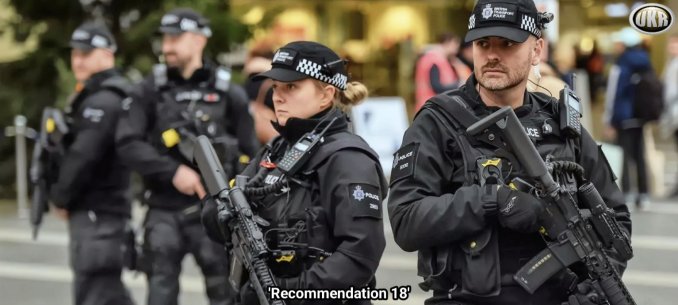
A call to arms? I don’t think so.
DOMINIC ADLER
A ‘secret report’ reveals the Met recently discussed arming patrol officers with handguns.
The Daily Telegraph has published an article revealing how the Metropolitan Police has, once again, considered routinely arming its officers. It was never going to happen, but ‘blue-sky’ post-incident reviews are required to explore every option. Senior managers are then able to say, straight-faced, they considered something they never really intended to do. While, of course, not changing much.
This time, ‘Recommendation 18’ was made during an officer safety ‘near-miss’ review, following an incident in 2022. Two police officers were stabbed in Leicester Square. One received life-changing injuries. The review admitted that:
[H]istorically, safety training for officers had been “unrealistic” and “stagnant” by concentrating on “isolated technical aspects of skills” rather than “realistic goal orientated training which allows the free thinking and problem solving of officers to come into effect”.
Absolutely. I wrote about the questionable efficacy of UK police officer ‘safety’ training here.
Recommendation 18 suggested:
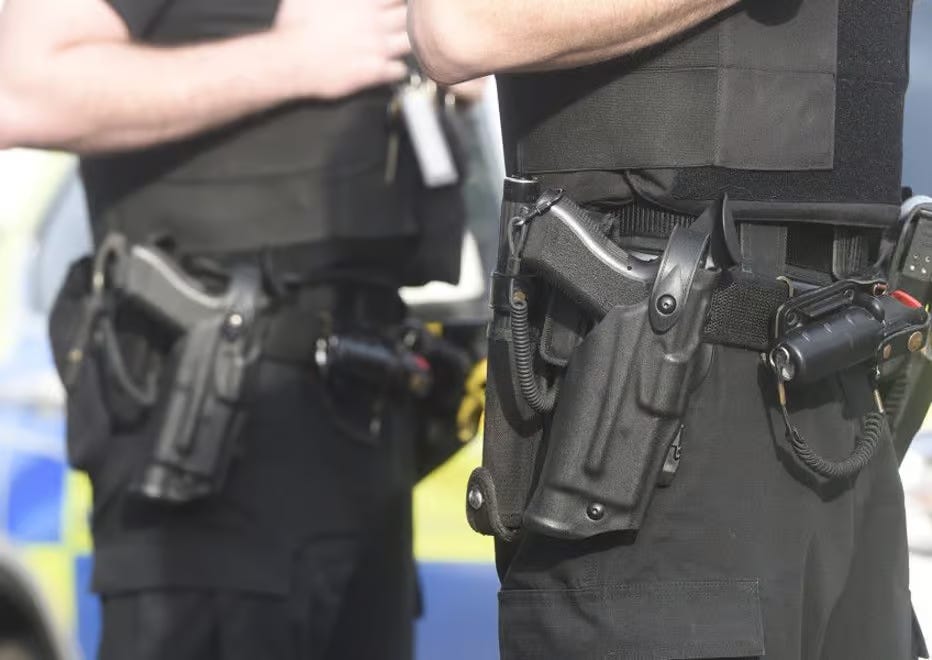
Officers carrying and trained in the use of a self loading pistol (SLP)
The advantages of the SLP is that it will remain on the officers’ belt equipment and would not require the adoption of vehicle firearm safes.
Not to be used proactive but able to use when faced with a spontaneous threat.
This will not affect the work of dedicated firearms units (MO19) and in practice will work in the same manner as BCU officers carrying TASER.
Hmmm. ‘Not to be used proactively.’ I was a ‘defensively armed’ AFO back in the day (read about it here). I’d suggest it isn’t quite that simple. Those words, along with ‘when faced with a spontaneous threat’, will keep lawyers, activists and public inquiries in clover for generations to come.
Which is my way of saying either train all police officers to the same (very high) standards… or don’t arm them at all. We don’t recruit our police on account of their suitability to carry firearms. Which is to say, if it became a determining factor we’d lose people who’d otherwise make excellent police officers. Right now? There are coppers out there I wouldn’t trust to look after a goldfish, but we give them tasers and batons and handcuffs anyway. As it is, our armed officers show remarkable restraint. Let’s keep it that way.
Nonetheless, we see stuff like Recommendation 18 thrown around as a sop to advocates of routine arming. ‘At least we thought about it, okay?’ After 9/11, for example, the whole Met heard the rumour SCO19 were about to buy thousands of Glocks and give us all a crash course in shooting things. Of course, it never happened.
At this point, given I’m going to gently critique the pro-arming lobby’s position, I’d like to emphasize this isn’t some sort of fundamental doctrinal schism. I don’t think those suggesting a fully-armed Met are necessarily ‘wrong’ – in fact many proponents offer perfectly valid arguments. I agree police are, when necessary, entitled to use lethal force. I agree the situation regarding officer safety is unacceptable. And I agree the poor bloody infantry – the patrol or response officer – is disproportionately affected by spontaneous outbreaks of violence (which usually involve knives). I also believe, unambiguously, that (as Sean Connery says in ‘The Untouchables’) anyone bringing a knife to a gunfight probably deserves to be shot.
I am, ultimately, a doughty proponent of FAFO.
I simply think if arming is our direction of travel, then Recommendation 18 is laughably – even dangerously – optimistic. The entire culture, policing style, training and deployment of police officers will change irrevocably. Weapons will be lost and stolen. Officers will commit suicide. There will be out-of-policy shootings – look at how contested shootings by highly trained firearms professionals are (by the establishment, incidentally, if not by juries). Yes, there’s also a cost / benefit analysis involving lives going on here. Which, if you think about it, is another reason why police officers are ridiculously underpaid.
So this stuff is important. It must be discussed in the public square. And, crucially, it’s a conversation that needs to take place with the general public – i.e. you and me, the policed. This isn’t to say the voices of our hand-wringing legal, media and political classes should be over-amplified – in fact the opposite is true.
Remember, I’m a small ‘c’ conservative on many issues and certainly no bleeding heart. This is possibly why I think there are better solutions to this problem. There’s stuff we could change that would make us all safer. Stuff that doesn’t involve every British police officer carrying a gun.

Hainault, Northeast London, 2024. Unarmed officers were called to deal with a man carrying a sword, who’d killed a 14-year old boy. They subdued him with Taser, but several officers were injured. How do the police deal with such incidents? Is it fair to expect them to be unarmed? There’s no such thing as an ‘unfair advantage’ in such a situation.
At this point, given he broke the Recommendation 18 story, I’ll respond to Rory Geoghegan’s comments. Rory was a police officer who subsequently became a political advisor and think-tanker (an unusual post-service career move for a young copper!). I highly recommend his Substack article covering this topic, which provides a compelling examination of the issues. In today’s Telegraph, titled The fatal folly of Britain’s unarmed policing model, he also advocates a fully-armed UK police service.
Rory begins by examining recent stabbings, including the Hainault incident mentioned above. He cites shabby officer training and ‘systemic neglect’ in operational doctrine. On this, I am with him one hundred percent. For example, he mentions how:
In Enfield, where another officer was stabbed, local commanders lamented that firearms officers were withheld because decision-makers deemed deploying armed officers to be “disproportionate” and that unarmed colleagues could handle it.
Yes, this sounds entirely familiar. Isn’t, though, an answer involve overhauling the risk-averse command and control models police services use? The control room General Melchetts controlling firearms deployments should be addressed before issuing everyone guns. This is a theme I shall return to – should routine arming be the answer to systemic management and doctrinal failure?
He continues:
And in Hainault, as 14-year-old Daniel Anjorin was murdered and officers gravely injured, Pava spray was fired five times with almost no effect, an inspector struck at a sword with his baton, and a tourniquet had to be fetched from a car bag while blood poured from a colleague’s wound.
This is not policing by consent. It is policing by gamble.
Powerful stuff, and difficult to argue against. Although there are other non-lethal options. Why aren’t response officers issued ballistic shields? Baton guns? Local-level tactical teams? Or, alternatively, officers could simply have shot the suspect. Which would have been fair enough. FAFO.
However… that means arming everyone, all of the time. It means changing the entire nature of UK policing, putting officers on a permanent tactical posture. It’s a Rubicon we cross only once.
Where I suspect Rory and I would agree is that policy-makers, and the public, need to swallow a reality pill. We ask police officers – especially response cops – to take risks on our behalf. Very occasionally, that involves facing utter loons carrying samurai swords. The question is, how do they deal with them? If, as a society, we aren’t prepared to accept local police might carry more offensive – albeit nonlethal – equipment, then perhaps we do deserve a fully armed service.
Rory also adds:
Critics of arming insist that Britain’s policing culture is unique, that a sidearm on the hip would corrode trust. But Northern Ireland proves otherwise. There, officers patrol with firearms as a matter of course, yet retain public support.
Having witnessed policing in Northern Ireland, I would respectfully suggest this is an apples-and-oranges comparison (I know few British officers required to check under their cars for IEDs, or get shot in front of their kids at football practice). Rory, to be fair, also cites continental European police forces carrying guns. That’s a better argument, although I’d reply many municipal forces in Europe – under a classic three-tiered continental policing model, are unarmed.
He hits the nail on the head here, though:
Yet ministers and senior police chiefs remain paralysed by nostalgia and anti-police activists, clinging to a model that no longer fits the reality of modern Britain.
When it comes to guns, however, this isn’t a mutually exclusive argument. Ask any veteran of the Territorial Support Group, who excel at risky, nonlethal interventions. Why Basic Command Units don’t have a local version is beyond me. Well, it isn’t really. It’s because of the spineless management Rory mentions.
And, lastly, Rory says:
Britain’s police deserve more than respectful applause at funerals and platitudes about bravery. They deserve leaders – political and professional – willing to confront reality. Bravery should be matched with competence, with training, with equipment, and yes, as the Met’s own secret review in 2022 called for: serious consideration of routine arming.
Again, we’re agreeing but not quite agreeing. Is a gun a magic bullet (see what I did there) for ‘competence, training and equipment’?

There’s a reason why UK police have an excellent firearms safety record – training, selection and… more training. Most AFOs I know argue that still isn’t enough time on the range.
This is an interesting debate, because I’m in broad agreement with the sentiments behind Rory Geoghegan’s argument. Yet I disagree materially on his conclusion. How, then, should UK police forces reform their officer safety models and what I’ll call ‘nonlethal tactical doctrine’?
Culture
Baroness Casey’s head might explode, but controlled aggression and use of force are essential features of policing. As things stand, police officers are now scared to routinely use lawful force. In doing so, they ironically invite violence. Put simply, there are too many scrotes who’ll behave badly unless they know they’re likely to get a corrective slap. This is sometimes called ‘robust policing.’ It’s what you see in social media video clips celebrating dickheads getting a comeuppance for antagonizing French or German cops.
As for The Guardian, BBC, IOPC (etc). Well, you killed that model of policing with ‘kindness’ and created a generation of younger people calling for routine arming. Well done, Tarquin. Off to the plant-based buffet with you.
Training and Doctrine
All police officers – and especially first responders – should receive comprehensive, team-based nonlethal tactical doctrine training for violent situations. This should, like any effective training, be frequent. It will require new equipment, doctrine and a more intensive training cycle, but compared to firearms? It’s small beer.
Equipment
Baton guns. Tasers. Beanbag-firing shotguns or bloody cattle-prods for all I care. These should be BCU assets, stored in a patrolling vehicle equipped with shields, helmets and armour. Response officers called to a violent scenario deserve access to proper kit. Devolve authority levels appropriately, too – i.e. police constable.
Dogs
Amazing force multiplier which often deescalate situations (scrotes tend to shit themselves when they see land-sharks). Put a dog van on EVERY BCU 24/7.

Any excuse to post a picture of a doggo.
Leadership
Tactical nonlethal deployment qualifications should be mandatory for all uniformed supervisors, up to the rank of chief inspector. Leadership, not management. The police urgently require a national facility (that doesn’t involve the College-of-fucking-Policing) dedicated to delivering such training.
Firearms
Yes, the irony of increasing the number of firearms officers decreasing the need for… firearms. Dichotomy alert! The police firearms empire is overly-dedicated to specialisation. Notice how there’s always resources to protect politicians using heavily-armed police tactical units. Funny that, eh? Armed response vehicles should be devolved, as per my suggestion with dog units. Guns aren’t forbidden sorcery, intended only for a self-selecting elite. They are tools for a job.
Sentencing and Mental Health care
Some things are beyond police control. If you let violent criminals out of prison, or don’t lock them up in the first place? You need someone to deal with them. As for mental health? Ever since ‘care in the community’ in the 1990s, British police forces have acted as mental health auxiliaries for the NHS. An honest conversation about residential detention for MH patients with a propensity for violence is also long overdue.
These are only a few ideas. The problem is they’d make the current cohort of chief constables retch. They really, really would prefer to be coordinating Macarena teams for next year’s Pride.

Not a great look, in my opinion. But this is the direction of travel if we don’t accept the current model’s broken.
My conclusion? Routine arming would create a whole new layer of problems for the average police officer and the public they’re charged with protecting. The State, on the other hand, fails miserably at every turn. Their failure to fulfill a basic function – security – feeds the demand for armed police. Their risk-aversion and visceral rejection of a simple, ugly reality – that the world is violent – makes matters worse.
Should police have more tactical options? Yes. Should police have more access to firearms support as one of those options? Yes. Should every patrol officer carry a gun? I think not.
One day they probably will. Maybe I’m naive, but I think that day’s worth delaying, for as long as possible. You can believe that and demand coppers are given better tools, protection and support. All of us with an interest in this debate should concentrate our efforts on the real problem – a querulous policing culture, broken criminal justice system, cowardly chief constables and not-even-mediocre politicians.
We all suffer their weakness, which is partly why our political system is close to collapse.
Then we’ll all need guns.
This article (‘Recommendation 18’) was created and published by Dominic Adler and is republished here under “Fair Use”

••••
The Liberty Beacon Project is now expanding at a near exponential rate, and for this we are grateful and excited! But we must also be practical. For 7 years we have not asked for any donations, and have built this project with our own funds as we grew. We are now experiencing ever increasing growing pains due to the large number of websites and projects we represent. So we have just installed donation buttons on our websites and ask that you consider this when you visit them. Nothing is too small. We thank you for all your support and your considerations … (TLB)
••••
Comment Policy: As a privately owned web site, we reserve the right to remove comments that contain spam, advertising, vulgarity, threats of violence, racism, or personal/abusive attacks on other users. This also applies to trolling, the use of more than one alias, or just intentional mischief. Enforcement of this policy is at the discretion of this websites administrators. Repeat offenders may be blocked or permanently banned without prior warning.
••••
Disclaimer: TLB websites contain copyrighted material the use of which has not always been specifically authorized by the copyright owner. We are making such material available to our readers under the provisions of “fair use” in an effort to advance a better understanding of political, health, economic and social issues. The material on this site is distributed without profit to those who have expressed a prior interest in receiving it for research and educational purposes. If you wish to use copyrighted material for purposes other than “fair use” you must request permission from the copyright owner.
••••
Disclaimer: The information and opinions shared are for informational purposes only including, but not limited to, text, graphics, images and other material are not intended as medical advice or instruction. Nothing mentioned is intended to be a substitute for professional medical advice, diagnosis or treatment.
Disclaimer: The views and opinions expressed in this article are those of the author and do not necessarily reflect the official policy or position of The Liberty Beacon Project.


Leave a Reply