

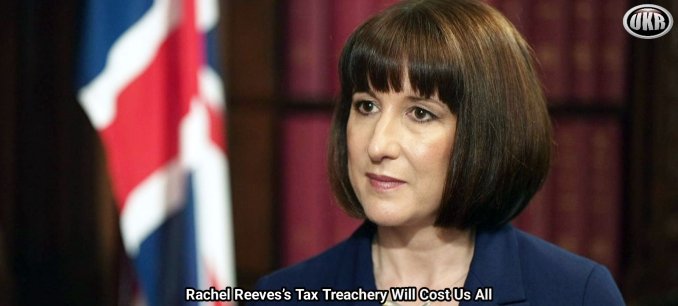
Rachel Reeves’s tax treachery will cost us all
REEM IBRAHIM
The pre-Budget speculation continues. How on earth is Rachel Reeves going to find £30 billion without breaking the manifesto pledge?
In her speech earlier this week, which in itself was rather unprecedented, Reeves set the stage for tax rises that would, probably, break the pledge. Page 21 of the Labour Party manifesto last summer read:
The Conservatives have raised the tax burden to a 70-year high. We will ensure taxes on working people are kept as low as possible. Labour will not increase taxes on working people, which is why we will not increase National Insurance, the basic, higher, or additional rates of Income Tax, or VAT.
These were very specific promises, and have not left Reeves with many options. She hiked employers’ national insurance contributions, which, along with the minimum wage increases and the incoming Employment Rights Bill, had some pretty disastrous effects on the labour market.
The Bank of England published its Decision Maker Panel survey in September, which surveys Chief Financial Officers from small, medium and large UK businesses. Firms reported that the NIC hike did mean they had to employ fewer people, and for those that were already employed, slower wage growth.
The proof is in the numbers. The estimated number of vacancies fell by 9,000 in July to September 2025. According to the ONS, average wage growth was down from 4.8% to 4.7% over the three months to July.
So far, the impact of Reeves’s tax hikes (combined with other bad policies) has made the fiscal situation even worse. The result has been fewer jobs, lower wages, and in the long run, slower economic growth.
But we still have a fiscal deficit of about 5.1% of GDP. Instead of spending cuts, which is what should be done, Reeves has reportedly informed the spending watchdog that she intends to raise income tax in the upcoming budget.
According to reports, the Treasury is considering a 2p rise in income tax.
Raising income tax would be one of the most economically damaging routes to take. Higher taxes on income blunt the incentives to work, save and invest, and have corrosive effects on economic growth. For middle-income earners already squeezed, a hike would mean less disposable income, reduced consumer spending and overall, lower productivity.
As wages are stagnating, and employers are less keen to take a gamble on hiring new people, raising income tax would sting the ‘working people’ the Government claims to champion. It would sap the dynamism out of the labour market (or what’s left of it) and make it even harder for families to build financial security or climb the income ladder.
In short, it punishes aspiration at a time when Britain desperately needs to reward it.
Income tax thresholds are frozen until 2028, and so in effect, income tax is already rising. As inflation eats away at our wages, more and more people are being dragged into paying more income tax.
If the basic rate of income tax is increased, which is currently at 20%, Reeves will be the first Chancellor to do so since Labour Chancellor Denis Healey did in 1975.
Perhaps there are some lessons to be learnt from Healey. Many comparisons have been made between the economic despair this country faced in the 1970s and the malaise we find ourselves in today. With strike action, out-of-control public spending and tax hikes, the parallels are clear. ‘Goodbye, Great Britain: it was nice knowing you’, read a Wall Street Journal headline in April 1975.
Healey, like Reeves today, inherited an economy that had been mismanaged by the Conservatives, but managed to make it even worse with high spending and taxation. In 1976, Britain went bust, and Healey went to the International Monetary Fund, cap in hand, to apply for a record $3.9bn loan.
It marked a new low point for Britain, and should still serve as a stark reminder that the Government cannot max out the nation’s credit card forever. Healey was ultimately forced to cut public spending, and the markets recovered.
The key lesson taught by the ghost of Healey is this: as far as the markets are concerned, spending cuts are far more powerful at installing business confidence than tax hikes.
If Reeves ignores that lesson, she risks repeating one of Britain’s gravest economic mistakes. The path to prosperity does not lie in squeezing workers and businesses ever tighter, but in restoring confidence through reducing the size of the state. Britain can’t afford another 1976 moment, and this time, there may be no IMF waiting to bail us out.
Click here to subscribe to our daily briefing – the best pieces from CapX and across the web.
CapX depends on the generosity of its readers. If you value what we do, please consider making a donation.
This article (Rachel Reeves’s tax treachery will cost us all) was created and published by CapX and is republished here under “Fair Use” with attribution to the author Reem Ibrahim

••••
The Liberty Beacon Project is now expanding at a near exponential rate, and for this we are grateful and excited! But we must also be practical. For 7 years we have not asked for any donations, and have built this project with our own funds as we grew. We are now experiencing ever increasing growing pains due to the large number of websites and projects we represent. So we have just installed donation buttons on our websites and ask that you consider this when you visit them. Nothing is too small. We thank you for all your support and your considerations … (TLB)
••••
Comment Policy: As a privately owned web site, we reserve the right to remove comments that contain spam, advertising, vulgarity, threats of violence, racism, or personal/abusive attacks on other users. This also applies to trolling, the use of more than one alias, or just intentional mischief. Enforcement of this policy is at the discretion of this websites administrators. Repeat offenders may be blocked or permanently banned without prior warning.
••••
Disclaimer: TLB websites contain copyrighted material the use of which has not always been specifically authorized by the copyright owner. We are making such material available to our readers under the provisions of “fair use” in an effort to advance a better understanding of political, health, economic and social issues. The material on this site is distributed without profit to those who have expressed a prior interest in receiving it for research and educational purposes. If you wish to use copyrighted material for purposes other than “fair use” you must request permission from the copyright owner.
••••
Disclaimer: The information and opinions shared are for informational purposes only including, but not limited to, text, graphics, images and other material are not intended as medical advice or instruction. Nothing mentioned is intended to be a substitute for professional medical advice, diagnosis or treatment.
Disclaimer: The views and opinions expressed in this article are those of the author and do not necessarily reflect the official policy or position of The Liberty Beacon Project.


Leave a Reply