

KIT KNIGHTLY
I’m starting to think a full-scale, nationwide compulsory digital ID won’t ever be a thing. Not officially, anyway. Not for quite a while.
It’s a vibe I feel coming off the news that gels more with the current methodology – the indirect authoritarianism of the easier path. Piecemeal tyranny washed in on waves of convenience.
According to a 2023 report (which resurfaced last week for some reason), in the near future, British citizens will likely need electronic “Carbon Passports” to travel. These will be digital documents that track and limit your travel based on carbon emissions.
During Covid, digital “vaccine passes” were needed to differentiate those who had been vaccinated from those who had not. If and when another “pandemic” rolls around, they will be used again.
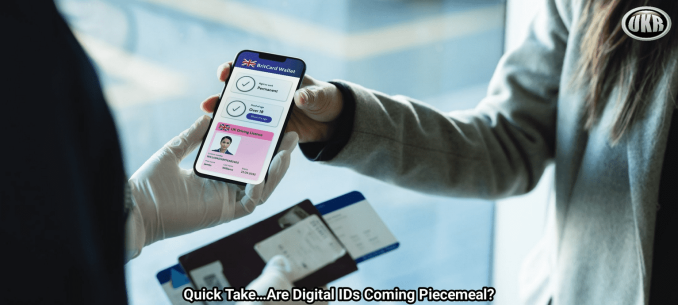
From the end of this year, British driver’s licenses will be digital and accessed through the government’s wallet app. In the future, your road tax will be paid via GPS tracking of your car, linked to your driver’s license.
Late last year, the government began replacing previous immigration documents with “eVisas”, a process which is due to complete before the end of 2025.
The Online Safety Act has brought in widespread age verification online. Wouldn’t that be so much easier if we had a government app, like the one being trialled in the EU, which verifies your age “whilst keeping all other personal information private”?
In short, even before we officially have the infamous Digital ID, every interaction with the state is being digitised via an app on your phone, which you likely carry around with you all day, every day.
It must be taken entirely on trust that the app which tracks your international travel, the app which tracks your car, the app which tracks your taxes, the app which tracks your immigration status, the app which tracks your health records and the app which verifies your age are all entirely separate.
Do you truly believe they are?
The fact of the matter is that, in one form or another, every proposed usage of digital ID scheme either already exists or will do so in the near future.
The only reason to formally unify it into a single mandatory ID badge would be normalisation, a watermark transformation of the mental and emotional relationship between citizen and state.
I’m beginning to think we will have digital ID – brought in a little at time – for years before anyone in power decides to call it by its true name
And they won’t do that until they’re asked.
Starmer’s proposed national ID scheme may be theatrically scrapped, a development which could be sold as a massive win for human rights even while the digital ID infrastructure remains.
In the intervening years, the performatively “separate” apps and trackers and forms will be plagued by much-publicised “inefficiencies”, which columnists will complain “cost the taxpayer millions in the name of mythical privacy”. Campaigns will call for “a more unified digital system” which “boosts interdepartmental communication” in the name of “increasing efficiency and cutting administration costs”.
…And then they’ll pull back the curtain, and announce the “streamlined” digital identity service, which will have existed for years but never been acknowledged.
But maybe I’m wrong. It could be the introduced tomorrow.
This article (Quick Take…Are Digital IDs coming piecemeal?) was created and published by off Guardian and is republished here under “Fair Use” with attribution to the author Kit Knightly
See Related Article Below
“Starmer orders move towards digital ID system” – report
#together
Flailing, failing Keir Starmer has just let it be known he plans to impose a compulsory national digital ID scheme on us all.
Will you please join us as a member HERE to support the fight against this?
Starmer has used a write-up in the Observer to effectively announce this. Key passages include:
“The prime minister is seriously considering introducing a universal digital ID system…
Cabinet ministers say Starmer has become increasingly convinced of the need…
Downing Street is now considering in detail the “workability” of a unique digital identifier for all residents…
…a No 10 source said any hurdles were practical, not philosophical…
A report from the Starmerite think tank Labour Together recently called for No 10 to make digital ID a “top prime ministerial priority” and begin a “fundamental transformation in the way British citizens interact with the government”…
A new internal paper by the Tony Blair Institute on the role of technology in government, commissioned by Morgan McSweeney, Starmer’s chief of staff, is understood to be “forceful” in pressing the case for digital ID as a way of meeting voters’ demands and heading off the threat from Reform UK.”
Needless to say, imposing a national digital ID system was nowhere in Labour’s manifesto – as Home Secretary Yvette Cooper pointed out herself, while denying this would happen shortly after the election!
If you’re wondering why the hell a national embarrassment like Tony “1m dead” Blair should have any influence over our lives at all…
If you think the name “Morgan McSweeney” rings a bell, because it keeps cropping up in regard to undeclared donations, shady censorship operations, and relatives on a £6m “gravy train” of asylum seeker accommodation at odds with the “tough on immigration” talk…
Because what happens now is entirely up to us…
The more members we have, the more chance we have of stopping this in its tracks – and ensuring a free future for ourselves, our kids, and our grandkids.
A few weeks ago, we beamed the NO TO DIGITAL ID message on to Parliament – but clearly we need to do much more.
The only way we can, is through member support.
Please join us here today and let’s get to work. Thank you.
SOURCE: #together
*****
Digital ID: How To Respond To Parliamentary Inquiry

STEP 2: Copy and paste your words into a document
- For example Word format
- Be sure to add your name
- Save your finished document ready for submitting
STEP 3: Submit your document
Follow the process of submitting your document via the Inquiry web page:
CLICK HERE to start the process of submitting the document you just created
STEP 4: To maximise responses, please share a link to this guide on social media – template below
You can copy and paste this text (download and add THIS IMAGE to your post for “bonus points!”)
Any plan for compulsory digital ID or ID cards would erode our privacy, undermine British values, and move us towards a “Papers Please” society that has no place in this country. I just responded to the Parliamentary Inquiry – please do the same before 21 Aug deadline. I used the free “how to” guide from #together here:
https://togetherdeclaration.org/respond
SOURCE: #together

••••
The Liberty Beacon Project is now expanding at a near exponential rate, and for this we are grateful and excited! But we must also be practical. For 7 years we have not asked for any donations, and have built this project with our own funds as we grew. We are now experiencing ever increasing growing pains due to the large number of websites and projects we represent. So we have just installed donation buttons on our websites and ask that you consider this when you visit them. Nothing is too small. We thank you for all your support and your considerations … (TLB)
••••
Comment Policy: As a privately owned web site, we reserve the right to remove comments that contain spam, advertising, vulgarity, threats of violence, racism, or personal/abusive attacks on other users. This also applies to trolling, the use of more than one alias, or just intentional mischief. Enforcement of this policy is at the discretion of this websites administrators. Repeat offenders may be blocked or permanently banned without prior warning.
••••
Disclaimer: TLB websites contain copyrighted material the use of which has not always been specifically authorized by the copyright owner. We are making such material available to our readers under the provisions of “fair use” in an effort to advance a better understanding of political, health, economic and social issues. The material on this site is distributed without profit to those who have expressed a prior interest in receiving it for research and educational purposes. If you wish to use copyrighted material for purposes other than “fair use” you must request permission from the copyright owner.
••••
Disclaimer: The information and opinions shared are for informational purposes only including, but not limited to, text, graphics, images and other material are not intended as medical advice or instruction. Nothing mentioned is intended to be a substitute for professional medical advice, diagnosis or treatment.
Disclaimer: The views and opinions expressed in this article are those of the author and do not necessarily reflect the official policy or position of The Liberty Beacon Project.


Leave a Reply