

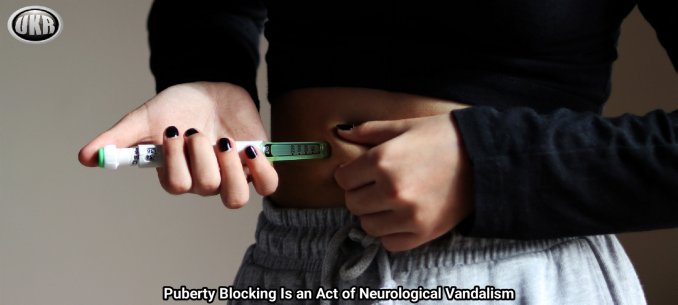
Puberty blocking is an act of neurological vandalism
MELANIE GILL
Children do not invent complex medical identities on their own. Someone teaches them.
FOR years we have been repeatedly assured that Britain was ‘taking safeguarding seriously’. Yet here we are in 2025 watching our own government prepare to run a clinical trial that would expose vulnerable children to puberty blockers, despite the Cass Review’s sober warning that the evidence base is remarkably weak, that long-term outcomes are unknown, and that irreversible harm is not merely possible but likely to be significant.
In 2009, I started a campaign to stop a Channel 4 programme that I believed exploited children called Boys and Girls Alone. The makers claimed a pseudo-scientific justification that it was an important social experiment. People were simply appalled, and we succeeded in getting the Minister for Children to review the law of children in the media.
Fast-forward to now: we are on the brink of medically abusing children by trial protocol using the same outrageous claims out of institutional cowardice and ideological capture.
This is not an abstract fear. Over a decade ago, in 2012, I worked on a case with a supervising consultant psychiatrist involving a parent who was pressuring a child to believe they were the opposite sex. We independently had the same reaction: this looks like factitious disorder imposed on a child. The parent, not the child, was driving the identity; the child absorbed it exactly as distressed children absorb adult narratives. At the time, such cases were extremely rare.
Today they are multiplying, not because more children are ‘born in the wrong body’, but because many parents caught in this wave are overwhelmed and outnumbered. Their child is affirmed at school, endorsed by peers, reinforced by online communities, validated by clinicians, and now quietly supported by a government that refuses to acknowledge that biological sex is real. Under this pressure, even confident parents can lose their sense of authority. They begin to doubt their instincts, defer to professionals, and silence their concerns. The result is a subtle but profound erosion of parental agency. Not because parents agree, but because the system has made dissent feel dangerous.
And of course many adults are confused, psychologically vulnerable, ideologically driven, or emotionally dependent on the role of ‘parent of a special medical child’. Within family cases involving allegations of parental alienation this is now a growing international phenomenon. Parents who pathologise their child’s trauma from the breakdown of their family.
This pattern is not hypothetical. It is directly described in the Royal College of Paediatrics and Child Health guidance on Fabricated or Induced Illness (FII), which explicitly warns that a parent may present a child as having a medical condition to meet the psychological needs of the parent (RCPCH, 2021) and that professionals may be groomed into accepting the parent’s version of reality. Older literature, such as Bass & Adshead’s seminal 2007 paper on the psychopathology of FII, notes that the child’s identity can become a projection of the parent’s internal world, and that the system itself may reinforce the parent’s fantasy when clinicians fail to challenge it.
Exactly this dynamic has unfolded within gender services.
The Kozlowska et al (2021) study from Australia is one of the most detailed clinical investigations into children presenting to gender clinics. It found overwhelming rates of trauma, attachment insecurity, parental mental illness, neurodevelopmental vulnerability, family conflict and emotional dysregulation among these children – far from the simplistic social narrative that such children are ‘clear-minded and certain’ about their identity. These are the children least able to make life-altering decisions, and most likely to internalise adult suggestion. The Cass Review echoed this, describing clinicians feeling pressured to affirm rather than assess, and children being rushed on to medical pathways without holistic evaluation.
Why did this happen? Because children are neurologically incapable of assessing the long-term consequences of puberty suppression. The child and adolescent brain is still under construction. Yet the proposed puberty blocker trial assumes that these children possess adult self-knowledge and adult decision-making capacity. They do not. The prefrontal cortex responsible for planning, consequence-evaluation, identity integration, and impulse control does not fully develop until the mid-twenties. Puberty is not a dispensable inconvenience: it is the biological engine that builds the adult brain. Blocking it is an act of neurological vandalism.
In other words, block puberty, and you block the core developmental process that creates an adult mind. It is not a ‘pause’ button. Developmental windows do not reopen.
The claim that children can meaningfully ‘consent’ to halting their own neurodevelopment is not only scientifically illiterate, it is ethically grotesque.
It gets worse. The cohort seeking gender services includes a significant number of children diagnosed with autism. The Kozlowska study found that 13.9 per cent met clinical ASD criteria, and a far larger proportion exhibited high autistic traits. Yet many of these traits are often not autism at all, but trauma-induced rigidity, social withdrawal, obsessive rumination, literal thinking, and attachment disturbance.
This is something I and others across the world have spoken extensively about: how trauma is frequently misdiagnosed as autism or ADHD particularly in parental alienation cases, because the behavioural overlap is profound. (Talks available here: The Fruit Doesn’t Fall Far From the Tree and How Trauma is Over Diagnosed as ASD and ADHD in Children in Parental Alienation Cases, Families Divided TV, YouTube.)
If clinicians routinely confuse trauma for autism, and autism for gender dysphoria, what happens when the same clinicians are allowed to prescribe puberty blockers under a research umbrella? Misdiagnosis becomes medicalisation. Children with trauma, identity instability, or parental psychological coercion are funnelled into drug trials instead of receiving actual care.
The government insists that this trial will be ‘carefully controlled’, but the Cass Review already documented the systemic weaknesses: clinicians afraid to question parents, ideological pressure, poor training in child development, and a culture in which to raise safeguarding concerns is to risk professional attack. This is the same institutional environment that presided over the Post Office scandal, the Rotherham, Nottingham and many other abuse scandals, and the Tavistock Clinic’s collapse. It has not changed. It has merely shifted target.
What does it mean when a child says, ‘I want to be a boy’, ‘I’d rather die than go through puberty’ or ‘my body is wrong’? Neuroscience tells us that children’s identity is plastic, relational, suggestible, and unfinished. Memory science shows that children absorb adult narratives into their semantic memory – into their belief system – even when the belief is factually false. Attachment science shows that distressed children shape their identities around the emotional needs of parents, especially in families where the parent is anxious, traumatised, narcissistically vulnerable or psychologically unstable.
So when a child expresses gender distress, the first question is never ‘what hormones should we give?’ but ‘what has happened to this child, in this family, in this environment, in their history?’
Yet activists, and now the Department of Health, want to skip the assessment and proceed directly to the drug trials.
This is not safeguarding.
This is not medicine.
This is not science.
It is the State functioning as the enabler of FII-style dynamics on a national scale.
Puberty blockers are not reversible. They are not benign. They are not neutral. They disrupt bone density, fertility, sexual function, emotional regulation, neurological maturation, and the development of adult identity. Their long-term harms are not ‘unknown’: they are entirely predictable from decades of developmental neuroscience.
Children are the most vulnerable beings in society. Their brains, their bodies, their identities all depend on adult protection. What the government is proposing is not protection. It is abandonment. It is the outsourcing of children’s futures to political ideology and clinical experimentation.
This failure is nowhere clearer than in the testimony of Keira Bell, the young woman who brought the landmark judicial review against the Tavistock Clinic. Bell explained that as a vulnerable teenager, she was not questioned, not challenged, and not helped to explore her distress.
These are the words not of someone who regrets a difficult but informed adult choice. They are the words of someone who recognises that safeguarding was abandoned. That professionals, entrusted with her development, allowed her to make decisions no child or teenager is neurologically equipped to make. Her experience is a warning not only about gender medicine, but about the psychological injury caused when trusted adults fail to tell children the truth.
This crucial point is often neglected in public debate: lying to children harms their brains. It is not simply a moral wrong, it is a neuropsychological injury. As my own research and teaching have explored, deception destabilises a child’s internal working model, activates fear circuits and fractures the trust that underpins emotional regulation and secure attachment. Chronic deception, especially by caregivers or professionals, can alter the architecture of memory systems, impair self-awareness, and create long-term hypervigilance.
A child who is told an untruth about their own identity is not merely misinformed but neurologically disoriented. Experiments on adults show significant neurological disruption. In children, these effects are magnified. Identity itself becomes unstable. The meaning-making systems that underpin memory absorb falsehoods as if they were facts. When children say, with certainty, ‘I am in the wrong body,’ we must ask what narratives they have been exposed to, and who has reinforced them.
On Wednesday I stood outside the Department of Health with many others to protest against this trial. Besides having abuse hurled at us from a masked pro-trial huddle, the fervour and shock was palpable. Speaker after speaker described their disbelief at what the Government in their total ignorance of human development are proposing. We are protesting about the destruction of safeguarding. We are protesting about the medicalisation of children’s distress. We are protesting about the silencing of clinicians who know better. We are protesting about a State that has forgotten its duty to the young.
The Cass Review was a warning.
This trial is a betrayal.
If we do not oppose it now, history will record it as one of the darkest medical scandals of the 21st century.
This article (Puberty blocking is an act of neurological vandalism) was created and published by Conservative Woman and is republished here under “Fair Use” with attribution to the author Melanie Gill
Featured image: goodrx.com
.

••••
The Liberty Beacon Project is now expanding at a near exponential rate, and for this we are grateful and excited! But we must also be practical. For 7 years we have not asked for any donations, and have built this project with our own funds as we grew. We are now experiencing ever increasing growing pains due to the large number of websites and projects we represent. So we have just installed donation buttons on our websites and ask that you consider this when you visit them. Nothing is too small. We thank you for all your support and your considerations … (TLB)
••••
Comment Policy: As a privately owned web site, we reserve the right to remove comments that contain spam, advertising, vulgarity, threats of violence, racism, or personal/abusive attacks on other users. This also applies to trolling, the use of more than one alias, or just intentional mischief. Enforcement of this policy is at the discretion of this websites administrators. Repeat offenders may be blocked or permanently banned without prior warning.
••••
Disclaimer: TLB websites contain copyrighted material the use of which has not always been specifically authorized by the copyright owner. We are making such material available to our readers under the provisions of “fair use” in an effort to advance a better understanding of political, health, economic and social issues. The material on this site is distributed without profit to those who have expressed a prior interest in receiving it for research and educational purposes. If you wish to use copyrighted material for purposes other than “fair use” you must request permission from the copyright owner.
••••
Disclaimer: The information and opinions shared are for informational purposes only including, but not limited to, text, graphics, images and other material are not intended as medical advice or instruction. Nothing mentioned is intended to be a substitute for professional medical advice, diagnosis or treatment.
Disclaimer: The views and opinions expressed in this article are those of the author and do not necessarily reflect the official policy or position of The Liberty Beacon Project.


Leave a Reply