

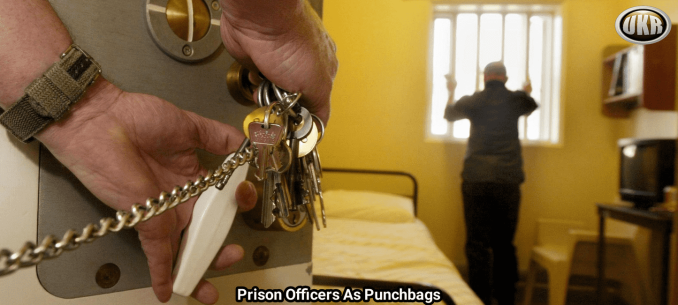
Prison officers as punchbags
And the theory of the lanyard class
HMP Gartree in my constituency is, I think, the only prison that is for lifers only.
Sensibly, when they show you round, they wait until you are just on your way out again to show you their gruesome wall display of the many, many improvised weapons they have taken off prisoners.
The sheer ingenuity on display is remarkable – you wouldn’t think there are so many ways to turn everyday objects into terrifying lethal weapons.
Prison officers are a remarkable bunch, putting up with Britain’s worst and most dangerous people, day in, day out.
When I have met officers, I have seen the literal scars they bear from the job.
I met one who’d had the end of his finger bitten off – and another who’d had his glasses punched, shattering into his eye.
I cannot imagine how much that hurt.
Prison officers are remarkably patient people, but also need some protection. That’s why in 2018 we gave officers in male prisons the option of pepper spray, known as PAVA spray in the trade.
It’s a non-lethal weapon that will incapacitate someone dangerous with a weapon and reduce the risk to the officer at least a little bit.
But I read a piece last week from an official body complaining about prison officers being given PAVA in youth offending institutions.
Elisabeth Davies, the national chair of the Independent Monitoring Boards (IMB), said: “There is clear racial disproportionality when it comes to the use of force,”
She told the Guardian: “It is therefore, I think, wholly irresponsible to expand use-of-force measures before disproportionality issues are addressed.”
There are three things to say about this.
An unbalanced system
The first is that the balance of the system is already insanely tilted towards the rights of the criminal. The plotter of the Manchester Arena bomb attacks, Hashem Abedi, was able to attack three prison officers because he was able to access hot cooking oil.
Axel Rudakubana, the Southport killer, threw boiling water in the face of an officer at HMP Belmarsh.
Why was he allowed a kettle? When did this even start? Minister Sir Nicholas Dakin said in Parliament that “small travel kettles have been allowed in prisoners’ possession for many years”. I’m not sure about “many years but we seem to have drifted into it, in the classic way that Britain’s asymmetric ‘rights culture’ evolves.
In 2012 a prisoner won the right to a keep a thermos flask of hot tea in his cell overnight after the Prisons and Probation Ombudsman said he deserved ‘decent treatment’. In 2015 the Chief Inspector of Prisons even criticised the fact that prisoners were asked to pay a small sum for the kettles (they are a tenner).
Shadow Justice Minister Robert Jenrick has rightly called for a rethink of this ‘right’ to a kettle, and for officers to have the tools they need to do the job.
Soft governance
A second interesting thing about this is that it shows how the institutional left operates. Let me explain.
A network of left-wing groups have been trying to stop prison officers from having PAVA for self defence for some time.
You can read reports about it from the anti-prison group the Prison Reform Trust or the Howard League or the Prisoners Advice Service, or Barnardo’s or the 38 “Youth Justice Organisations” that criticised it.
These groups then aim to percolate these ideas into the state through its soft edges and peripheral organs. The IMB is one example a statutory organisation that been around since at least 1952, but which was given a new, progressive function during the Blair years (many such cases) to promote the “humane and just treatment” of prisoners.
What the groups will hope for is to gradually colonise the space around the MOJ. You start with an agency here, an inspectorate there, or an outlying “office” of something. For example, around the criminal justice space they might try to persuade the prison or parole inspectorates, or the Office of the Public Guardian. They could try get senior people from the parole board and Youth Justice Board to say things. Maybe someone from the Advisory Council on the Misuse of Drugs. Today’s state has blurry edges.
And that is one of the risks inherent in the move to soft-governance, where chunks of decision making (and the processes that lead up to decision making) are outsourced to people who are not elected and do not have the regular salutary experience of having to go and knock on people’s doors and ask what the normal public think.
I’ve mentioned examples before like Natural England and nutrient neutrality, and the Sentencing Council proposals for two tier justice. This, from the IMB is another example.
There are a whole class of people in civic life who have made a career not in politics or even in the civil service, but in regulators and in the soft margins of the state. The National Chair of the IMB has a fairly characteristic CV. I’m sure she is a good and hard working person, and has done many important jobs. But one thing she (inevitably) has not done is democratic politics: knocking on doors, getting elected, making difficult and unpopular trade offs, and accepting responsibility for them. That is not her fault, but is a reminder that it is elected politicians, not officials who should be commenting on and deciding on political issues. I quote her CV below not as any criticism, but an example of the world of soft governance.

How the lanyard class (don’t) think.
The third interesting aspect of this story is that it is a good example of the way that the lanyard class think.
For example, their moral order. The implication of their recommendation is this.
Prison officers need to just suck up the fact that they will be less safe, because PAVA is somehow racist, and that is the ultimate trump value.
Just like the kettles, the organisations making the recommendations aren’t the ones who have to deal with the consequences.
The Prison Officers Association make the key points here, noting that IMB members were “not the ones on the receiving end of life-changing injuries… Using the ethnicity or age of offenders to excuse their violent behaviour is shameful… Nobody should ever enter their workplace and be expected to become a victim.”
That’s right: people have agency, and the simple way to avoid being pepper sprayed is to simply not violently attack or threaten your prison officer.
But anyway, the IMB’s own logic is flawed.
It’s a good example of their lack of curiosity and willingness to probe things.
In justifying their opposition to PAVA the IMB point to a report done for the government on the use of force in prisons. According to the Guardian:
The government’s “use of force” evaluation report, published in April, found black prisoners were nearly twice as likely as white prisoners to experience Pava and baton use.
That may be true. But is this evidence that terrible racist prison officers are pepper spraying black prisoners unnecessarily?
Or could there be other reasons for this disparity?
For example, black prisoners are twice as likely to be in prison for possession of weapons than white prisoners (3.8% white prisoners, 7.4% of black prisoners). Black prisoners are also more likely to be in for violence against the person.
In contrast, white prisoners were more likely to be in for sex offences and theft, while Asian prisoners were more likely to be in for drug and fraud offences. All these people, regardless of skin colour, are in jail for a good reason.
But isn’t it at least possible that a group where there are twice as many people in jail for possession of weapons on the outside may be more likely to threaten officers with weapons on the inside?
This first, obvious question doesn’t seem to have occurred to the IMB. In fairness I had to ask a parliamentary question to get the data – weirdly, it is not normally published.
And what about age. We know from the same government report that younger prisoners are much more likely to require force to be used against them. If you are under 20, young and strong and hot headed, you are 37 times more likely to require the use of force than are the old lags aged 60+. Maybe having a swing at an officer doesn’t seem such a good idea when you are a pensioner.

And black prisoners are much younger than the white ones. Again, the stats don’t seem to be regularly published, but in 2019 data released under FOI showed that while 13.6% of white prisoners were aged 24 or younger, twice as many (28.4%) black prisoners were young. And 10.8% were under 21, compared to 4.3% of white prisoners. Couldn’t the age profiles be another, fairly obvious, reason for the differences here?
However, doing such analysis doesn’t seem to have occurred to the IMB.
Instead, they think they have detected evidence of racism – the greatest of all sins in their world – and then moved directly to a conclusion that prison officers should have to suck up more danger from violent criminals.
Conclusion
The whole thing just seems like a parable about how governance works in today’s Britain – and also about how a large chunk of the official class think.
Or rather, how they don’t think.
This article (Prison officers as punchbags) was created and published by Neil O’Brien and is republished here under “Fair Use”
Featured image: Alamy

••••
The Liberty Beacon Project is now expanding at a near exponential rate, and for this we are grateful and excited! But we must also be practical. For 7 years we have not asked for any donations, and have built this project with our own funds as we grew. We are now experiencing ever increasing growing pains due to the large number of websites and projects we represent. So we have just installed donation buttons on our websites and ask that you consider this when you visit them. Nothing is too small. We thank you for all your support and your considerations … (TLB)
••••
Comment Policy: As a privately owned web site, we reserve the right to remove comments that contain spam, advertising, vulgarity, threats of violence, racism, or personal/abusive attacks on other users. This also applies to trolling, the use of more than one alias, or just intentional mischief. Enforcement of this policy is at the discretion of this websites administrators. Repeat offenders may be blocked or permanently banned without prior warning.
••••
Disclaimer: TLB websites contain copyrighted material the use of which has not always been specifically authorized by the copyright owner. We are making such material available to our readers under the provisions of “fair use” in an effort to advance a better understanding of political, health, economic and social issues. The material on this site is distributed without profit to those who have expressed a prior interest in receiving it for research and educational purposes. If you wish to use copyrighted material for purposes other than “fair use” you must request permission from the copyright owner.
••••
Disclaimer: The information and opinions shared are for informational purposes only including, but not limited to, text, graphics, images and other material are not intended as medical advice or instruction. Nothing mentioned is intended to be a substitute for professional medical advice, diagnosis or treatment.
Disclaimer: The views and opinions expressed in this article are those of the author and do not necessarily reflect the official policy or position of The Liberty Beacon Project.


Leave a Reply