

Politics: who governs Britain?
RICHARD NORTH
It comes as no surprise to learn that foreign secretary Yvette Cooper has intervened publicly in the growing controversy about Alaa Abdel Fattah.
In a letter to Emma Thornberry, chair of the foreign affairs committee, she has complained that current and former ministers were never briefed on his “abhorrent” tweets when they spoke publicly about this case in the past, and also that the civil servants in charge of this case were unaware.
It is clear, she wrote, “that this has been an unacceptable failure and that long standing procedures and due diligence arrangements have been completely inadequate for this situation, leading to the serious problem of successive foreign secretaries and prime ministers making public statements without all relevant information”.
She has ordered an urgent review into “the serious information failures” in the Fattah case and “more broadly the systems that are in place within the department for conducting due diligence on the individual high-profile consular and human rights cases for which the FCDO is responsible”.
From this, one might infer that, had foreign secretaries and prime ministers been fully and accurately briefed, they might have been less enthusiastic in their pursuit of Fattah’s freedom, giving rise to a possibility that he might still be incarcerated where he belongs, in an Egyptian prison.
That being the case, and more generally, multiple interests would be served if this so-called “activist” were no longer in the country, and it would certainly solve a lot of problems if proceedings were initiated which led to his early deportation.
However, far from pursuing this course of action, by early evening yesterday, the Guardian was suggesting that Starmer was doubling down on his original error, with his spokesman defending the handling of the case.
In an official statement, he said: “We welcome the return of a British citizen unfairly detained abroad, as we would in all cases and as we have done in the past. That is central to Britain’s commitment to religious and political freedom”. He added: “It doesn’t change the fact that we have condemned the nature of these historic tweets and we consider them to be abhorrent” but made no mention of any further action.
It was the Telegraph that gave a hint of why this was the case, reporting government officials’ belief that the historical tweets would not be sufficient reason to support any action, and any move to revoke Fattah’s citizenship would be struck down by the courts. This view was endorsed by Emily Thornberry, who insisted that it was not legally possible to deport him.
Earlier, though, The Times had already given the game away, reporting that “senior government sources” were indicating that they were “leaning against” deporting Fattah. They believed there were no grounds for stripping his citizenship because, the paper said, case law from 2016 had established this could only be done in cases of fraud or in the cases of dangerous criminals and terrorists.
Trying to do so, the paper continued, could spark a prolonged legal battle at major cost to the taxpayer, with confidence low in Whitehall that the move would be upheld in the courts.
It is not clear to which case law The Times is referring but the baseline for formal deprivation of citizenship comes within section 40 of the British Nationality Act 1981.
There are two distinct grounds, the first set out in Section 40(3) which deals with fraud, false representation, or concealment of material facts in obtaining citizenship. The second is Section 40(2) which allows deprivation if the Secretary of State is satisfied it is conducive to the public good (although it cannot render someone stateless unless specific exceptions apply).
The “conducive” ground is set out in Home Office Guidelines, primarily used for national security, terrorism, serious organised crime, or “unacceptable behaviour” such as being involved in war crimes, crimes against humanity, or other unacceptable behaviour (e.g., espionage, glorification of terrorism, or high-harm conduct).
There is further elaboration in this report while Pham v Secretary of State for the Home Department and Begum v Secretary of State for the Home Department (the Shamima Begum case) uphold deprivation on national security grounds.
As regards Alaa Abdel Fattah, any potential deprivation would fall under the “conducive” provision, requiring evidence that retaining his citizenship was not conducive to the public good (e.g., a national security risk). It is unlikely, though, that historic social media posts alone could meet that threshold.
It is generally agreed that this power must be used sparingly and proportionately. Decisions must be based on sound evidence rather than speculation, assessing whether the person’s actions are serious enough to warrant such a severe measure at the time of the decision, with the emphasis on current threats rather than past conduct.
Even if these challenges were overcome, though, there are other hurdles. Chahal v United Kingdom (1996) might apply, which would be likely to prevent the UK government from deporting Fattah back to Egypt.
This centres on the principle of non-refoulement under Article 3 of the ECHR, which prohibits expulsion to a country where there is a real risk of torture or inhuman/degrading treatment. The protection is absolute, applying even if the individual poses a national security risk or has expressed controversial views.
Soering v United Kingdom (1989): (ECtHR) established that extradition/deportation engages Article 3 responsibility if substantial grounds show a real risk of prohibited treatment in the receiving state. The UK would violate the ECHR by exposing someone to such risk, even indirectly through removal.
This landmark case reinforced the absolute nature of Article 3. The ECHR ruled that the UK could not deport a Sikh separatist to India despite national security concerns, as evidence indicated a real risk of torture. The Court explicitly stated that the prohibition applies “irrespective of the victim’s conduct”, no matter how undesirable or dangerous. This directly counters arguments for deportation based on past statements or perceived extremism.
Given Fattah’s history as a prominent “pro-democracy activist and political prisoner” in Egypt – where there are said to be substantial grounds to believe he faces a risk of re-imprisonment, ill-treatment, or worse upon return – even if the UK revoked his British citizenship, rendering him deportable as a foreign national, Article 3 ECHR could still be used to bar his deportation to Egypt.
Diplomatic assurances from Egypt would likely be insufficient, as ECtHR jurisprudence treats Article 3 as non-derogable. Thus, while current political calls for deportation (from opposition figures) cite “historic” social media posts, under Chahal, such conduct cannot justify overriding the absolute ban.
To overcome these hurdles, the government, via parliament, could invoke the constitutional principle of parliamentary sovereignty, and “disapply” or effectively overrule case law through the standard legislative process, by enacting new primary legislation that explicitly changes the law on which the relevant court cases were based.
Using the same principle, parliament could also selectively disapply the ECHR, rendering action immune to legal challenge as no court (not even the Supreme Court) can overturn primary legislation.
Without such bold moves, the writ of the lawyers would prevail, forcing government to stand impotent while any moves to rid the nation of Fattah were overturned by the courts. This issue, therefore, is shaping up to be a “who governs Britain” test – the politicians or the lawyers.
There are no prizes for guessing which way the Starmer Regime will move, but if ever there was a hill to die on, this is it. As Peter McCormack remarks, this case is an inflection point for the UK.
It touches so many issues which are angering the country – immigration, law, culture and values. But it also shows how much the hard-working British public are being taken for a ride. It shows we have a weak constitutional system that cannot protect citizens and a government that prioritises people that hate us, ahead of us.
Should the Tories make deporting Fattah their central attack point on Labour for the coming parliamentary session, it could be a test of their strength and determination as an opposition and, if they fight effectively, it could transform their position in the polls.
Jenrick, as shadow justice secretary, has made a good start, but the party needs to keep up the momentum. Fattah’s citizenship is self-evidently an issue which has caught the attention of the public, giving the Tories a chance to show whose side they are on, and who is really in charge.
See Related Article Below
UK Admits Vetting Failure Over Freed British-Egyptian Extremist
The row has intensified concern within Jewish communities and prompted criticism of ministers who publicly welcomed the man’s return.
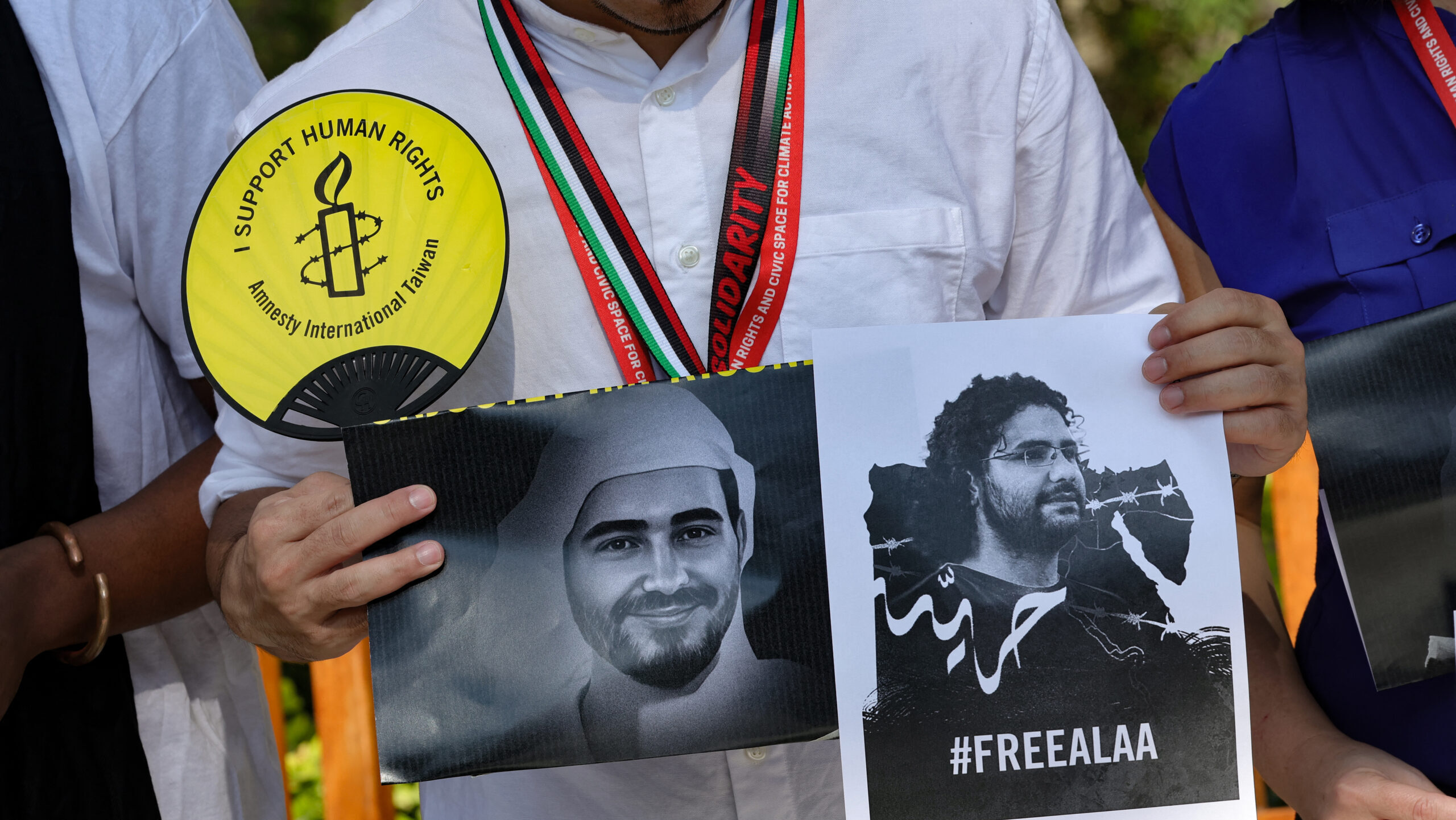 An Amnesty International protester holds portraits of Alaa Abd el-Fattah (R) and Mohammed al-Siddiq in Dubai, 2023.. Photo by AFP




Leave a Reply