

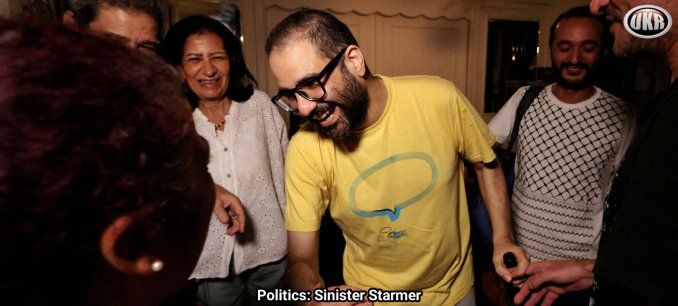
Politics: sinister Starmer
RICHARD NORTH

What might have been disregarded as a typical love-in piece by the BBC, announcing the arrival in this country of Alaa Abdel Fattah, has spectacularly backfired on the broadcaster, and dragged Starmer into yet another controversy.
The BBC is happy to describe Fattah as a “British-Egyptian writer and pro-democracy activist” which, with a long history of his being imprisoned by successive Egyptian regimes, seems to have signalled to the prime minister that it was safe to associate with him, leading to a gushing post on X, declaring:
I’m delighted that Alaa Abd El-Fattah is back in the UK and has been reunited with his loved ones, who must be feeling profound relief. I want to pay tribute to Alaa’s family, and to all those that have worked and campaigned for this moment. Alaa’s case has been a top priority for my government since we came to office. I’m grateful to President Sisi for his decision to grant the pardon.
As it turns out though, Fattah is very much more than the simple “writer and pro-democracy activist” that the BBC would have him be, or even just the “dissident” that the Guardian wants him to be.
According to The Times of Israel – which keeps notes of such things – back in 2014 Fattah was nominated for the prestigious Sakharov Prize by over 50 European Parliament members despite, as the paper put it, “having advocated the assassination of Israelis and political leaders in Egypt and called for an end to the State of Israel”.
Having opened a Twitter account (as it was then) in 2007, his views on Egyptian politics can, at the very least, be described as forthright. On 6 July 2011, as Egypt seethed in violent protests against its military rulers, he tweeted: “Will no one form an armed organization and randomly assassinate Interior Ministry officers and be rid of them?”, adding: “We all know that they’re all criminals”.
The following year, on 6 September 2012, he wrote that the 1981 assassination of then-Egyptian president Anwar Sadat was “a service to the nation,” since Sadat was a traitor to his people. “A president isn’t just anyone. It is our right to kill the president if there is no other way to get rid of him. Was the killing of [former Libyan leader Muammar] Gaddafi a crime?”, he wrote.
At the time, Fattah added that he would consider the killing of former Egyptian general Mohammed Hussein Tantawi, who served as de facto ruler of Egypt in 2012 as chairman of the Supreme Council of the Armed Forces (SCAF), “a patriotic act”.
Considering the British state’s response to Lucy Connolly and others, imprisoning them for lengthy periods for remarks considerably less inflammatory, it is hardly a surprise that he found himself incarcerated by the Egyptian authorities.
But it was Fattah’s comments on Israel that had the MEPs worried. During an exchange on generalisations in the Egyptian political context, Fattah wrote: “All Zionists are criminals, all racists are stupid, all humans have rights. These are examples of acceptable generalizations”.
Debating the Palestinian issue, he wrote on 15 November 2012, that “there is a critical number of Israelis that we need to kill and then the problem is solved”. The following day, he wrote: “there should be no equal relations with Israel or any other relations. Israel must come to an end”.
This was sufficient for the nomination to have been withdrawn, which it was in February 2015, when Fattah sought to defend his comments on Israel, stating that it was part of a “private conversation” that took place during Israel’s Operation Pillar of Defence assault on Gaza in 2012 – on an account which had 600,000 followers.
While in prison though – for the umpteenth time – his family successfully applied on his behalf for British citizenship, to which he was apparently entitled through descent from his mother, Laila Soueif, who had been born in London. This, by all accounts, was treated as a routine application, with the award granted in December 2021.
In April 2022, with his citizenship in the bag, the family publicly announced it and appealed for UK consular intervention. And, despite the red flags, Fattah’s cause was enthusiastically embraced by Boris Johnson, who raised the case directly with Egyptian President Abdel Fattah el-Sisi in August 2022, alongside calls for release during international pressure around COP27.
As foreign secretary, Liz Truss raised the case multiple times with Sisi in June and July 2022 while Foreign Secretary, pressing for consular access and improved conditions and then, after Johnson’s resignation, Rishi Sunak took over.
As prime minister, he raised the case with Sisi at COP27 in November 2022, expressing “deep concern” and hoping for swift resolution, writing to Fattah’s family in November 2022, affirming commitment to resolution and noting prior efforts by Truss. He continued raising it in subsequent meetings and calls with Sisi.
In September, his 68-year-old mother went on a hunger strike to demand his release. Supported by the usual clutch of luvvies and celebs, such as actors Judi Dench and Olivia Colman, she held near-weekly protests outside the Foreign Office, calling on the UK government to do more to secure her son’s release, chalking on the pavement the number of days of his imprisonment.
Surviving on water, rehydration salts, and sugarless tea and coffee, she abandoned the hunger strike temporarily in February 2025, resuming in May with a daily one-hour vigil outside Downing Street urging the UK government to do more.
It was then confirmed that Starmer had taken an interest and had been attempting to contact the Egyptian president, but Sisi had not returned his calls.
However, on 22 September, Fattah was freed from prison after a pardon from Sisi but he was not allowed to leave the country until a travel ban was lifted last Friday, triggering Starmer’s incautious tweet.
Since that post, social media has been busy trawling Fattah’s account for archived material. An expanding collection includes a comment on 11 January 2009 which supported the killing of Israeli civilians, and one on 31 May 2010 when he wrote “can we get back to killing zionists please? they seem to be more violent when we stick to non-violence”, a comment expressing frustration with non-violent approaches.
The story has since been picked up by the Telegraph, noting further posts which have called the British “dogs and monkeys”, another advocating “killing police” and “hating white people”, and shooting white males to “convince them racism costs lives”, as well as a gem calling for Londoners to burn down Downing Street.
Other gems include him stating “I consider killing any colonialists and especially Zionists heroic”, adding: “we need to kill more of them” and one where he “confesses” to wanting a drone of his own which he promises “to only use it to shoot zionist weddings”. He even talks of himself as a “terrorist”, discussing how “we’ll take over your town and rape ur women”.
The Times has also joined the fray, sporting the headline: “Killing Zionists is OK, said released activist Alaa Abd El-Fattah”, with the sub-head telling us: “Keir Starmer fought for the release of a prisoner whose violent social media comments led to the withdrawal of a humanitarian award”.
The Mail on Sunday is in on the act as well, boasting an “exclusive”, claiming: “Starmer faces backlash after expressing ‘delight’ at return to UK of Egyptian activist who said ‘kill Zionists’”.
Jenrick, as shadow justice secretary, has joined in complaining in a letter of Starmer’s “public endorsement” of a man with a record of “extreme statements about violence, Jews and the police”, calling it a “serious error of judgement” and declaring that no prime minister should “place the authority of his office behind someone whose own words cross into the language of racism and bloodshed”.
In his letter, he asks of Starmer whether he knew of Fattah’s statements before he issued his “delighted” message. Even though, as a Tory MP, he is somewhat compromised by the actions of previous Tory prime ministers, this is a good point.
Given the diligence of the authorities in searching for violent and “hurtful” social media post by British citizens, it seems the very least Starmer’s officials could have done was to check the output of this prodigal son. If this was not done, then it suggests extraordinary incompetence. But, if Starmer was aware, then that points to something altogether more sinister.
All too often, Starmer conveys the impression that he believes non-indigenous people, of whatever persuasion, have a greater call on the resources of the British state than any indigenous citizen. Time and time again, he shows that he sees native members of the British nations as second-class citizens whose interests are of little concern to him. This may well go down as yet another example – reinforcing our impression that we have a prime minister who hates his own people.
This article (Politics: sinister Starmer) was created and published by and is republished here under “Fair Use” with attribution to the author Richard North
See Related Article Below
Keir Starmer under fire for welcoming ‘extremist’ who praised killing ‘Zionists’ and said he hated white people
 Alaa Abd El-Fatah – http://www.manalaa.net/node/87368 Profile photo of “Alaa Abd El-Fatah” CC BY-SA 2.5
CP
In past posts, Alaa Abd el-Fattah had referred to British people as “dogs and monkeys”, praised Osama bin Laden, denied the Holocaust, said he hated white people, and called for the killing of “Zionists”, including civilians.
Keir Starmer, is facing mounting political pressure after publicly welcoming the return to the UK of Alaa Abd el-Fattah, an Egyptian-British activist whose past social media posts include endorsements of violence against Jews, Israelis and police officers.
Robert Jenrick, the shadow justice secretary, has written to Sir Keir demanding answers about what the Prime Minister knew of Abd el-Fattah’s record before describing himself as “delighted” at his arrival in Britain and thanking Egypt’s president, Abdel Fattah el-Sisi, for granting him a pardon.
Abd el-Fattah, who holds dual British-Egyptian citizenship, arrived in the UK on Friday after Egypt lifted a travel ban imposed following his release from prison earlier this year. He has spent more than a decade in detention in Egypt on various charges, including protesting against the government and “spreading false news”.
In a post on X, Sir Keir said Abd el-Fattah’s case had been a “top priority” for his government and said he was “delighted” that he had been reunited with his family. Similar messages were issued by senior cabinet ministers, including the foreign secretary, Yvette Cooper, and the justice secretary, David Lammy.
I’m delighted that Alaa Abd El-Fattah is back in the UK and has been reunited with his loved ones, who must be feeling profound relief.
I want to pay tribute to Alaa’s family, and to all those that have worked and campaigned for this moment.
Alaa’s case has been a top priority…
— Keir Starmer (@Keir_Starmer) December 26, 2025
However, the Prime Minister’s comments have sparked a backlash after renewed attention was drawn to Abd el-Fattah’s historic online statements, many of which date from the late 2000s and early 2010s. In posts since deleted, he referred to British people as “dogs and monkeys”, praised Osama bin Laden, denied the Holocaust, said he hated white people, and called for the killing of “Zionists”, including civilians. He also wrote that “police are not human” and urged people to “burn the City or Downing Street” during the 2011 London riots.
Some of the remarks previously led to controversy, including the withdrawal of his nomination for the Sakharov Prize for Freedom of Thought in 2014. At the time, Abd el-Fattah said his words had been taken out of context and were written during periods of conflict, later saying he was “completely reconciled” to a Middle East that included Israel while opposing what he described as apartheid policies.
In his letter to the Prime Minister, dated 27 December, Jenrick said Sir Keir’s public welcome went far beyond quiet diplomatic support and amounted to a personal endorsement. He asked whether the Prime Minister was aware of Abd el-Fattah’s past statements before issuing his message, whether he condemned them “without qualification”, and whether he would withdraw what Jenrick described as an “unalloyed endorsement”.
“The timing could scarcely be worse,” Jenrick wrote, citing recent antisemitic attacks and heightened concern within Jewish communities. He said that while no one should be imprisoned arbitrarily or for peaceful dissent, the Prime Minister should not place the authority of his office behind someone whose own words had crossed into “racism and bloodshed”.
The Prime Minister very publicly endorsed and welcomed to the UK a man with disgusting, extremist views.
Does he really support him? Or was he just ignorant?
My letter to @Keir_Starmer👇 pic.twitter.com/Iefk4VxmZc
— Robert Jenrick (@RobertJenrick) December 27, 2025
In comments to The Telegraph, Jenrick accused the government of bringing “an extremist” into the country and said ministers appeared more interested in political symbolism than public safety. Nigel Farage, the Reform UK leader, said both Labour and the Conservatives had been too willing to “open our doors to the wrong people”.
Jewish groups and campaigners have also criticised ministers. Alex Hearn of Labour Against Anti-Semitism said it was “reckless” for ministers to celebrate Abd el-Fattah’s return, while the Campaign Against Anti-Semitism questioned whether the government had properly assessed his record. Some campaigners have called for a review of how Abd el-Fattah was granted British citizenship and whether it could be revoked.
The government has defended its position, with a spokesperson saying Abd el-Fattah is a British citizen and that securing his release and return had been a long-standing priority under successive governments. Abd el-Fattah has been approached for comment.
Image: Alaa Abd El-Fatah – http://www.manalaa.net/node/87368 Profile photo of “Alaa Abd El-Fatah. Uploaded: 23 March 2011 CC BY-SA 2.5
This article (Keir Starmer under fire for welcoming ‘extremist’ who praised killing ‘Zionists’ and said he hated white people) was created and published by Conservative Post and is republished here under “Fair Use” with attribution to the author CP
Featured image: Sky News

••••
The Liberty Beacon Project is now expanding at a near exponential rate, and for this we are grateful and excited! But we must also be practical. For 7 years we have not asked for any donations, and have built this project with our own funds as we grew. We are now experiencing ever increasing growing pains due to the large number of websites and projects we represent. So we have just installed donation buttons on our websites and ask that you consider this when you visit them. Nothing is too small. We thank you for all your support and your considerations … (TLB)
••••
Comment Policy: As a privately owned web site, we reserve the right to remove comments that contain spam, advertising, vulgarity, threats of violence, racism, or personal/abusive attacks on other users. This also applies to trolling, the use of more than one alias, or just intentional mischief. Enforcement of this policy is at the discretion of this websites administrators. Repeat offenders may be blocked or permanently banned without prior warning.
••••
Disclaimer: TLB websites contain copyrighted material the use of which has not always been specifically authorized by the copyright owner. We are making such material available to our readers under the provisions of “fair use” in an effort to advance a better understanding of political, health, economic and social issues. The material on this site is distributed without profit to those who have expressed a prior interest in receiving it for research and educational purposes. If you wish to use copyrighted material for purposes other than “fair use” you must request permission from the copyright owner.
••••
Disclaimer: The information and opinions shared are for informational purposes only including, but not limited to, text, graphics, images and other material are not intended as medical advice or instruction. Nothing mentioned is intended to be a substitute for professional medical advice, diagnosis or treatment.
Disclaimer: The views and opinions expressed in this article are those of the author and do not necessarily reflect the official policy or position of The Liberty Beacon Project.


Leave a Reply