

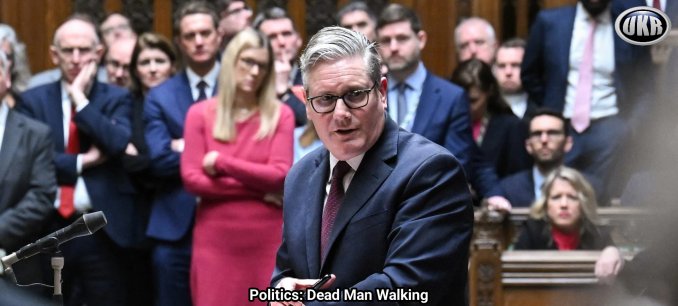
Politics: dead man walking
RICHARD NORTH
It was sort of shooting fish in a barrel. On the third time of asking from Olukemi Badenough at PMQs, Starmer admitted that the official security vetting he received on Mandelson’s appointment as US Ambassador did mention his ongoing relationship with the paedophile Jeffrey Epstein.
With that, by general consensus, it was game set and match. Starmer was “dead man walking”: it was only a matter of time (and a very short amount of time) before the toolmaker’s son became an ex-prime minister.
There had been some speculation that he might have been forced to step down if the local election results in May had been disastrous, and there was an outside chance that a calamitous performance by The Greek Lady at Gorton and Denton might bring the date forward.
But now, just about every political pundit in the British media that ever walked the earth seems convinced that, as soon as the details of the vetting have been disclosed – to which Starmer has reluctantly agreed – the axe will fall.
Oddly enough the saviour for the moment is the Metropolitan Police, which has asked for a delay in the release of documents in case it interferes with the ongoing investigation into Mandelson’s potential criminal liability over sending confidential information to his favourite paedophile.
Since the police processes, by their very nature, will tend to be laborious, that gives Starmer a stay of execution for the moment. That might even extend beyond the end of February when the Gorton and Denton result comes in, which is long enough for further revelations and the renewal of the crisis which may have died down a tad by then.
In the meantime, the knives are out for Morgan McSweeney, Starmer’s chief of staff. According to the Telegraph, he is being blamed by many Labour MPs for Mandelson’s appointment.
It is said that McSweeney pushed the idea, and it was he who sent a skimpy list of just three questions to Mandelson about his friendship with Epstein before he was offered the ambassador role.
The Times goes into this in some considerable detail – more than most rational humans would want to know – but we also get added detail on McSweeney, confirming that he is seen as the driving force behind Mandelson’s appointment.
McSweeney, we are told, was convinced he was the man for the job. The appointment was long in the making. Even before the 2024 election, officials were told that Labour would make a political appointment to the British embassy in Washington. Mandelson’s name was mentioned in access talks with civil servants, as was Jonathan Powell, a former chief of staff to Tony Blair.
Powell was destined for other things. Starmer ultimately appointed him as his national security adviser, clearing the way for Mandelson. Even the late shortlisting of George Osborne, the former chancellor and friend of the vice-president JD Vance, was not enough to stop him.
Throughout the process, says the paper, he was championed by McSweeney. The two men first worked together during the 2001 election campaign although McSweeney was a relatively junior figure at the time. Their relationship was forged under the leadership of Jeremy Corbyn, when they worked together to wrest back control of the party from the organised left.
Thus, this man, already a hate figure for the Labour Left because of his strategy of steering the party to the Right – or so we are told – looks doomed. Yet, such is Starmer’s dependency on him that sacking him, it is said, would be like switching off the prime minister’s political life support machine.
Nevertheless, as the Guardian makes it clear, Labour MPs are not going to be satisfied with a token sacrifice. They are after blood, with the paper telling us: “Labour MPs say Starmer’s days as PM are numbered amid fury over Mandelson”.
The eventual release of the vetting documents is going to be the seminal moment, the point at which a leadership challenge is triggered. The paper conveys the mood, citing one MP who says: “We need all the poison to come out”.
A former minister adds to the sense of gloom, saying: “We’ve had a lot of bad days recently, but this is the worst yet, I think”, while another MP warns: “Trust is finite. I’m personally not sure I could trust myself to back the prime minister in a confidence vote”.
Interestingly, it seems to be the most loyal Starmerites who are cracking first. This comes from an MP from the 2024 intake who says: “The most terminal mood is among the super-loyal”.
All admit that Starmer’s admission at PMQs was the turning point. “You could feel the atmosphere change; it was dark”, said one MP. Another remarked: “It’s just indefensible. They knew all about Peter’s relationship with Epstein but gave him the job anyway”.
“The moment Keir admitted it then that was it – it’s over”, is the general view. Another former minister said: “We were meant to be the ones who didn’t do this stuff. It’s time for a fresh start, the sooner the better”.
Of those on the Right forecasting Starmer’s demise, one of the leaders of the pack is Alister Heath who writes of recent events that: “These are the humiliating death throes of Starmer’s sordid regime”, telling us that “The grotesque Mandelson scandal is an epoch-defining indictment of the Labour establishment”.
He’s not the only one seeing more depths to this issue than just the daily froth, arguing that this scandal is a calamity for a Labour establishment that dismissed his scandals as incidental to Mandelson’s “genius”, or who mythologised his pathologies.
Heath thinks it will damage Blair, as he created Mandelson, and for all his furious protestations that he was double-crossed, it will further tarnish Gordon Brown: he gave him his peerage and brought him back from the cold.
Most importantly of all, though, he accepts that it will finish off Starmer, in what essentially is his own monumental error of judgment, the ultimate proof of his lack of competence at basic politics. And now, his authority is draining away.
Those who rejoice at the prospect of his early departure, though, may have cause to think again. Heath tells us that Ed Miliband, Rayner and the “soft Left” are circling, ready to pounce, prepared to claim that only a drastic shift towards socialism can expunge the failings of New Labour.
However bad Starmer might have been, it looks as if we are about to confront that iron rule of politics: just when you think you have hit rock bottom… it gets worse. But then, I suppose, if the whole system has to be brought tumbling down before things get better, there is probably no quicker way of doing it than to have Ed Miliband as prime minister.
The thing to watch for though is how far-reaching this political earthquake has been. Even with a new leader for Labour, the mood has changed and a simple reversion to business as usual is probably not realistic.
Former Telegraph journalist Peter Oborne says we’re very lucky to have the Epstein files. They shed light on a deeply corrupt system of government that functions in the interests of criminal elites, who believe that they have no obligation to obey the laws that constrain ordinary voters.
And while Starmer’s Labour, Badenough’s Tories, and the oligarch media are all part of the system, things are not the same: eyes have been opened. Oborne hopes that the future belongs to those who can confront the billionaire class, which has taken control of democratic politics on both sides of the Atlantic.
Personally, I think it will take a lot more than this present crisis to break the system, but it’s a start. A few gaps have been opened and we’ve been able to peer inside: what we see isn’t pretty. Now is the time to widen those gaps and shake out the contents.
This article (Politics: dead man walking) was created and published by Turbulent Times and is republished here under “Fair Use” with attribution to the author Richard North


Leave a Reply