

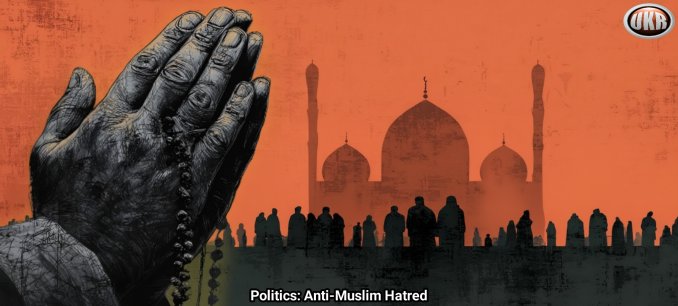
Politics: anti-Muslim hatred
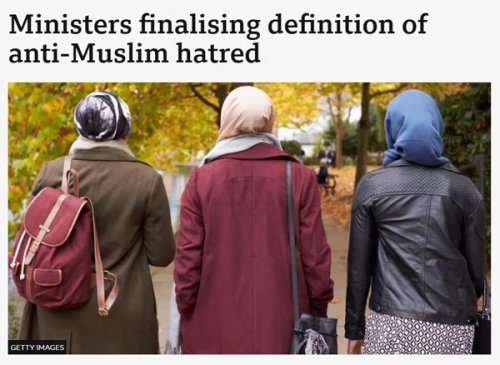
RICHARD NORTH
With the country going to Hell in a handcart and the Russians poised to attack momentarily, and the country on the brink of a world war, it does not seem the best of times to devote political time and energy to the introspective interests of a sectarian lobby group.
It thus says a great deal of Labour – and even more of the Islam lobby – that they have not abandoned their divisive and contentious attempt to introduce blasphemy by the back door, as it applies to their primitive, unreformed religion invented by a long-dead paedophile.
The good news, of a sort, is that they have given up trying to foist the term “Islamophobia” on the official, quasi-legal vocabulary, but the bad new is that, to a great extent, what replaces it is even worse – we are now going to be confronted with “anti-Muslim” hatred”.
This came to us via the BBC which seems to have been given privileged access to this vile, sectarian lobby, being first out with the news, although the story was quickly picked up by the Telegraph, which also had an opinion piece, as did The Times.
It was the BBC though, which gave us chapter and verse on a proposed definition, which was prepared by a working group set up in February, with the text being submitted to the government for approval in October.
The definition, we are told, will be non-statutory, meaning it is not set in law or legally binding, but will provide a form of words public bodies can adopt. It is said to provide guidance to the government and other bodies on what constitutes unacceptable treatment of Muslims, “aiming to help them better understand and quantify prejudice and hate crimes against this group”.
According to the BBC, the draft definition is:
Anti-Muslim hostility is engaging in or encouraging criminal acts, including acts of violence, vandalism of property, and harassment and intimidation whether physical, verbal, written or electronically communicated, which is directed at Muslims or those perceived to be Muslims because of their religion, ethnicity or appearance.
It is also the prejudicial stereotyping and racialisation of Muslims, as part of a collective group with set characteristics, to stir up hatred against them, irrespective of their actual opinions, beliefs or actions as individuals.It is engaging in prohibited discrimination where the relevant conduct – including the creation or use of practices and biases within institutions – is intended to disadvantage Muslims in public and economic life.
Apparently, the working group met last week to consider changes suggested by the Ministry of Housing, Communities and Local Government. One area of debate, it is understood, centres on the use of the word “racialisation” in the definition, although we are not told whether this debate has been resolved.
Baroness Gohir, a second-generation Pakistani immigrant whose parents hail from Punjab, sits on the working group and favours the unaltered text. She asserts that the group’s submission achieves “the right balance” by “safeguarding individuals while avoiding overreach”, although some might think she has a finger on the scales.
According to Gohir, “The definition also recognises that Muslims are frequently targeted not only for their beliefs but also because of their appearance, race, ethnicity, or other characteristics”, and she this maintains that “including the element of racialisation validates these lived experiences”.
In its news piece, the Telegraph tells us that critics of the racialisation proposal including the Equalities and Human Rights Commission (EHRC), argue that a reference to race should not be included as Muslims can be any racial group and are not defined as such under the law.
The Commission thus argues that it would be inconsistent to describe any prejudiced action against a Muslim as being racist under a new definition. However, removing the racial element, we are told, could spark a backlash from Labour’s Muslim supporters, who favour Islamophobia as a definition and also want racism included.
The paper’s opinion piece is written by Toby Young, under the title “Labour’s watered-down ‘Islamophobia’ definition will still undermine free speech”, with the sub-head telling us that: “British Muslims are already protected under the law. Virtue-signalling gestures will not tackle racial and religious hatred”.
Young advises us that the definition was supposed to be rolled out by the government on Monday, but the murder of 15 people on Bondi Beach by Islamist terrorists has led to a rethink.
In his view, the new definition isn’t as bad as the original “Islamophobia” offering which had it as “rooted in racism and a type of racism that targets expressions of Muslimness or perceived Muslimness”, but he argues that this doesn’t mean it won’t have a chilling effect on free speech.
He takes exception to the inclusion of “prejudicial stereotyping”, fearing that it could inhibit a social worker or school teacher in a Muslim area from drawing attention to child sexual exploitation, not to mention female genital mutilation or forced marriages. It might also, he suggests, give news organisations pause before mentioning the religion of the father and son who carried out the terrorist attack in Australia.
The danger of any definition, he adds, is that it will make people think twice before referring to Muslims doing anything wrong, prioritising them above people of other faiths, warning that even the perception that the government is granting Islam a privileged status may itself fuel anti-Muslim hatred.
Oddly – as Young is supposed to be the champion of free speech – a far more robust offering comes in The Times from the shadow equalities minister, Indian-heritage Claire Coutinho, whose parents are of Goan Catholic descent.
She weighs in by declaring that the “woolly terms” used in the new definition will give those who wish to shut down legitimate criticism of Islam the means to do so, whilst missing the bigger problem.
Referring to Sara Sharif, the eight-year-old child who suddenly started wearing hijab, forced to wear it by her father who wanted to hide his abuse behind it, and then went on to murder her, Coutinho argues that she might be alive today if the authorities hadn’t been too scared of being branded racist to ask why she had been dressed in this way.
She adds that councils and police forces failed to protect vulnerable girls from rape and abuse by predominantly Pakistani Muslim grooming gangs, again, because of fears of being called racist. The security guard who had a “bad feeling” about the Manchester Arena bomber didn’t approach him because he, too, was scared of appearing prejudiced.
Thus says Coutinho, we have created an environment in which our public services worry more about the reputational damage of causing low-level offence than they do about preventing serious harm.
Noting that the public are rightly horrified by these failures and undoubtedly that the war in Gaza has further exposed divisions here at home, she asserts that it is grossly naïve to believe that creating a separate tier of protections for one religious group is going to lead this country to greater unity.
In a splendidly incandescent paragraph, she then asserts: “Do you know what would reduce prejudice and resentment? No more Jews being slaughtered in synagogues. No more protests blocking our streets calling to “globalise the intifada”. No more turning a blind eye to the rape of young women and girls”.
But her concluding view matches that of Toby Young, that at best, the new definition will breed more resentment amongst a public weary of two-tier justice. At worst, she says, it will stop our public services from grasping difficult issues such as sex equality, grooming gangs and terrorism.
Needless to say, the tone-deaf Muslim Council of Britain disagrees. “Stripping out or diluting the concept of racialisation does not protect free speech”, it says. Rather, “it obscures the nature of the harm and weakens the ability of public bodies to understand, address and prevent discrimination”.
To my mind, there is something not right with the way their minds are working, when those who dress up in their pyjama suits, silly hats and straggly beards, and cover their women in black tents with eye slits, complain about “prejudicial stereotyping” and “discrimination”.
And the worst of that is that people who express a totally natural aversion to this overt rejection of Western values will find themselves on the wrong side of the law, with the police ever too willing to abuse their powers.
If the government is foolhardy enough to go ahead with this madness, it will find a new meaning of hatred, and it won’t be directed exclusively at Muslims.
This article (Politics: anti-Muslim hatred) was created and published by Turbulent Times and is republished here under “Fair Use” with attribution to the author Richard North
See Related Article Below
The anti-Muslim hate definition will be bad for free speech
DAVID SHIPLEY
After a long wait, the government’s Islamophobia definition has finally taken form. There has been plenty of criticism of the idea, and many warnings of the dangers it would pose to freedom and our ability to fight crime. But fear not, the state has come up with a brilliant solution: rebranding. Instead of ‘Islamophobia’ we are to be given a definition of ‘anti-Muslim hatred’.
The draft text, apparently submitted to the government in October, reads:
‘Anti-Muslim hostility is engaging in or encouraging criminal acts, including acts of violence, vandalism of property, and harassment and intimidation whether physical, verbal, written or electronically communicated, which is directed at Muslims or those perceived to be Muslims because of their religion, ethnicity or appearance.
It is also the prejudicial stereotyping and racialisation of Muslims, as part of a collective group with set characteristics, to stir up hatred against them, irrespective of their actual opinions, beliefs or actions as individuals.
It is engaging in prohibited discrimination where the relevant conduct – including the creation or use of practices and biases within institutions – is intended to disadvantage Muslims in public and economic life.’
There is much to be concerned with here. What exactly is ‘the prejudicial stereotyping and racialisation of Muslims’? Might it include accurate descriptions of reality, which some Muslims might find upsetting, or which they might choose to weaponise?
We can’t trust our institutions to respect lawful speech, so why would we hand them more weapons to use against us?
Although these rules won’t be statutory it’s very easy to see how they might prevent councils, the police and other public bodies from being honest about the religious aspect of crimes committed by Muslim men, such as the rape gangs. We’ve already seen the harm done by the fear officials had of appearing racist. Another definition, another set of behavioural rules, will only make this worse.
Similarly, as we’ve seen this year with Hamit Coskun’s ongoing persecution by the CPS for burning a Quran, the state will absolutely abuse speech laws. The state was happy to attempt to prosecute Coskun for the invented crime of ‘offending the religious institution of Islam’, and it is very easy to imagine them prosecuting people for ‘Anti-Muslim hostility’ in short order.
Even if the courts and free speech lawyers are able to hold the line against such abuses, being labelled as having exhibited ‘anti-Muslim hatred’ will no doubt have many other consequences. Just look at the recent case of former Royal Marine Jamie Michael. In the aftermath of Axel Rudakubana’s horrific killings in Southport, Jamie posted a video in which he described the murderer as a ‘creature’ and called for protests against high levels of illegal migration.
A Labour party employee reported Jamie to police and he was prosecuted for inciting racial hatred, before being acquitted by a jury after just 17 minutes of deliberations. Despite this, Jamie has now been banned from working with children, including coaching his daughter’s football team. The Welsh FA have even warned him that he will be ‘monitored’ if he watches her play. This decision was apparently taken after the local council claimed children ‘are at risk of harm’ due to the ‘dehumanising language’ Jamie used, and that he breached Axel Rudakubana’s human rights because he is ‘non-white’.
Councils, sporting associations and other public bodies are already going far beyond the law. If ‘anti-Muslim hatred’ is defined by the government it will soon become a part of their arsenal. Might those of us who accurately state that Muslim men are disproportionately overrepresented when it comes to the rape gangs, or agree with MI5’s assessment that Islamists are the greatest terrorist threat we face, soon find ourselves banned from teaching, coaching, or even watching our children play sport? We certainly can’t trust our institutions to respect lawful speech, so why would we hand them more weapons to use against us?
The final section of the guidance is even more sinister. The ‘creation or use of practices and biases within institutions’ will very quickly come to include all kinds of ‘indirect discrimination’. What this means is workplaces will be expected to ensure they comply with Islamic cultural and religious preferences. An organisation which doesn’t offer Halal food or which allows staff to express thoughts which Muslims believe to be blasphemous might quickly find itself labelled as exhibiting ‘anti-Muslim hatred’. The effect will be public spaces increasingly bending to the preferences of a group which is less than 10 per cent of the population.
Similarly, might efforts to honestly investigate and challenge harmful, predominantly Muslim cultural practices such as FGM or cousin-marriage find themselves deemed to create an ‘anti-Muslim’ environment? Many British institutions are already bending to Islamic preferences. In September the NHS published an article which described ‘benefits’ of first-cousin marriage, and this week the BMJ has published an article opposing the word ‘mutilation’ when describing female genital mutilation.
The aggregate effect of all these new rules would be dangerous. As Toby Young, director of the Free Speech Union, told me, ‘the government thinks free speech campaigners should be grateful that the definition’s not worse – forgive me if I don’t start opening the champagne. Even in this diluted form, the definition will have a chilling effect on free speech. The entire point of the exercise is to fetter criticism of the religion of Islam and its followers that’s a feature, not a bug.’
We have enough limits on free speech, and enough caution about honestly describing Islam in this country. This definition is dangerous, and needs to be rejected.


In the BBC reported definition, try replacing the word ‘Muslim’ with the word ‘British’. You might not be surprised?