

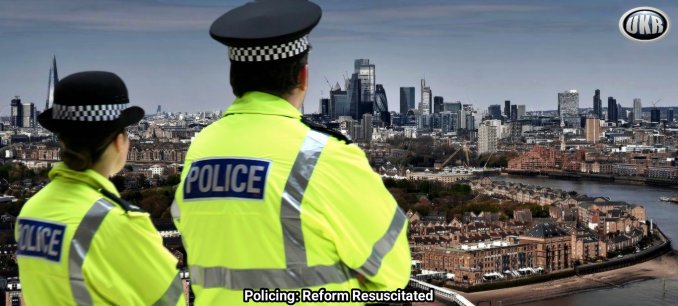
Policing: reform resuscitated
RICHARD NORTH
No sooner have we begun to digest Lammy’s jury proposal, set out without a mandate and therefore lacking democratic legitimacy, then The Muslim Lady is at it, mooting fundamental changes to our police forces, with a radical scheme to alter the structure of policing that barely, if at all, gets cover from the 2024 Labour manifesto.
What we do get there, amid 30 mentions of the word “police” is a commitment to “raise standards by reforming the police”. But the only reference to any structural reforms – amid a welter of small changes – is a promise to ensure the service “is organised so as to enable investment in specialist capabilities, such as digital forensics, and to more effectively tackle cross-border issues such as serious organised crime”.
According to The Times though, Mahmood is proposing to go much, much further than this, talking of “generational reforms” which would see the 43 territorial forces in England and Wales reduced to a mere 12 regional units.
As the moment, no details have been published as we are told that Mahmood has delayed the publication of a long-awaited White Paper for police reform until the new year because she wants to make bolder changes than previously planned, having discussed the changes with police chiefs over the past fortnight in a series of meetings.
Although The Times refers to England and Wales, the figure of 12 regions is suspiciously similar to John Prescott’s 2002 proposals for regional governments, which would have had eight English regions, plus London and one each for Wales, Scotland and Northern Ireland, corresponding with the electoral regions for the European Parliament.
The regions project was very much John Prescott’s baby, who had long championed the cause, although many suspected what he was working to an EU agenda, with the Commission very much favouring regional government in the member states as a means by bypassing national governments and reducing their power.
In Prescott’s grand scheme, the government pledged that referendums would be held “region by region” to allow people to decide if they wanted a directly elected assembly.
The North East was the first, and ultimately the only, region where a referendum was held, taking place in November 2004. To Prescott’s evident chagrin, the proposal was decisively rejected by voters, with nearly 78 percent voting “No”.
Following this emphatic defeat, the government shelved plans for elected regional assemblies in the other English regions, even though arrangements had already been made for a ballot in Yorkshire.
Despite this, it seems that the Labour government’s regional ambitions have not been shelved – nor indeed do they seem to have been confined to Labour, with successive Tory governments laying the foundations for creeping regionalisation.
The most recent round started under the guise of local government reorganisation in 2019, following an already established trend towards single-tier “unitary” authorities. The Starmer regime initiated a further, broader push for “unitarization” in December 2024 with the publication of the English Devolution White Paper, inviting all remaining two-tier areas to submit proposals.
Since 2019, this process of creeping regionalisation by stages has imposed on us new unitary authorities in Dorset, Buckinghamshire, Northamptonshire, Cumbria, North Yorkshire and Somerset, entirely without democratic consent – lacking even a whiff of anything like a referendum.
The English Devolution White Paper in December 2024 invited remaining two-tier areas to propose unitary status, with potential establishments starting in April 2027 or April 2028. Councils in 21 areas across England are currently developing proposals, the net effect of which will be to abolish the ancient two-tier local government structure of districts and counties.
Doubtless, that is not going to be the end of the process, as the government seems intent on a process of regionalisation by stealth, and is having to complete the process in stages, presumably fearing that an overt agenda would trigger the sort of pushback experienced in 2004.
As to these new police “reforms”, the proposal to amalgamate existing forces into a mere 12 regions is far too close to government aspirations to be a coincidence and is doubtless another lurch in the direction of a national structure of regional government.
The Muslim Lady, of course, is talking the language of making police forces more effective and consistent at fighting crime, arguing that the amalgamation will save money by pooling technology, procurement and expertise – alongside a modernisation of policing practices across England and Wales.
However, we’ve been there before. I remember as a trainee local government officer concerned with the rest of my colleagues about the 1972 local government reorganisation, being assured by our lecturer that there has never been a reorganisation “without officers having to take their salaries home in armoured cars”.
So it turned out to be – for the upper-echelons at least – and the current enthusiasm of chief constables for amalgamation is probably fuelled by the anticipation of bloated “fat cat” salaries for the top tier of the new regional forces.
The Times does in fact partially give the game away when it suggests that Mahmood’s proposed changes “could mirror other areas of the criminal justice system such as the 12 probation regions or the local government changes giving new powers to mayors, which will replace police and crime commissioners (PCCs) from 2028”. But “could” is not the operative word. The intent is about as transparent as an Afghan youth following an English girl into the local park.
We are told that Mahmood hinted at the reforms at a policing conference last month when she described the structure of police forces in England and Wales as “irrational” and causing inconsistencies, a conference appearance that was reviewed at the time by the BBC.
At the time, she complained that: “We have 43 forces tackling criminal gangs who cross borders, and the disparities in performance in forces across the country have grown far too wide, giving truth to the old saw that policing in this country is a postcode lottery”.
As well as abolishing PCCs, we are told that the white paper will also include reforms that were announced under Yvette Cooper, the former home secretary, such as the new national centre of policing that will support police forces with specialist functions such as forensics, drone technology and artificial intelligence, and a new national procurement body to tackle huge disparities between police forces on how much they pay for vital kit.
However, claims of greater efficiency and improved performance must be taken with a pinch of salt. The effectively single-tier structure of UK forces is relatively uncommon in police forces throughout Europe and the United States, with many forces not only adopting multi-tier structures but also embracing high levels of decentralisation – certainly in the lower tiers.
There are a number of international bodies which provide performance rankings of national police force performances and while the UK generally performs well according to these indices, it is by no means a leader and is outranked by some multi-tier forces.
As much to the point, there is no clear correlations between force performances and structures, as results of studies are mixed and context-dependent. There is no universal “better”. Crucially, continental multi-tier doesn’t clearly underperform the UK’s single-tier in indices, suggesting that structure is secondary to resources/culture.
Multi-tier decentralisation often correlates with higher efficiency in property crime prevention and community trust but can increase violent crime rates or coordination costs. Centralisation (single-tier) excels in uniform standards and rapid national responses but risks “one-size-fits-all” mismatches and community alienation.
As regards the Mahmood structural reforms, while there is theoretical and some empirical support for potential cost savings and operational benefits from consolidation, the evidence of any gains is mixed and inconclusive.
Experience drawn from the Scotland’s 2013 merger, when eight forces were reduced to one, achieved £1.7 billion in savings, but a 2022 evaluation could not detect any clear crime reduction attribution to structure alone. Some reviews have been highly critical.
On the other hand, we’ve been there before, with the previous Labour government. In 2005, home secretary Charles Clarke launched plans to bring force numbers to “as few as 12 strategic forces”, only to be faced with a rebellion by the police authorities throughout the country.
In 2006, Clarke tried again in England and Wales, with a proposal to reduce the force number to 24, but this was abandoned due to £1 billion-plus transition costs, local opposition (e.g., rural concerns over “city takeover”), and a leaked Home Office document warning mergers could be “costly and protracted” without guaranteed benefits, causing management distraction.
Official annual assessments of police performance suggests that most forces are “good”, and although smaller forces score lower on complex crimes like cyber/terrorism due to limited capacity, it has been noted that collaboration (not full mergers) yields efficiencies without restructuring risks.
The Institute of Fiscal Studies carried out research in 2024 on station closures (a proxy for consolidation) and found 11 percent violent crime spikes near closed sites, suggesting efficiency losses from reduced local presence. Broader studies highlighted the problem of “blind” cuts eroding trust and deterrence more than targeted reforms.
Amalgamation and further centralisation in itself, therefore, is no panacea and does not guarantee any gains – and no more than might be achieved by closer collaboration between forces. Outcomes depend on implementation, upfront costs, and unintended effects like disruptions to local policing.
When it comes to broader experience of government performance, the MoD’s 60-plus years of centralisation haven’t exactly yielded any great efficiencies, and the near 80 years of NHS centralisation have delivered as many disasters as they have success.
On anything but a lengthy timescale, with pilot regional alliances to test the viability or larger forces without full risk, and without the introduction of other improvements such as enhanced powers and capabilities for the National Crime Agency, Mahmood would be flying blind, playing with the risk of delivering an expensive fiasco, with no expectation of a successful outcome.
Without the White Paper in our hands, to see the detail, Mahmood’s precise motivation cannot be assessed. But, with past experience, we can only fear the worst and suspect that this is primarily a political project being implemented to a predetermined agenda, resuscitated from the previous Labour administration.

••••
The Liberty Beacon Project is now expanding at a near exponential rate, and for this we are grateful and excited! But we must also be practical. For 7 years we have not asked for any donations, and have built this project with our own funds as we grew. We are now experiencing ever increasing growing pains due to the large number of websites and projects we represent. So we have just installed donation buttons on our websites and ask that you consider this when you visit them. Nothing is too small. We thank you for all your support and your considerations … (TLB)
••••
Comment Policy: As a privately owned web site, we reserve the right to remove comments that contain spam, advertising, vulgarity, threats of violence, racism, or personal/abusive attacks on other users. This also applies to trolling, the use of more than one alias, or just intentional mischief. Enforcement of this policy is at the discretion of this websites administrators. Repeat offenders may be blocked or permanently banned without prior warning.
••••
Disclaimer: TLB websites contain copyrighted material the use of which has not always been specifically authorized by the copyright owner. We are making such material available to our readers under the provisions of “fair use” in an effort to advance a better understanding of political, health, economic and social issues. The material on this site is distributed without profit to those who have expressed a prior interest in receiving it for research and educational purposes. If you wish to use copyrighted material for purposes other than “fair use” you must request permission from the copyright owner.
••••
Disclaimer: The information and opinions shared are for informational purposes only including, but not limited to, text, graphics, images and other material are not intended as medical advice or instruction. Nothing mentioned is intended to be a substitute for professional medical advice, diagnosis or treatment.
Disclaimer: The views and opinions expressed in this article are those of the author and do not necessarily reflect the official policy or position of The Liberty Beacon Project.


Leave a Reply