

PETER FRANKLIN
Peter Franklin is an Associate Editor of UnHerd
At times it feels like this government is on the verge of collapse. But as I’ve argued before, that’s a comforting illusion. With 411 MPs out 650, Labour is here for the duration.
At the time of writing, a petition calling for a fresh election has gathered more than two million signatures. That’s impressive, but it can only be a token (though satisfying) gesture. Unlike Rishi Sunak, Keir Starmer won’t be subjecting himself to the voters’ verdict any earlier than he has to.
At some point, the Conservative Party will wake up to the powerlessness of opposition. The protracted leadership race and its aftermath created a semblance of agency because we’ve had decisions to make — but, unfortunately, none of them have anything to do with running the country. So as bad as the last five months have been, the fact is that Keir Starmer, Rachel Reeves, David Lammy, and the rest of the crew have got ten times as long to do their worse, and there’s not much we can do about it.
Of course, Labour ambitions are constrained by a low growth, highly indebted, and over-taxed economy. But in terms of what they might do next, that’s just the problem — the Blair-Brown model of placating Bolshie backbenchers ( the credit-fuelled expansion of the state) is broken. Other titbits must be found to toss to the wolves.
We’ve seen where that leads already. Take the tax raid on family farms. Do you think that was the result of some Treasury official getting their sums wrong? Admittedly, there was a case for closing a loophole in the tax system, but the fact that so many ordinary farmers were caught up in the sweep is a feature of the policy, not a bug. The Left despises private property, self-reliance, and the countryside. With this ruinous measure they can hit all three in one go. When in doubt, expropriate the Kulaks.
So if you want to know why Labour are doing this, it’s because they can. Losing power carelessly has consequences — and there’s plenty more to come.
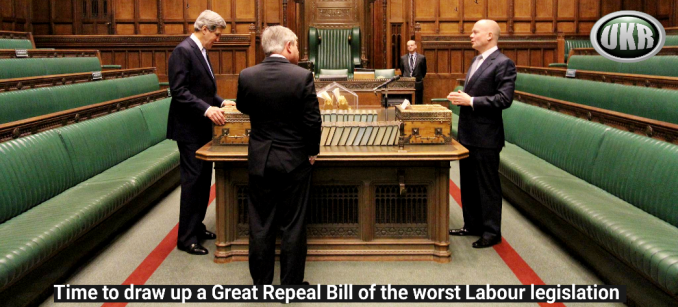
But enough doom and gloom, it’s time to fight back. For that we need ideas beyond the usual routines of opposition. What I’d like to propose today is inspired by the Great Repeal Bill, which was the centre-piece of The Plan — a programme for government drawn up by Daniel Hannan and Douglas Carswell in 2008.
The purpose of the bill was to topple a stack of New Labour legislation in one fell swoop. A watered-down version, focused on civil liberties, was taken up by David Cameron’s government — and eventually passed as the Protection of Freedoms Act 2012. I should also mention the European Union (Withdrawal) Act 2018 — because that too was first proposed using the Great Repeal title.
In 2024, the Conservative front-bench should draw up a third Great Repeal Bill. Its purpose wouldn’t be to get rid of all the legislation passed under Starmer, but rather to target and expose the worst of it.
Items would be added under one or more of the following headings. Firstly, badly drafted and poorly scrutinised legislation. Secondly, measures which are clearly spiteful in intent. And thirdly, new laws for which Labour has no mandate and which have been pushed through in the face widespread public opposition.
Examples include the attack on family farms I’ve already mentioned. Another would be the levying of VAT on school fees. Labour’s sabotage of free speech protections in universities could also be reversed via this Bill. In addition, I’d put the beer garden smoking ban on the list — because even a militant anti-smoker like me can see what a petty, puritanical measure that is.
At the other end of the significance scale, there should be major doubts over Kim Leadbetter’s assisted dying bill. Strictly speaking, this isn’t government legislation — but it is the Government’s decision to set aside a wholly inadequate amount of time for parliamentary scrutiny. Wherever you may stand on the issue itself, it’s wrong that such a far-reaching change to the law should be made in such a peremptory fashion. If it is rushed through its remaining stages then it too must be marked for repeal.
We should also look at the interpretation of existing laws by various arms of the state. A prime example is the decision of the British Transport Police to allow trans-identifying male officers to strip-search women. Though this doesn’t count as new legislation, the significance of the “guidance” is as if a new law had been passed — one with an intolerable impact on women’s rights. The Great Repeal Bill would be an opportunity to amend legislation wherever it’s been subject to official interpretations that Parliament never intended or even foresaw.
But what would be the point of drawing up a bill that the Conservative opposition is in no position to introduce, let alone pass?
For one thing, it begins the process of fleshing out a policy agenda. In the leadership contest, Kemi Badenoch consistently emphasised the importance of not making major policy commitments before properly thinking them through. She was right to do so. However, the via negativa of identifying examples of what should not be done — especially the most pointless, petty, and ill-considered legal innovations is a very different matter.
Drawing up a little list is something the party can get working on without delay. Furthermore, as the bill takes shape, voters who have lost faith in our ability to achieve change will be able to read, line-by-line, the precise changes we’d make as the first legislative act of a new Conservative government. Given its history, I hesitate to use the adjective “oven-ready”, but if and when we return to office it would be great if we could take back control from day one.
Used selectively — as a roll call of legislative and regulatory shame — the Great Repeal Bill might just serve as a disincentive to Labour’s worst instincts. At the very least, a party that lucked-out by winning a three-figure majority on just one-third of the vote would receive a salutary reminder of its loveless landslide and temporary grip on power.
Quoting Keith Joseph, Margaret Thatcher once spoke about the “socialist ratchet” — meaning the deep-seated assumption that “once a socialist reform had been introduced, it remained.” It was as if the post-war, pre-Thatcher Tories had swallowed a Left-wing narrative of history, in relation to which the sole of purpose of conservatism was to act as a moderating influence.
If nothing else, Thatcher taught us that another way was possible. There are no inevitabilities in our national story and we’re no more bound to ever-encroaching collectivism then we are to irreversible decline.
Today, we need to re-learn that lesson. The Old Labour ideas and practices that Thatcher defeated might not be coming back, but they’ve been replaced by a 21st-century form of Leftism — one that is all the more dangerous because it’s been semi-internalised by a defeated and defeatist Conservative Party.
The project of a Great Repeal Bill would have a much-needed galvanising effect. While we can’t stop Labour now, we can prepare the first draft of a better future.
This article (Peter Franklin: Time to draw up a Great Repeal Bill of the worst Labour legislation) was created and published by Conservative Home and is republished here under “Fair Use” with attribution to the author Peter Franklin

••••
The Liberty Beacon Project is now expanding at a near exponential rate, and for this we are grateful and excited! But we must also be practical. For 7 years we have not asked for any donations, and have built this project with our own funds as we grew. We are now experiencing ever increasing growing pains due to the large number of websites and projects we represent. So we have just installed donation buttons on our websites and ask that you consider this when you visit them. Nothing is too small. We thank you for all your support and your considerations … (TLB)
••••
Comment Policy: As a privately owned web site, we reserve the right to remove comments that contain spam, advertising, vulgarity, threats of violence, racism, or personal/abusive attacks on other users. This also applies to trolling, the use of more than one alias, or just intentional mischief. Enforcement of this policy is at the discretion of this websites administrators. Repeat offenders may be blocked or permanently banned without prior warning.
••••
Disclaimer: TLB websites contain copyrighted material the use of which has not always been specifically authorized by the copyright owner. We are making such material available to our readers under the provisions of “fair use” in an effort to advance a better understanding of political, health, economic and social issues. The material on this site is distributed without profit to those who have expressed a prior interest in receiving it for research and educational purposes. If you wish to use copyrighted material for purposes other than “fair use” you must request permission from the copyright owner.
••••
Disclaimer: The information and opinions shared are for informational purposes only including, but not limited to, text, graphics, images and other material are not intended as medical advice or instruction. Nothing mentioned is intended to be a substitute for professional medical advice, diagnosis or treatment.


Leave a Reply