

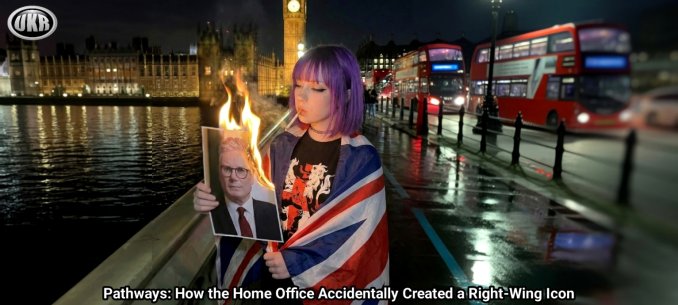
Pathways: How the Home Office accidentally created a right-wing icon
Amelia is a reminder of how badly governments misjudge the nations they claim to protect
PAUL BIRCH
A version of this article appears in The European Conservative
The UK Home Office’s Pathways training package was intended to counter the threat of radicalisation in the United Kingdom. Needless to say, this wouldn’t be the most ferocious form of radicalisation, which is Islamism, and by a huge margin. No, they decided to spend a great deal of time and taxpayers’ money on a programme highlighting that spectral terror which lurks only in the minds of civil servants and Church of England clergy—the dreaded ‘far right.’
Marketed as an interactive educational tool for schools, Pathways adopts the language and aesthetics of a video game to guide young people away from ‘dangerous pathways.’ In practice, of course, it’s only the one pathway they’re worried about. It reveals a great deal about how the modern British state now defines extremism and why that definition is detached from reality. Pathways has become a case study in institutional overreach, ideological confusion, and the persistent failure of Britain’s counter-extremism establishment to understand either public opinion or the threat landscape we ask them to manage on our behalf.
At the centre of Pathways is a character called Amelia; a purple-haired goth girl wearing a choker and a pink dress. Unless you have completely detached yourself from the internet over recent weeks, you will have almost certainly come across her, and you will have probably seen her indulging in such extremist practices as waving a Union Jack and generally loving her country.
Amelia is a teenage activist who questions mass immigration, protests against demographic transformation and expresses alarm at the direction of modern Britain. Within the game’s internal logic, engaging with Amelia’s views increases a ‘risk’ score, pushing the player closer to state intervention and the government’s Prevent process. The message is not subtle. Concerns regarding mass immigration and unwanted cultural change are treated not as political positions to be debated, but as symptoms to be managed. The line between radicalisation and dissent is not merely blurred—it is erased.
This framing exposes the true function of Pathways. It is less an anti-terrorism tool than a mechanism of ideological conditioning, one that treats mainstream concerns about borders, identity, and social cohesion as inherently suspect. In doing so, it confirms what many critics of Prevent have long argued: that counter-extremism policy has quietly expanded into the regulation of thought.
Unbelievably, the Home Office appears to have been caught entirely off guard by the reaction to Amelia. Rather than being rejected, she has been embraced, memed, remixed, and elevated into a symbol across online right-wing communities in Britain and across Europe. Far from functioning as a warning sign, she has become an anti-hero: a shorthand for the ordinary citizen whose views place her on the wrong side of official ideology.
This outcome was entirely predictable. When the state caricatures legitimate political positions, it does not delegitimise them; it validates them. Amelia’s popularity is not evidence of mass radicalisation. It is evidence of widespread exasperation with a political class that insists on vilifying dissent rather than engaging with it. Once released into the digital ecosystem, Amelia escaped Whitehall’s control. She now circulates across European right-wing spaces as a familiar figure—not because of British politics alone, but because her story resonates across the continent. Every country, it seems, now produces its own Amelias—citizens who notice social change, articulate concerns, and are told that doing so places them on a dangerous path.
The most serious flaw in Pathways is not its tone, but its priorities. Britain’s security services have been clear for years: Islamist extremism remains the most serious and ideological threat to the country. The overwhelming majority of attacks, disrupted plots, and terrorism-related deaths in the United Kingdom are linked to Islamist ideology. This is not a matter of opinion; it is a matter of record. And it is the same across Europe.
Yet, Pathways reflects a broader institutional drift away from this reality. Increasingly, counter-extremism resources are directed towards policing right-wing opinion, often defined so broadly that it includes views held by a sizeable portion of the electorate, while the most dangerous forms of extremism are treated with comparative caution—if, indeed, they are treated at all. The result is a grotesque imbalance. The state devotes ever more energy to monitoring attitudes while kowtowing to ideologies which have demonstrated a repeated willingness to translate belief into violence. This imbalance does not enhance public safety; it most assuredly undermines it.
Pathways also reopens uncomfortable questions about the Prevent Strategy itself. Originally introduced as a safeguarding mechanism aimed at preventing radicalisation turning into violence, Prevent has steadily expanded into a bloated, ill-organised surveillance framework. Teachers, youth workers, and public servants are encouraged to interpret political views as early warning signs, with teenage boys even being reported for crowding around a screen and looking at Andrew Tate-related content. This muddles any distinction between safeguarding and ideological enforcement.
This expansion has consequences. It erodes trust in public institutions, discourages open discussion and teaches young people that certain viewpoints (however widely held) are best kept hidden. Far from building resilience, it fosters yet further cynicism and resentment. Amelia’s transformation into a cultural icon should be understood in this context. She is not celebrated because she is thought of as extreme, but because she represents resistance: resistance to being infantilised by a state that no longer distinguishes between disagreement and danger and which holds most of us in utter contempt.
Ultimately, Pathways has backfired because it embodies a worldview that cannot or will not differentiate between terrorism and democratic dissent. By collapsing these distinctions, the UK Home Office has handed its critics a powerful symbol of its own making. The irony is spectacular. In attempting to warn young people away from so-called dangerous narratives, the British government has demonstrated precisely why those narratives flourish; because institutions refuse to engage honestly with public concern, preferring instead to moralise, stigmatise, surveil and, often, arrest. Counter-extremism policy cannot succeed if a nation’s government treats its ordinary citizens as latent threats, or if it prioritises ideological conformity over physical security. Britain does not need gamified moral lessons. It needs honesty about where real danger lies and the confidence to defend free political disagreement.
Until things change, Amelia will continue to grow and circulate across our continent.
This article (Pathways: How the Home Office accidentally created a right-wing icon) was created and published by Paul Birch and is republished here under “Fair Use”

••••
The Liberty Beacon Project is now expanding at a near exponential rate, and for this we are grateful and excited! But we must also be practical. For 7 years we have not asked for any donations, and have built this project with our own funds as we grew. We are now experiencing ever increasing growing pains due to the large number of websites and projects we represent. So we have just installed donation buttons on our websites and ask that you consider this when you visit them. Nothing is too small. We thank you for all your support and your considerations … (TLB)
••••
Comment Policy: As a privately owned web site, we reserve the right to remove comments that contain spam, advertising, vulgarity, threats of violence, racism, or personal/abusive attacks on other users. This also applies to trolling, the use of more than one alias, or just intentional mischief. Enforcement of this policy is at the discretion of this websites administrators. Repeat offenders may be blocked or permanently banned without prior warning.
••••
Disclaimer: TLB websites contain copyrighted material the use of which has not always been specifically authorized by the copyright owner. We are making such material available to our readers under the provisions of “fair use” in an effort to advance a better understanding of political, health, economic and social issues. The material on this site is distributed without profit to those who have expressed a prior interest in receiving it for research and educational purposes. If you wish to use copyrighted material for purposes other than “fair use” you must request permission from the copyright owner.
••••
Disclaimer: The information and opinions shared are for informational purposes only including, but not limited to, text, graphics, images and other material are not intended as medical advice or instruction. Nothing mentioned is intended to be a substitute for professional medical advice, diagnosis or treatment.
Disclaimer: The views and opinions expressed in this article are those of the author and do not necessarily reflect the official policy or position of The Liberty Beacon Project.


Leave a Reply