

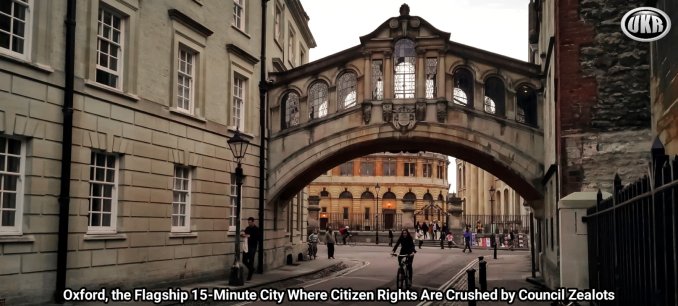
Oxford, the flagship 15-minute city where citizen rights are crushed by Council zealots
DR SHANE FUDGE
LOW Carbon Oxford (LCO) describes itself as ‘a network of organisations with a shared vision of Oxford as a low carbon city. Over 40 diverse organisations working together to achieve the city’s very ambitious target of reducing emissions in Oxford by 40 per cent by 2020’.
The LCO website has clearly not updated its calendar, but you get the picture. At the heart of this endeavour, Oxford city council has been one of the leading local authorities (LAs) in the UK’s green agenda for the best part of three decades.
Spotting the perfect opportunity to assert its position at a time of reduced spending and political marginalisation by the then Conservative administration, the council was jostling for position in the wake of the 1992 Rio Earth Summit when the role of local government, communities and committed individuals was first proposed in the UN’s ‘Local Agenda 21’ and then extended practically through UN-affiliated organisations such as ICLEI (Local Governments for Sustainability).
Such has been the success of the council’s alignment with this programme that it ‘finds itself’ positioned as the flagship 15-minute city, and a central element of the UK Government’s push to line up all their ducks in preparation for the elite’s fourth industrial revolution.
As the Oxfordshire Guardian reflected: ‘A 15-minute city is the title that has been given to traffic reducing schemes in cities around the world and is a decentralised residential environment where everything you could need – work, food, education and cultural facilities – is within quarter of an hour by foot or bike.’
Or you could interpret this utter scam as Rosa Koire communitarianism where ‘individual rights in general are to give way to the needs of communities, as determined by a globalist governing body’.
It was the volatility of energy prices after privatisation – and the ways these effects rippled out into society – which ostensibly drew LAs back into an area where they had once been central players.
The liberalisation of energy markets in the 1980s and 1990s meant that fuel poverty, energy efficiency in housing and planning became bigger issues for local government and enabled them to grab back some of their power and decision-making capabilities from central government.
Then we had sustainable development. Oxford was among a group of local authorities at the time who embraced this agenda as a way forward during a politically and economically uncertain time.
Manchester city council, Woking borough council, Cornwall council and Surrey county council are just a few of the more obvious examples of LAs which have, over time, reinvented themselves around ‘sustainable development’. Some LAs were more ambitious. Woking for example, embraced a renewable energy pathway. Its Poole Road Energy Centre will become the centre of ambitions to generate, distribute and supply heat to businesses and residents and power in the town and surrounding areas.
Others have taken a more diverse approach. Manchester’s ambitions are, for instance, more about embedding sustainable practices into their own operations – ‘sustainable procurement’ – and funding ‘appropriate’ local businesses and organisations which more directly engage with issues such as sustainable transport and mobility, the development of green spaces, or the promotion of cleaner air quality.
The spectre of the imminent roll-out of 15-minute cities across the UK is on another level from what has been accomplished by these institutions so far, however. They will be the climate fanatics’ fantasy.
If this agenda crosses the finishing line, all the green movement’s perceived injustices, inner projections on the rest of humanity and finger-wagging contempt for all the careless ways we have treated Mother Earth will become crystallised into one neat package of control and subordination.
As the third part of the ‘triple lock’ and the final addition to digital ID and programmable currency, a UK-wide 15-minute city infrastructure will constitute the ‘space and location’ element of enforced change upon business-as-usual and ‘profligate’ consumption. These digital/physical structures will redraw, ring-fence and relegalise our rights and freedoms.
Surveillance cameras, road sensors and physical barriers will by then have ensured compliance, obedience and acquiescence to the UN’s sustainable development programme – all justified under the guise of a ‘climate crisis’.
The rise of data centres in the UK – which will harvest and store the information by which 15-minute cities will run – is the latest example of what the role of LAs has really been about since 1992, as local government planning moves ever closer towards the great reset.
As the plan to divide the UK into 15-minute cities continues apace, the Government has given its blessing to the increased powers and duties of LAs to deliver and co-ordinate the ‘on the ground’ practicalities of what is to come. Not that it really had any choice. This has indeed been the central aim of Local Agenda 21 – to co-ordinate and empower global, national and local level sustainability endeavours in the same direction. So much the better if these networks begin to undermine sovereignty and the powers of the nation state through ideological push from below. By offering increased powers to local government agencies, community organisations and citizens who are desperate to see the green agenda come to fruition, it is all about ‘win-win’ for the UN and its technocratic overlords.
As with other forward-thinking LAs, Oxford has been clever opportunistically, quick to capitalise on the growing politicisation of sustainability as a brand which would, over time, draw together stakeholders, enable beneficial partnerships with sustainability-facing businesses and civil society groups, and construct five-star funding stream beneficiaries.
These LAs would also become a lightning rod for activists – both organic and paid for by vested interests. This organisational strategy aligns with Anthony Downs’s observations that bureaucracies are wired to facilitate networks of external information and then harnessing these connections to maximise institutional capabilities, resources, and longevity.
The emergence of Oxford city council and the 15-minute city as a beacon of sustainability illustrates how it has flourished as the vanguard of a significant nexus of public-private partnerships and interests, all ultimately operating under the auspices of the UN.
This article (Oxford, the flagship 15-minute city where citizen rights are crushed by Council zealots) was created and published by Conservative Woman and is republished here under “Fair Use” with attribution to the author Dr. Shane Fudge

••••
The Liberty Beacon Project is now expanding at a near exponential rate, and for this we are grateful and excited! But we must also be practical. For 7 years we have not asked for any donations, and have built this project with our own funds as we grew. We are now experiencing ever increasing growing pains due to the large number of websites and projects we represent. So we have just installed donation buttons on our websites and ask that you consider this when you visit them. Nothing is too small. We thank you for all your support and your considerations … (TLB)
••••
Comment Policy: As a privately owned web site, we reserve the right to remove comments that contain spam, advertising, vulgarity, threats of violence, racism, or personal/abusive attacks on other users. This also applies to trolling, the use of more than one alias, or just intentional mischief. Enforcement of this policy is at the discretion of this websites administrators. Repeat offenders may be blocked or permanently banned without prior warning.
••••
Disclaimer: TLB websites contain copyrighted material the use of which has not always been specifically authorized by the copyright owner. We are making such material available to our readers under the provisions of “fair use” in an effort to advance a better understanding of political, health, economic and social issues. The material on this site is distributed without profit to those who have expressed a prior interest in receiving it for research and educational purposes. If you wish to use copyrighted material for purposes other than “fair use” you must request permission from the copyright owner.
••••
Disclaimer: The information and opinions shared are for informational purposes only including, but not limited to, text, graphics, images and other material are not intended as medical advice or instruction. Nothing mentioned is intended to be a substitute for professional medical advice, diagnosis or treatment.
Disclaimer: The views and opinions expressed in this article are those of the author and do not necessarily reflect the official policy or position of The Liberty Beacon Project.


Leave a Reply