

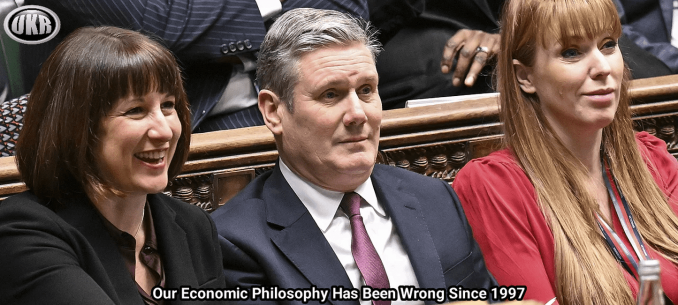
Our economic philosophy has been wrong since 1997
EWEN STEWART
ONE OF my friends is a joker. He sent me this from Starmer’s X account a few days ago proclaiming the Good News of Labour.
‘The Tories left us with a £22bn black hole. My government has fixed the foundations of our economy. We now have the fastest growth in the G8 (sic), four interest rate cuts and we have signed three trade deals to protect jobs and put more money in your pockets. Keir Starmer 9/6/2025’
Does our Prime Minister really believe this nonsense, or is it just part of the spin and optics he thinks will impress us? If he does believe it he is deluded.
I have followed and written on the British economy for over thirty years and, believe me, while there has been a steady erosion in the edifice over the last twenty or so of those years, we are now reaching a point which is close to terminal. The foundations are built on sand.
To cap Starmer’s amusing alchemy was Rachel Reeves’s statement in the Commons on Wednesday outlining her spending plans for 2025-26. Listening to her toss money around you would have thought the patient had a strong bank account, not that it was on its knees.
There is a complete misunderstanding here as to how economies become healthy, sustainable and prosperous. The Reeves view seems to be she knows best and the orchestra requires her conducting. Every assumption she made strengthened the state and weakened the private sector. Central spending was to increase, employment legislation to tighten yet further, weakly costed and largely unviable infrastructure projects announced and yet more money was put into pet projects and the net zero fantasy.
Public spending remains out of control and will continue to grow at 2.3 per cent in real terms, a rate much faster than the private sector and that is from a base where public spending is already not far off half the entire economy.
Reeves’s spending plans amount to the State spending a staggering £48,000 for each of the 28 million households in the land. £48,000 – imagine! I would be fascinated as to what proportion of readers believe they are even getting half that amount in ‘value back’. This extraordinary largesse is despite the fact that the national debt has increased eightfold since Tony Blair came to power in 1997. Eight times for exactly what?
Reeves’s statement was full of factual errors. Her starting assumption that there was a £22 billion hole is utter fiction. The hole is more like £200bn in excess spending after inflation since Johnson became Prime Minister in 2020. (Total managed expenditure £888bn 2019-20, forecast £1,389bn current year, Office for Budget Responsibility – nominal numbers before inflation) And she wishes to increase that imbalance further.
Moreover Reeves continues to peddle the myth of austerity. The trouble is that this fiction, repeated so often, gains traction. As a matter of record, how could there conceivably have been any austerity when the state has increased from a third of the economy under Blair to almost half today? The austerity has entirely been in the private sector as absurdly poor policy decisions on spending, tax, regulation, net zero, the lot, have been taken by successive governments.
Each decision has the false underlying assumption that we the State benevolently know best. It’s a complete fallacy. Successful economies are built on strong foundations of trust and consistency of law, moral foundations based on family, community and mutual trust, non-arbitrary tax and regulation, and a strong competitive private sector. All of these factors have been greatly, and in some cases deliberately, eroded.
The unfortunate truth is Britain is no longer in any material sense a free-market economy. It is one of the most directed command economies in the world. There are a few nations whose state spending exceeds the 45 per cent that is the UK’s figure (France, Belgium and Italy come to mind) but the UK state is some 10 points higher than OECD averages and often twice the size of Asian competitors who are catching up to the UK rather quickly. As corrosive as the scale of the state is, the degree of control even over notionally private sectors is every bit as damaging.
A few examples:
Energy policy is entirely under direct state control, with disastrous effects – domestic energy pricing is several times that of the US.
The banking sector is regulated to an inch of its life, as is the City.
Employment terms are also highly dictated from minimum wage legislation to diversity targets and contextual offers.
Transport policy is hardly free. Look at the railways.
Private education is marginalised and bullied as the state does not like competition.
Even agriculture is under the regulatory and tax thumb.
The unfortunate truth is the unfettered private sector in the UK is now tiny, perhaps less than a third of the entire economy. It is not a coincidence that as this highly productive free market sector has shrunk, so our economy has withered and growth stagnated.
Consider when was the last time any significant manufacturer listed on the London Stock Exchange over the last twenty years? I can barely think of one. Come to mention it, with the honourable exceptions of the recent tech float Raspberry Pie and the drinks manufacturer Fever Tree, when was the last time any UK company in any productive sector floated excluding government outsourcing companies, or some public sector-backed consultancy? Doubtless there are one or two, but a very few. Contrast this with the US where literally hundreds of true private-sector start-ups have blossomed over the same period.
I have followed a very simple personal investment philosophy over my career. Never invest in anything where the Government is the substantial customer or regulatory controller. The reasoning was simple. Their decisions are often arbitrary and open to review. They are what one might call an exogenous factor; in plain English unpredictable and unreliable.
This philosophy has broadly served me well. Unfortunately the entire UK economy is now becoming the plaything of the State. Until there is a change of philosophy, and we must urgently pray that there is, Britain is largely uninvestible. Far better opportunities, sadly, exist elsewhere.
If you appreciated this article please share and follow us on Twitter here and like and comment on facebook here. Help support Global Britain publishing these articles by making a donation here.
Ewen Stewart is a City economist whose career has spanned over 30 years. He is director of Global Britain and a co-founder of Brexit-Watch.org.
This article (Our economic philosophy has been wrong since 1997) was created and published by Global Britain and is republished here under “Fair Use” with attribution to the author Ewen Stewart
See Related Article Below
The ‘experts’ you’ve never heard of inspiring Rachel Reeves’s disastrous economic policy
If you want to know who the Chancellor will clobber next, try looking at the radical tax ideas pushed by CenTax
A little like the Chagos Islands giveaway and, more recently, the apparent Gibraltar sell out, it’s almost impossible to work out the motivations behind each and every idiotic decision this Labour Government takes.
There’s a palpable sense of incredulity spreading across Britain as the Prime Minister and Chancellor continue to insist that everything is going swimmingly despite most key markers showing precisely the opposite is true.
Take the economy. In Wednesday’s Spending Review, Rachel Reeves boasted that she had “wasted no time” removing the barriers to growth. Less than 24 hours later, the Office for National Statistics (ONS) revealed that UK GDP had shrunk by 0.3 per cent in April.
Labour continues to splurge taxpayers’ hard-earned cash despite the national debt sitting at around 96 per cent of GDP, the budget deficit more doubling in the past seven years, and public spending being on a par with the profligate Labour government of the 1970s, which almost bankrupted the country.
Back then, taxes as a share of GDP were around 33 per cent. Forecasts suggest that, by 2027, they could reach 37.7 per cent. Unemployment is at its highest level in four years, UK payrolls have lost 276,000 employees since the autumn Budget, and a millionaire is reportedly leaving the UK every 45 minutes under Labour.
Still, no one in the Cabinet appears able to rule out further tax rises, with Paul Johnson, the outgoing chief of the Institute for Fiscal Studies (IFS) concluding that “council tax bills look set to rise at their fastest rate over any parliament since 2001-05.”
Who is advising Reeves on tax policy, and her relentless assault on our wallets?
Readers may not have heard of Arun Advani and Andy Summers, but these little known academics may have been the inspiration for Labour’s seemingly never-ending tax grab.
They run the Centre for the Analysis of Taxation (CenTax), which some credit for Labour’s farm tax.
Advani, who is associate professor in the economics department at the University of Warwick, called for inheritance tax “loopholes” on farms to be scrapped in two reports for the Institute for Fiscal Studies, as well as writing a further report for CenTax making the same arguments for changes to both Agricultural Property Relief (APR) and Business Property Relief (BPR) last October.
After Advani boasted at the Labour Party Conference that he was “optimistic” because the Labour government is “genuinely listening” to his ideas, Reeves announced in the Budget that the availability of 100 per cent relief for agricultural and business property would be capped at £1 million.
So far, so predictable, you may argue. What’s the harm in tapping up Left-wing think tanks for radical tax ideas? Do Conservative governments not rely on the research of free market institutes? Well, some have alleged the Treasury relied solely on CenTax’s projection that the changes would raise £520 million, without doing its own calculations.
As it conceded in response to a Freedom of Information request: “H M Treasury does not hold a disaggregated cost projection for the revenue raised from the measure announced at Autumn Budget 2024 to restrict these reliefs. This is a combined policy across the reliefs, rather than separate policies for each relief.”
Even more problematically, the £520 million figure has been challenged. The OBR itself said it was uncertain how much would be raised as a result of behavioural responses, whilst CBI Economics calculates that the new tax on both family firms and farms will actually cost the Treasury £1.9 billion over the next five years.
Advani claimed that only around 500 farms would be affected by the tax. As the Adam Smith Institute points out, however, “the government’s much-quoted ‘500’ a year is really 15,000 a generation.” The true number of farms could be more than 40,000.
Separate research, commissioned by Ashbridge Partners, found that one in 10 farmers surveyed said they will face an IHT bill of more than £1 million due to the inheritance tax hike, with 31 per cent expecting to pay more than £500,000.
Why didn’t Labour listen?
The Telegraph: continue reading
Image by By © UK Parliament / Maria Unger – UK Parliament, CC BY 3.0, https://commons.wikimedia.org/w/index.php?curid=149439832

••••
The Liberty Beacon Project is now expanding at a near exponential rate, and for this we are grateful and excited! But we must also be practical. For 7 years we have not asked for any donations, and have built this project with our own funds as we grew. We are now experiencing ever increasing growing pains due to the large number of websites and projects we represent. So we have just installed donation buttons on our websites and ask that you consider this when you visit them. Nothing is too small. We thank you for all your support and your considerations … (TLB)
••••
Comment Policy: As a privately owned web site, we reserve the right to remove comments that contain spam, advertising, vulgarity, threats of violence, racism, or personal/abusive attacks on other users. This also applies to trolling, the use of more than one alias, or just intentional mischief. Enforcement of this policy is at the discretion of this websites administrators. Repeat offenders may be blocked or permanently banned without prior warning.
••••
Disclaimer: TLB websites contain copyrighted material the use of which has not always been specifically authorized by the copyright owner. We are making such material available to our readers under the provisions of “fair use” in an effort to advance a better understanding of political, health, economic and social issues. The material on this site is distributed without profit to those who have expressed a prior interest in receiving it for research and educational purposes. If you wish to use copyrighted material for purposes other than “fair use” you must request permission from the copyright owner.
••••
Disclaimer: The information and opinions shared are for informational purposes only including, but not limited to, text, graphics, images and other material are not intended as medical advice or instruction. Nothing mentioned is intended to be a substitute for professional medical advice, diagnosis or treatment.
Disclaimer: The views and opinions expressed in this article are those of the author and do not necessarily reflect the official policy or position of The Liberty Beacon Project.


Leave a Reply