

The War on Public Mobility is Escalating
#TOGETHER
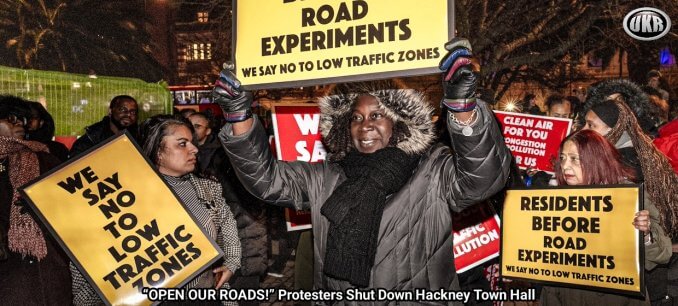
On Monday night, protesters surrounded Hackney Town Hall chanting “open our roads” and forced a halt to a council meeting.
“Since Hackney Council’s road closures and ‘Low Traffic Neighbourhoods,’ residents report longer journeys, reduced access, displaced traffic, and daily disruption to work and family life” said a resident.
This came a couple of days after an article headlined “Labour opens door to ‘Stalinist’ 15-minute cities across Britain,” The Telegraph reports that:
“Ministers have said that they will allow councils to use driver licence (DVLA) databases to impose fines on drivers who fall foul of “traffic filters”, which restrict driving in certain areas.”
While councils have long used DVLA data to enforce traffic offences, the explicit application of this system to traffic filters – which restrict access across whole neighbourhoods – seems to represent a significant and concerning extension of its use.
The War on Public Mobility is very much ongoing…
…and it is a war on the public, since it’s clear that while the main focus of the many measures introduced in recent years is on drivers, restrictions on the roads make it difficult for everyone to get around.
20mph speed limits – and the congestion Transport for London now admits Low Traffic Neighbourhood roadblocks cause – slow buses down, making for longer journey times. Average speeds in London have now fallen below 9 mph.
The recent Budget also brought news of two new measures which will make it more expensive to get around: pay-per-mile (wasn’t this called a “conspiracy theory?”) and a tax on taxis.
And if you assume a Net Zero worldview that starts from the premise that people must be forced to drive less, it’s hard to regard proposed (and actual) new restrictions on young drivers at one end, and older drivers at the other, as separate or accidental.
Here’s a roundup of some of the key issues around the country – and the public pushback…
Mad bad councils – and legal challenges
With its apparently never-ending introduction of new charges and restrictions, Oxford is arguably the epicentre of the war on road-users.
The introduction of the notorious permit system in which drivers will exceeding their allocated hundred journeys a year will have to pay a £70 fine to drive in the centre of Oxford, has been postponed till August 2026. Instead, a temporary congestion charge of £5 a day for drivers without a permit was introduced on 29th October. Oxford now has a number of active campaign groups working to preserve public mobility. One of them, Open Roads for Oxford, is taking the first step towards a legal challenge against the congestion charge.
The prospect of yet more taxes and restrictions on drivers by Oxfordshire County Council, which include the introduction of a Workplace Parking Levy, are generating widespread opposition from the public. In a recent survey commissioned by the Oxford Business Action Group, 64% of respondents said they either agreed “strongly” or “tended” to agree with the statement “Oxfordshire County Council is anti-car”.
Co-chairman of OBAG and local business owner Jeremy Mogford said that “extreme measures” such as traffic filters weren’t wanted by locals, many of whom lived outside the centre and relied on cars to get into the city:
“It’s time Oxfordshire County Council stopped making their lives more difficult. Instead of divisive anti-car ideology, we need sensible, harmonious transport policies embracing walking, cycling, taxis, buses and the car. We know that many local journeys can only be made by car.”
There’s a growing perception that the council is using motorists as “cash cows”. According to data gathered by the Oxford Mail, the cameras for Oxford’s zero emissions zone have brought in £1.84 million in fines since 2022. On top of all this, the city has no fewer than nine Low Traffic Neighbourhood (LTN) roadblocks!
Meanwhile in Hackney…
With 19 LTNs covering half of its total area, Hackney is the London borough with the most traffic restrictions of this kind. Since they were introduced by the Labour-run administration in 2020, nearly two-thirds of the borough’s roads are now part of LTNs.
Recently more than 1,500 people signed a petition lambasting Hackney Council for following “urban theory and not real life”.
“We wake up, and another road is closed. We’re no longer driving through Hackney – we’re being pushed to the outskirts of our own borough,” states the petition. “The result? Ten-minute journeys taking 30+ minutes, delays in reaching loved ones, essential services … disruption for parents, carers, elderly and disabled residents. Local businesses are struggling [and] emergency services and workers are being held back.”
It’s not that the council itself doesn’t know this. Its own data shows that the LTNs haven’t improved air pollution while an internal survey found that a majority of those surveyed did not agree with LTNs. A Labour councillor has expressed her “lack of confidence” in LTNs.
Having passed the threshold of 750 signatures, the petition should be debated at a full council meeting.
Bristol – the sorry saga goes on
The latest in Bristol’s war on cars is the news that fire brigades have been impeded from attending emergencies by the bollards and planters the council placed in the roads.
Campaigners in Bristol, with support from Together, have been warning about the likely consequences of the East Bristol Liveable Neighbourhood since early 2023. But Bristol City Council refused to listen, using the police to help contractors install roadblocks in the middle of the night.
Unbelievably, the council is now trying to impose a mega-LTN on the south of the city, despite conclusive evidence that locals do not want it. Council bosses are making noises about “listening” while revealing the different tactics they plan to use this time around – banning parking in some areas and requiring residents to pay for parking permits.
Residents, beware: councils like controlled park zones because they effectively turn the street into council-run car parks. As this article in the Daily Mail shows, once CPZs are in place, the price of parking permits can go up… and up. They’re another stealth tax on the motorist.
Support from the top
In August, government ministers quietly ditched reforms that would have made it harder for councils to impose measures that make life difficult for road users.
Rishi Sunak’s “Plan for Drivers” in October 2023 included draft guidance that would have forced councils to focus more on the views of residents and businesses when considering LTNs.
Then, campaigning for the election in 2024, Starmer actually told the electorate: “Labour is the only party on the side of drivers”.
This was a lie, of course. Months into his premiership, Starmer announced rises in car tax, while his transport minister Louise Haigh said councils would have her “absolute support” to introduce LTNs, before quitting after a fraud offence was revealed. Friend-of-the-motorist Starmer’s answer to this was to appoint Heidi Alexander – one of the so-called “architects of ULEZ” and a supporter of 20mph zones – as her successor.
Funding followed. In February the government announced almost £300 million for “active travel schemes” (mostly a euphemism for LTN roadblocks) in England, followed by a £1 million “innovation fund” in October.
On the face of it, schemes to “promote walking and cycling” sound benevolent. But we’ve been here before – the LTNs which have blighted the lives of so many were sold to an unsuspecting public like this.
More taxes on movement
One of the many unpleasant surprises of the Budget for some was the news that pay-per-mile taxes are to be levied on electric vehicles from April 2028.
The tax at a rate of 3p per mile for electric vehicles and 1.5p per mile for plug-in hybrids will be administrated by DVLA, and supposedly involve annual checks of mileage, seemingly at the MOT. But questions remain as to how exactly it will work – will cars still be charged for motoring holidays in Europe, for example? What about new vehicles which don’t require an MOT for three years? Asked on BBC News, Rachel Reeves appeared not to have the first idea.
As we highlighted earlier this year, think tanks and even motoring organisations like the AA have long been pushing for pay-per-mile, right down to providing recommendations for the technology – a telematics dongle and app – that could be used to track the mileage… and the driver’s whereabouts. Experts point out that new cars have in-built tracking devices.
Tracking issues aside, this method of taxation gives the government much more control over the cost of getting around.
What’s 3p per mile today could become 10p, or £1 or even more at some point in the future. Since many new taxes are explicitly about changing behaviour, it would only take a couple of steps to “justify” the use of pay-per-mile in a system of carbon rationing.
The £££ signs are already flickering in tax collectors’ eyes, with Budget documents suggesting that drivers who under-declare mileage could be charged an increased rate in future.
Crucially, the introduction of pay-per-mile for electric vehicles belies the official line about them being “green”. Suddenly the narrative has shifted from emissions to road use and the fact that electric vehicles are up to 40% heavier than their petrol and diesel counterparts is now starting to be used as a “reason” why EV drivers should pay the Treasury more. See this comically absurd article about “autobesity” and why the drivers of some vehicles should pay more.
So why not be a good citizen and do without a car, instead getting the odd taxi when time is short, you have luggage to carry or you need to travel through a dodgy area late at night?
Well… as of the new year, every UBER or Bolt will cost you more too – with 20% VAT added to every trip!
It’s clear that while growing numbers of people are wising up and fighting back, the war on public mobility is escalating.
Together has been campaigning to Free Our Streets for a number of years now, and:
If you agree with us that people should have freedom to get around as they see fit, please join us as a member today.
We’re a small organisation but in a short time have shown we can have an impact, by:
➡ Being instrumental in getting the previous Government to stop central Government funding for Low Traffic Neighbourhood roadblocks (AKA “Liveable Neighbourhoods”)
➡ Spreading the word multiple times a day via social media with around 12,000 posts across eleven different platforms plus dozens of TV, radio and podcast appearances.
➡ Co-organising a large Trafalgar Square event against ULEZ ahead of the shock Uxbridge by-election result.
➡ Publishing two key research reports from Together’s Ben Pile, the first exposing Sadiq Khan’s bogus ULEZ claims and the second, ‘Clean’ Air, Dirty Money, Filthy Politics exposing anti-democratic organisations like UK100, C40 Cities and the Global Covenant of Mayors, with media coverage here and here.
SOURCE: #Together newsletter

••••
The Liberty Beacon Project is now expanding at a near exponential rate, and for this we are grateful and excited! But we must also be practical. For 7 years we have not asked for any donations, and have built this project with our own funds as we grew. We are now experiencing ever increasing growing pains due to the large number of websites and projects we represent. So we have just installed donation buttons on our websites and ask that you consider this when you visit them. Nothing is too small. We thank you for all your support and your considerations … (TLB)
••••
Comment Policy: As a privately owned web site, we reserve the right to remove comments that contain spam, advertising, vulgarity, threats of violence, racism, or personal/abusive attacks on other users. This also applies to trolling, the use of more than one alias, or just intentional mischief. Enforcement of this policy is at the discretion of this websites administrators. Repeat offenders may be blocked or permanently banned without prior warning.
••••
Disclaimer: TLB websites contain copyrighted material the use of which has not always been specifically authorized by the copyright owner. We are making such material available to our readers under the provisions of “fair use” in an effort to advance a better understanding of political, health, economic and social issues. The material on this site is distributed without profit to those who have expressed a prior interest in receiving it for research and educational purposes. If you wish to use copyrighted material for purposes other than “fair use” you must request permission from the copyright owner.
••••
Disclaimer: The information and opinions shared are for informational purposes only including, but not limited to, text, graphics, images and other material are not intended as medical advice or instruction. Nothing mentioned is intended to be a substitute for professional medical advice, diagnosis or treatment.
Disclaimer: The views and opinions expressed in this article are those of the author and do not necessarily reflect the official policy or position of The Liberty Beacon Project.


Leave a Reply