


One year of Keir Starmer
An era of inertia
PIMLICO JOURNAL
During the run-up to the 2024 General Election, Keir Starmer was keen to define himself not by what he is, but by what he is not. Positioning himself as a largely contentless alternative to the operational dysfunction and ideological abandonment that had characterised the previous Conservative government. Picking up the mantle from an era of Corbynite radicalism, his pitch to the electorate was one based not on the merits of any particular platform, but on the objectively flawed nature of his opposition. Building a public image as a ‘sensible’, ‘moderate’ and ‘fundamentally decent’ person who should, at worst, be regarded as an unobjectionable placeholder to the task of keeping anyone else out of government.
Given the sheer size of the majority Starmer went on to achieve one year ago today, it is impossible to say that this as an election strategy wasn’t effective. Yet, the flaws of having no clear agenda vindicated by the electorate were revealed almost immediately upon taking office. The opening policy salvos — the abolition of the winter fuel allowance for most pensioners, increasing employer national insurance contributions — were intended to convey an image of a government willing to confront dire fiscal realities, which they (not entirely unreasonably) went to great efforts to blame the Tories for. This was the government that perhaps voters needed, rather than necessarily wanted: implementing unpopular policies intended to restore market confidence in the state’s ability to control spending.
Instead, both policies were simply interpreted by the public and Labour backbenchers as a fundamental breach of trust from a party that had promised stability and moderation, generating vast internal and external opposition. Meanwhile, the policies failed to deliver confidence in the markets, as investors judged the government’s tax and spending targets to be unrealistic. Since the budget, even against a backdrop of globally unfavourable bond markets, UK gilts have performed noticeably poorly compared to their European and global peers. Needless to say, the rolling back of these fiscal measures did little to reassure in an investor environment that appears to have already judged Labour to be no more economically literate than their predecessors. Whether it be across economic, defence, migration, or industrial strategy, government policy can increasingly only be uniformly characterised by indecision and inaction. ‘Starmer the competent operator’ is swiftly becoming ‘Starmer the directionless bureaucrat’. In a nation where the electorate is increasingly restless with the status quo, a head of government with personal tendencies of risk aversion and respecting systemic prudence is not one likely to repeat his previous electoral success.
All of this is not to say that Starmer’s government holds no preference or objectives at all, yet as months give way to years in power, any notion of radical change appears to have been ruled out already. Whilst the Chancellor has repeatedly disregarded advice she will be forced to raise personal taxes in order to pay for the government’s spending commitments, the calculations on which her rules are based continue to be relentlessly eroded by waves of fiscal and monetary events, some within and others outside of her control. Treasury insiders have executed a quiet but deliberate anti-tax narrative, as the economy strains under the current record burden of taxation. Reeves and other senior Labour figures are probably correct that there is currently no public consent for openly increasing taxes not on ‘the rich’, who are already shouldering a record share of the tax burden, but on ‘ordinary people’, which is surely required if the spending ambitions of most Labour MPs were to be respected.
So whilst personal tax rates remain politically untouchable, there is a clear direction of travel toward raising further revenues through less visible mechanisms, of which the changes to employer national insurance is just the most important. The issue of sticky inflation will produce an ever-stronger fiscal drag effect, gradually and deliberately bringing the UK closer to continental European norms of fiscal extraction. In an uneasy unison, senior government figures continue to insist on the simultaneous adherence to the fiscal rules, heavy capital expenditure, growing defence spending, big union pay deals, and maintaining crumbling structures of the state across every area of policy that will decide the next election.
Starmer’s personal flaws as a politician only compound this issue: his caution, his reactive instincts, his lawyerly tendency towards proceduralism over persuasion. On immigration, the Prime Minister’s extensive legal expertise means that he must know that without repeal or significant modification, the Human Rights Act will continue to make it effectively impossible for illegal migration to be curbed or for offshore processing and deportations to be meaningfully enacted. Starmer, despite his promises to smash the gangs, has seen record small boat crossings on his watch, and has seemed impotent when dealing with the issue of illegal migration more generally. On this trajectory, Reform will not require a particularly strenuous effort to craft the narrative for the 2029 campaign. Central figures in the government, such as Morgan McSweeney, are amongst the the few that appear to at least somewhat understand the increasingly dire predicament the government is in (though the recent revelation of McSweeney creating ‘synthetic voters’ with ChatGPT to test policy ideas must call even that into question). Pushing priorities towards the traditional white working class base of the party will be difficult whilst having little room to manoeuvre on delivering genuine structural reform. The effect has been to create a platform defined more by constraint than by direction; a politics of limitation, in which every lever of meaningful reform has been ruled out in advance.
Entirely absent from Downing Street’s arsenal is the ability to convey the message of what the next four years in government will look like. The government’s internal contradictions have rendered it incapable of articulating a coherent plan or hierarchy of priorities. At a deeper level, Labour remains bound by an unwillingness, partly thanks to the bovine moralism of their own backbenchers, to re-evaluate how the structures of the welfare state should operate in an age that is seismically different to the one in which these structures were created. Trapped by the persistent belief that reshaping or resizing the fabric the state is politically impossible, the cabinet is almost entirely devoid of the creativity or conviction that could sell and execute on a vision of a modern centre-left government. This is a cabinet caged within the confinement of Whitehall norms, operating under the same structures and doctrine created by the last Prime Minister that was able to genuinely move tectonic plates of government, back in the ’80s. Indeed, we could even say that this is a government that has led to civil service rule by default, owing to their total lack of competence and any new ideas, other than ‘being decent’ — thus allowing Treasury officials to force Labour into unwisely adopting their politically unpalatable technocratic pet policies, such as removing exemptions to inheritance tax on agricultural land.
Without the genuine force of will required to break out of the civil service mould, the Starmer government has will have pre-prescribed itself an unfortunate destiny: utter strategic paralysis. No vision or direction has emerged because no viable path has been left open — instead what is left is a cabinet hemmed in from all directions. Every action the government has taken has therefore been interpreted by the public through the same lens: not as forward motion, but as entirely reactionary. It is difficult to say where this government will go as their economic and social plans crumble. Potentially vicious culture-warring (not a hopeless idea, but of limited political utility). Perhaps constitutional reform (though only Brown seems to have much interest in this nowadays). Maybe the increased legal persecution of their opponents (itself risky given existing ‘Two-tier Keir’ concerns). But most likely, nothing much at all.
The only department with a discernible agenda is DESNZ, led by militant eco-communist Ed Miliband — the one minister the government appears to actively want to see fail, owing to the widespread internal recognition (as per The Times) that his plans are obviously insane. Miliband’s continued presence in Cabinet functions less as a statement of ideological coherence than as a means of symbolic containment. The fact that he alone is permitted a programme of action — one which even his colleagues privately disavow — speaks to the deep ambivalence at the heart of this government.
In the face of all of this is renewed opposition from Farage, a man who for all his flaws has built a brand over the past two decades on seizing the narrative from slower-moving main party politicians. Despite Reform’s economic plans being even less coherent than whatever the Chancellor is currently pursuing, the strength of Farage’s personal brand and his focused messaging has pushed the party to becoming the obvious alternative across the centre-right. Especially since the beginning of 2025, Reform has pulled as many votes from Labour as it has from the Conservatives, pushing the government and the broader parliamentary Labour Party into panic. Reform’s indisputable victory in the 2025 local elections only served to intensify this response to such an extent that major cabinet figures now devote significant time to attacking a party that stills only holds a handful of parliamentary seats.
This diversion of energy risks further deepening the crisis of confidence in a government that is seemingly unable to win a single policy confrontation with Reform. Politically, the seemingly invincible Starmer, with his colossal majority, has now inexplicably been forced into a series of humiliating policy u-turns. There is already a stench of death about him. Cuts to winter fuel allowance have been mostly reversed, due to his fear of Reform. The review of disability benefit has been massively scaled back, thanks to a backbench rebellion which Starmer inexplicably failed to face down. Structural NHS reform, led by Streeting, appears to have been postponed. Each of these decisions only eat further into the Chancellor’s fiscal headroom, whilst winning back virtually no political capital across the electorate. Amongst the modest attempt at a political defence, the ‘far-right’ attack banner has already been cheapened on an electorate that has grown tired of having their basic priorities dismissed. Even Starmer’s ‘Island of Strangers’ speech, made in a desperate attempt to win back the traditionally Labour-voting demographics that continue to abandon the party for Reform, succeeded only in alienating his own backbenchers, eventually leading to yet another humiliating apology. As their time in government crawls on, Labour’s ability to frame their failures as a Conservative Party legacy will become increasingly unconvincing, particularly with Reform as their primary challenger.
Until recently, Starmer’s biggest challenge was that nobody understood quite what he stood for; now his issue is that the electorate recognise his inability to stand up against a government system stocked full of conflicting priorities. If a neutral observer was unaware of the sheer size of Labour’s majority or the huge length of time left on their mandate to govern, he’d be fooled into thinking this was a minority government running up against bump-stops of their term limits, such is the total lack of confidence in the way it is currently governing. Rather than dedicating time and resources to convincing the public that Reform is not the real answer to Britain’s problems, Starmer is already running out of time to spell out his alternative vision. No government in recent British history has experienced a collapse in popularity as quickly and as dramatically as this one. No government has been forced to walk back so many policy commitments despite commanding such a recently won mandate.
This is a battle of establishment party versus challenger party, in an age of Western democracy that looks poorly upon the incumbent. As the party enacts a total idealogical retreat, it has created a dynamic that has enabled Farage to achieve the breakthrough in mainstream personal popularity that had previously eluded him. Beyond simply gaining the support of disaffected voters, his control of the agenda has turned him from an outside figure of protest, into a leader ever more widely anticipated to be Prime Minister before the end of the decade. This has lent him an implied legitimacy he has never before enjoyed, further complimented by the Conservatives becoming an ever-more anonymous political force under the weak leadership of Kemi Badenoch. As Labour increasingly attempt to take on Farage on his terms, they are setting themselves an inevitable trap for when they inevitably fail to deliver and must face the democratic process.
Starmer’s time in government is being written entirely by events outside of his control: a foreign policy agenda set by Washington; a defence policy defined by NATO; an economic policy set by Treasury doctrine. To look back on our recent history, Starmer’s failures are somewhat reminiscent of those of David Cameron; another supposedly moderate and modernising leader who found himself forced into a reactionary stance by an inability to control the narrative in the face of the popular discontent brought by Farage and other Eurosceptics. Judging by his first year in office, it seems inconceivable that Starmer will be able to escape a fate any different from Cameron’s, except to be challenged by Farage head-on rather than adjacently. Yet Starmer’s government will not be remembered as we remember Cameron’s. The Cameron years were characterised by fiscal prudence under the austerity programme and the changing nature of British democracy with the Brexit vote. Starmer’s government will have no such impact. Constrained by contradiction and unable to recover their initial brief popularity, Starmer’s government seems destined to continue to flounder for the next four years before it is inevitably wiped out by forces it was instrumental in incubating, leaving no discernible legacy across any field of government.
In all likelihood, the Starmer years will not be recalled as a separate and distinct episode of the British political story. Rather, this is the prologue to the rise of a new populist party in a political system that is very, very effective at excluding rogue outsiders. Neither the direction nor the story of this government belongs to Keir Starmer, this is the caretaker government that never was. Farage is not yet Prime Minister — but for now, he doesn’t need to be. He is already running the show.
This article was written by an anonymous Pimlico Journal contributor. Have a pitch? Send it to [email protected].
This article (One year of Keir Starmer) was created and published by Pimlico Journal and is republished here under “Fair Use”
See Related Article Below
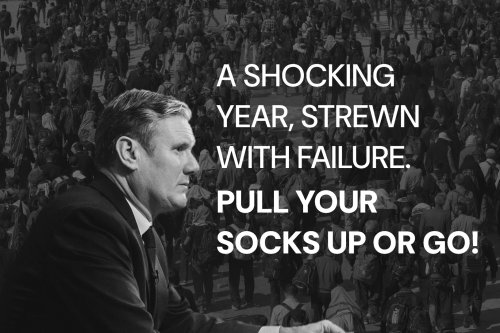
A Shocking Year, Strewn With Failure. Pull Your Socks Up or Go
.
MIGRATION WATCH UK
It’s been exactly one year since Labour won the 2024 General Election. Given that “immigration and asylum” was the second-most important issue for voters at the time– and by far the most important issue for Conservative and Reform voters – how has Labour performed on this issue? More specifically, how has the government performed on its own manifesto commitments?
When the manifesto finally arrived at immigration policies, with a section called “Secure Borders” (page 16), they were framed in the context of Britain’s “proud tradition of welcoming people fleeing persecution and abuse”, such as the Ukrainian, Hong Kong, Syrian refugees. Doing so allowed Labour to position itself as opposed to mass migration as a recent phenomenon, phrasing recent years as an exception to the rule of controlled migration.
The manifesto was also full of a number of useless newspeak: “we will also act upstream, working with international partners to address the humanitarian crises which lead people to flee their homes, and to strengthen support for refugees in their home region”.
On this basis, the manifesto made a number of commitments – but have they been delivered on? And have they been successful?
Legal immigration
Introducing visa restrictions
Pledge: To “reform the points-based immigration system so that it is fair and properly managed, with appropriate restrictions on visas”.
- Source: Page 41
Performance?: The Immigration White Paper was the closest thing we’ve had to any action on this pledge, but the reality is this paper amounts to tinkering with the edges, rather than any substantive reform:
- Targets – There is no commitment to a target level of immigration, meaning the government can claim even a slight reduction in numbers as a victory. The reiteration of the period 2021-2024 as an outlier of unacceptably high levels implies that the average of the preceding decade (200,000 to 300,000 on average) ought to be the norm.
- Work visas – There are very few concrete measures which are ready to be implemented. Raising the minimum skills threshold for a skilled work visa is welcome, but migrants already here and below the threshold are likely to be moved onto a “Temporary Shortage List”, should the Migration Advisory Council (MAC) recommend it.
- Study visas – Reducing the Graduate Visa from two years to eighteen months is unlikely to affect numbers. The current data around lengthy stays suggest this will fail to bring numbers down or be poorly enforced.
- Family visas – The paper states that a new policy framework will be created regarding family visas, but no details are given.
- Indefinite Leave to Remain – The minimum period of residence for ILR to be granted is to be extended from five years to ten, which is unlikely to make much difference, as many will be happy to wait for the decade to pass, and it is already diluted with promise of exceptions for those making “a significant contribution”.
If this White Paper had been issued in Autumn 2024 with a view to being implemented in 2025, the lack of detail and urgency would have been acceptable. As it stands, nearly a year into this government’s tenure, we could have expected more precision. It amounts to tweaks to existing policy, rather than any substantial overhaul, and will likely have a minimal impact on numbers. Moreover, as we’ve explained before, the attempts to tighten language requirements will have no actual effect on any of the numbers in any of the visa routes.
However, we must recognise the right moves where they are made: ending the Health and Care Visa is a positive step, as it was a visa route rife with abuse and mismanagement, while the new cap on lower-skilled workers via the Temporary Shortage List indicates a willingness to focus on the highest quality migrants rather than neglecting control altogether.
Verdict?: Mostly failure, with some success
Illegal migration
Punishing employer abuses
Pledge: To crack down on employers who are breaching employment law, with those who flout the rules being “barred from hiring workers from abroad”.
- Source: Page 41
Performance?: The Deliveroo scandal goes to show just how poor the government’s intel is on this issue.
How is it that asylum seekers in hotels are able to work as couriers? Part of the reason is because companies like UberEats and Deliveroo “hire” their employees as “contractors”, and do not do (and are in fact incapable of doing) appropriate background checks if the contractors choose to “subcontract” their work.
This is the tip of the iceberg; without any indication that the government either has, or intends to find, clear data on exactly how many illegal migrants are working for employers wilfully exploiting the gaping holes in the system, we cannot begin to comprehend the scale of this issue.
Part of the reason Labour made such a big thing about this issue is the intention to protect British workers. Why, then, has the news broken this week that lower-skilled workers will be waved through under new visa rules? We already know that immigration undercuts wages and makes competing for the few jobs that are out there even harder – is this really going to protect working Brits?
Verdict?: Failure
Border Security Command
Pledge: To establish a “Border Security Command”, that would be funded by ending the Rwanda Scheme, to disrupt people smugglers and seek an EU security agreement.
- Source: Page 17
Performance?: On a strict basis, this manifesto pledge has been achieved – but so what? The Border Security Command was announced the day after the election and, after scrapping the Rwanda Scheme, was funded with an annual budget of £75m, which has been used to fund “sophisticated new technology and extra capabilities for the NCA to bolster UK border security and disrupt the criminal people smuggling gangs”.
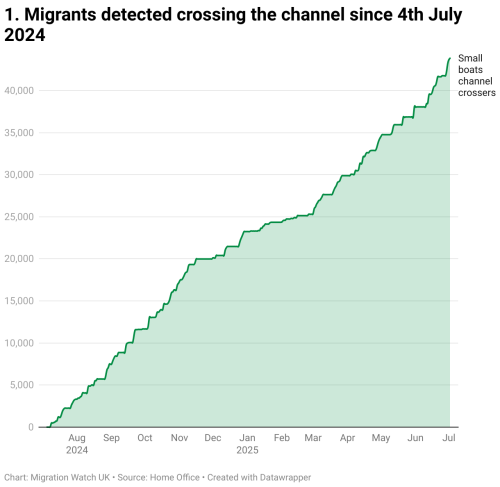
Well, so much for all that: 41,760 migrants have been detected crossing the channel since the Labour Party came to power, and the people-smuggling gangs are still active. Arrests are being made, but the numbers are still rising – almost as if the focus on the gangs is a smokescreen, and as a way of excusing the actual migrants from their illegal actions.
Verdict?: Failure
1. Migrants detected crossing the channel since 4th July 2024
Asylum
Clearing the asylum backlog
Pledge: To recruit additional caseworkers to clear the asylum backlog, which stood at 224,742 in June 2024, a record of four times its standing only a decade earlier.
- Source: Page 17
Performance?: We will need to wait until September to determine if the asylum backlog has fallen, but on recruiting additional caseworkers, the government has categorically failed: there were over 2,500 asylum caseworkers at the end of 2024 and this has fallen to just over 2,100. It seems there is either a failure to recruit, or an even bigger failure to retain, the staff capable of providing this vital service.
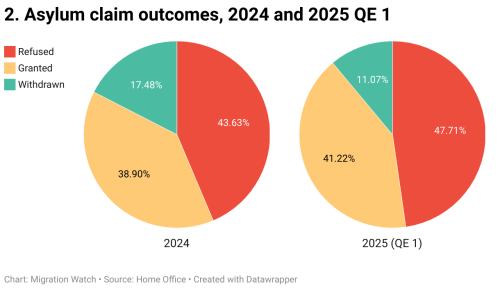
One positive though is the increased rate of refusals.
Verdict?: Failure
2. Asylum claim outcomes, 2024 and 2025 QE 1
End the use of hotels for asylum accommodation
Pledge: To end the use of hotels for asylum accommodation.
- Source: Page 17
Performance?: No, the government has not achieved this target – in fact, the number of asylum seekers in hotels and barges has increased, with the government issuing a new contract for using hotels and barges until 2027, despite campaigning on the opposite promise.
In addition to this, the “government has opened more migrant hotels than it has closed”, with The Telegraph reporting that “there are currently about 30,000 migrants in hotels at a cost of more than £4.2 million a day to the taxpayer.” That’s a cost of £1.5bn a year.
Verdict?: Failure
Establishing a returns unit
Pledge: To create a “Returns unit” with 1,000 staff to fast-track removals and negotiating returns agreements.
- Source: Page 17
Performance?: On the face of it, you would be forgiven for thinking the government is on course to achieve this target, with Lord Hanson remarking in the Lords on behalf of the government that “we have already begun delivering a major surge in immigration enforcement and returns activity to remove people with no right to be in the UK and ensure the rules are respected and enforced, redeploying significant numbers of staff to a returns and enforcement programme.” But as ever, the devil is in the detail: for the manifesto committed to 1,000 “additional” staff; this has clearly not been achieved if the returns unit is neither staffed by 1,000 people, nor by newly-recruited staff.
Verdict?: Failure
Conclusion
Overall, if this was a school report card for the government, it would be expelled. There is no serious attempt to address illegal immigration, and legal migration is tinkered with at the edge while abuses of the asylum system by parasitic companies fly under the radar or are ignored completely.
Almost all of the proposals in the manifesto regarding immigration were concerned with attempting to address illegal immigration, which is a complete red herring: in reality, illegal immigration is one tenth of the scale of legal migration. It is all well and good trying to disrupt the gangs profiting off the desperation of channel migrants, but where is the attempt to end the farce that is 431,000 net migration year ending December 2024?
Net migration figures have come down, that much is true, but that is attributable entirely to the Conservative government (not that their record is acceptable either). Any reduction in figures cannot be claimed as a success for this government, and there’s no indication they even want to reduce the figures any further – Keir Starmer’s admission of “regretting” the “Island of Strangers” speech is proof of this. And the White Paper really is pathetic after ten months of trying to deal with an issue which, by now, has become the most important issue for Brits.
This government has categorically failed the British people in getting migration, both legal and illegal, under control. It’s been a year – this level of inaction is inexcusable.
4th July 2025 – Current Affairs, Illegal immigration, Legal Matters, Migration Trends, Policy, Refugees
.

••••
The Liberty Beacon Project is now expanding at a near exponential rate, and for this we are grateful and excited! But we must also be practical. For 7 years we have not asked for any donations, and have built this project with our own funds as we grew. We are now experiencing ever increasing growing pains due to the large number of websites and projects we represent. So we have just installed donation buttons on our websites and ask that you consider this when you visit them. Nothing is too small. We thank you for all your support and your considerations … (TLB)
••••
Comment Policy: As a privately owned web site, we reserve the right to remove comments that contain spam, advertising, vulgarity, threats of violence, racism, or personal/abusive attacks on other users. This also applies to trolling, the use of more than one alias, or just intentional mischief. Enforcement of this policy is at the discretion of this websites administrators. Repeat offenders may be blocked or permanently banned without prior warning.
••••
Disclaimer: TLB websites contain copyrighted material the use of which has not always been specifically authorized by the copyright owner. We are making such material available to our readers under the provisions of “fair use” in an effort to advance a better understanding of political, health, economic and social issues. The material on this site is distributed without profit to those who have expressed a prior interest in receiving it for research and educational purposes. If you wish to use copyrighted material for purposes other than “fair use” you must request permission from the copyright owner.
••••
Disclaimer: The information and opinions shared are for informational purposes only including, but not limited to, text, graphics, images and other material are not intended as medical advice or instruction. Nothing mentioned is intended to be a substitute for professional medical advice, diagnosis or treatment.
Disclaimer: The views and opinions expressed in this article are those of the author and do not necessarily reflect the official policy or position of The Liberty Beacon Project.


Leave a Reply