

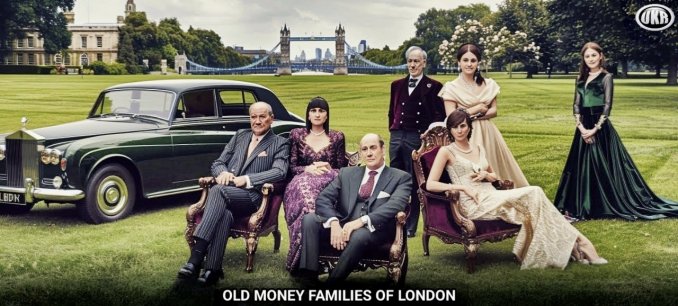
The barely known but very private aristocrats who rule their dynasties with discretion
FRANCES LEADER
During my interview with
I was only able to give a very vague answer to one of his questions. James wanted to know whether all British aristocracy were part of the Black Nobility. I thought about it for a few seconds and answered in the negative. I resolved, in that moment, to research the subject more closely and to write about it eventually.
I finally got through it today!
—0—
Imagine strolling through London’s most exclusive streets—Mayfair, Belgravia, Chelsea, Marylebone. Behind the polished facades and manicured squares, you might think you’re walking through a public city.
But you’re not.
Beneath your feet lies a hidden map of ownership—territory controlled by dynasties whose wealth stretches back centuries. These aren’t flashy billionaires or modern moguls. These are families who quietly shaped London itself—its land, its skyline, even its soul. Their power was built not on stock prices or tech IPOs, but on land, titles, and centuries of carefully guarded influence.
Today, we pull back the curtain on ten of the most elusive old-money families—dynasties that still own the ground beneath London’s most iconic streets. This isn’t just history.
This is the hidden blueprint of power.
LIVINGSTONE BROTHERS
The Livingstone brothers, Ian and Richard, are British property magnates who have built a vast multibillion-pound empire primarily through strategic investments in real estate and a highly lucrative stake in the online gambling technology company Evolution Gaming. Their fortune, estimated at $7.2 billion, stems from a combination of property holdings and a 5,000% return on their early investment in Evolution Gaming, which is now worth nearly $3 billion. They began their business journey in the late 1980s and 1990s, starting with Ian’s opticians chain, Optika, and gradually expanding into property, including the acquisition of iconic hotels like Cliveden House and Chewton Glen. Their investment in Evolution Gaming, which provides the technological backbone for live casino games used by major operators worldwide, has proven exceptionally profitable, especially during the pandemic-driven surge in online gambling. The brothers are known for their extreme privacy, rarely appearing in the media, and are considered among the most secretive billionaires in London.
COMPTON FAMILY – MARQUESS OF NORTHAMPTON
The title of Marquess of Northampton has been created twice, with the second creation being chiefly associated with the Compton family, who descend from Sir Henry Compton, summoned to the House of Lords as Baron Compton in 1572. The first creation of the marquessate occurred in 1547 for William Parr, brother of Catherine Parr, wife of King Henry VIII, but became extinct upon his death in 1571. The second creation was in 1812 for Charles Compton, 9th Earl of Northampton, who was elevated to Marquess of Northampton, Earl Compton, and Baron Wilmington in the Peerage of the United Kingdom. The current holder of the title is Spencer Compton, 7th Marquess of Northampton, who succeeded his father in 1978.
The Compton family has a long history of political and military service. Henry Compton, a son of the second Earl, served as Bishop of London, while Spencer Compton, 1st Earl of Wilmington, was Prime Minister of Great Britain from 1742 to 1743. The family’s estates include Castle Ashby House in Northamptonshire and Compton Wynyates in Warwickshire, and they also own property such as the 16th-century Canonbury Tower in Islington, north London, where several streets are named after family members. The family’s influence extends to education, with the Northampton Institute, founded in 1894 and named after William Compton, 4th Marquess of Northampton, now being City, University of London.
The 2nd Marquess, Spencer Joshua Alwyne Compton, was a patron of science and the arts, serving as President of the Royal Society from 1838 to 1848 and helping the College of Preceptors receive its Royal Charter. The 4th Marquess, William Compton, was an admiral in the Royal Navy and was made a Knight of the Garter in 1885. The 5th Marquess, William George Spencer Scott Compton, was a Liberal politician who served as a Member of Parliament and was involved in the London County Council. He also served as a special envoy to the courts of Europe in 1910 to announce the accession of King George V. The 6th Marquess, William Bingham Compton, fought in the First World War, was wounded, and was awarded the Distinguished Service Order (D.S.O.) in 1919. He married three times and divorced twice, with his first marriage ending in divorce in 1942.
The heir apparent to the current Marquess is his son, Daniel Bingham Compton, who holds the courtesy title of Earl Compton. The family’s motto is “JE NE CHERCHE QU’UN” (I seek but one).
SWIRE FAMILY
The Swire Family has a huge international investment portfolio which was founded in Liverpool in 1816. They have a detailed website showing their progress over time.
https://www.swire.com/ourjourney/tablet/en/index.php
WESTON FAMILY
The Weston family is a prominent international business dynasty founded in Canada in 1884 when George Weston purchased a bakery in Toronto, Ontario, which grew into George Weston Limited. The family’s business interests expanded globally, establishing significant holdings in the food and retail sectors across Canada, the United Kingdom, Ireland, and the United States.
The Canadian branch of the family, through George Weston Limited and various holding companies, currently owns or controls over 200 companies, including the Loblaws supermarket chain, Shoppers Drug Mart, and Holt Renfrew in Canada.
The family’s British branch is primarily managed through Wittington Investments, a holding company where 79.2% is owned by the Garfield Weston Foundation, a British charitable trust. Wittington Investments holds a majority stake in Associated British Foods (ABF), the parent company of the discount clothing chain Primark, and owns 100% of British retailers Fortnum & Mason and Heal’s.
The family’s wealth has been consistently ranked among the highest in the UK and globally. In the Sunday Times Rich List 2025, the Weston family was ranked eighth in the UK with an estimated fortune of £14.493 billion (C$27 billion), having added £3.253 billion (C$6 billion) to their wealth in the past year. This places them above the UK’s King Charles III on the list. In 2020, their estimated wealth was £10.53 billion, and they were named the eighth richest family in the UK. The family’s wealth is derived from their extensive retail empire, including Primark, Selfridges, Fortnum & Mason, and their Canadian operations.
The family has a long history of philanthropy. The Garfield Weston Foundation, based in the UK, has donated £1.661 billion over the past 20 years, making it one of the most charitable families in the UK. The Weston Family Foundation, based in Canada, focuses on advancing the well-being of Canadians through support for world-class health research, innovation, and biodiversity protection, having supported over 350 early-career scientists through its Northern Research Awards since 2007. The family’s legacy includes figures like Galen Weston, who was Chairman Emeritus of George Weston Limited and played a pivotal role in revitalizing Loblaws and expanding the family’s retail empire. https://dailyhive.com/canada/weston-loblaw-uk-rich-list-2025
PORTMAN FAMILY
The Portman family’s lineage traces back to merchants in Taunton, Somerset, in the 14th century, with their prominence beginning when Sir William Portman (1498-1557), a lawyer at the Middle Temple, leased 270 acres in the Manor of Lillestone outside London in 1532 and later purchased the freehold from the Crown in 1554 following the Dissolution of the Monasteries. This land, which would become the core of the Portman Estate, remained largely agricultural until the mid-18th century.
The family’s influence extended across Somerset and Dorset, where they built a significant mansion at Bryanston, Dorset, and played leading roles in local society and politics. The family’s connection to the London estate was solidified through the marriage of a junior line of the Berkeley family to Joan Portman, the great-granddaughter of Sir William Portman, in the late 16th century, which led to the acquisition of land in Marylebone.
The family’s fortunes in London were significantly advanced by Henry William Portman, a descendant of Sir William, who initiated the major development of the estate in 1764 with the creation of Portman Square, a project involving renowned architects like James Wyatt, Robert Adam, and James ‘Athenian’ Stuart. This development, spurred by the end of the Seven Years’ War in 1763, transformed the farmland into a fashionable residential area, with the construction of houses continuing through the 1780s. The Portman Estate became a cornerstone of the family’s wealth, combining residential properties with valuable retail businesses and important railway stations.
The family’s ancestral title, Viscount Portman, was created in 1873 for Edward Portman, 1st Baron Portman, who was also a former Lord Lieutenant of Somerset and Liberal MP. The current holder of the title is the 10th Viscount Portman, born in 1958.
The family’s West Country estates, including Bryanston and Hestercombe, were sold in the 20th century due to a succession of deaths and the imposition of heavy death duties. The sale of the West Country estates was finalized after the death of the 7th Viscount in 1948, which triggered a £7.6 million tax bill on an estate valued at £10 million, leading to the sale of the northern part of the London Estate in 1951 and 1952. Despite these losses, the Portman Estate continues to manage a significant portion of London’s real estate, including residential properties, offices, and retail spaces, with over 130 family beneficiaries and a management structure led by the 10th Viscount through the Estate Trustees and Portman Settled Estates Limited. The estate also includes rural properties in Buckinghamshire and Herefordshire. The family’s history is detailed in the 2022 book “From Somerset to Portman Square” by Tom Mayberry and Richard Bowden. https://portmanestate.co.uk/archives/
HOWARD DE WALDEN FAMILY OF MARYLEBONE
The Howard de Walden family is the owner of the Howard de Walden Estate, a significant property portfolio in Marylebone, central London, which they have managed for generations. The estate, originally developed from land purchased by the Duke of Newcastle in 1711, was inherited by the family through a lineage that began with the marriage of Henrietta Cavendish Holles and Edward Harley in 1713. It became known as the Howard de Walden Estate after Frederick, son of Lucy, widow of the 6th Lord Howard de Walden, inherited it in 1899.
The estate, now valued at approximately £4.7 billion as of 2020, holds the freehold to over 800 properties across 95 acres, extending from Marylebone Road in the north to Wigmore Street in the south, and from Hallam Street in the east to Marylebone High Street in the west. The family’s business, Howard de Walden Estates Limited, manages a diverse portfolio including residential, office, medical, retail, and educational properties. The estate is renowned for its role in revitalizing Marylebone High Street, creating the Marylebone Village retail and leisure destination, and establishing the Harley Street Health District as a hub for private healthcare.
The family has a long history of investment and stewardship in the area, with significant dividends paid to its members; for instance, in 2017, around 60 family members shared a £30 million dividend, a 14% increase from the previous year. The family’s influence extends to notable individuals, including film producer Peter Czernin, who is set to inherit the title of Baron Howard de Walden. The current holder of the title is Peter Czernin, the son of the late Lady Howard de Walden, who played a key role in the estate’s transformation. The estate’s management is a limited company beneficially owned by the Howard de Walden family, with its headquarters located at 23 Queen Anne Street, London W1G 9DL.
CADOGAN FAMILY – CHELSEA & KNIGHTSBRIDGE
The Cadogan family is a prominent British aristocratic family with roots tracing back to the royal tribes of medieval Wales, specifically to Cadwgan ap Elystan, a prince from Radnorshire, whose coat of arms the family adopted. The family’s rise to prominence began during the War of the Spanish Succession, when William Cadogan, a distinguished soldier and diplomat, served as the Duke of Marlborough’s Quartermaster-General and later became Master-General of Ordnance, MP for Woodstock, and Governor General of the Isle of Wight. He was created a Baronet in 1716 and an Earl in 1718, though the earldom fell into abeyance upon his death without a son.
The family’s enduring wealth and influence were secured through the marriage of William Cadogan’s younger brother, Charles Cadogan, 2nd Baron Cadogan, to Elizabeth Sloane, the heiress of the renowned physician and collector Sir Hans Sloane. Sloane, who served as personal physician to three British monarchs and was President of the Royal Society, had purchased the Manor of Chelsea in 1712 and Beaufort House on Cheyne Walk in 1737. Upon his death in 1753 without male heirs, his extensive estate, including the Chelsea properties, passed to his daughter Elizabeth and her husband Charles Cadogan.
This inheritance formed the foundation of the Cadogan Estate, which has remained under the family’s stewardship ever since. The estate, now managed by the privately-owned Cadogan Group and its subsidiary Cadogan Estates, covers 93 acres in the Royal Borough of Kensington and Chelsea. It includes approximately 3,000 flats, 200 houses, 300 shops, 500,000 square feet of office space, and over a dozen gardens. The family’s influence is evident throughout the area, with streets like Cadogan Street, Cadogan Square, and Sloane Street, as well as landmarks such as the Cadogan Hall and the Cadogan Hotel, bearing their name.
The family’s legacy is also tied to the transformation of Chelsea from a rural village into a planned Georgian town. In 1771, Charles Sloane Cadogan, the eldest son of Charles and Elizabeth Cadogan, commissioned architect Henry Holland to lay out the area, creating the first purpose-built new town in England, known as ‘Hans Town’ in honor of Sir Hans Sloane This development included the creation of Sloane Street, Sloane Square, Hans Place, and Cadogan Place, which remain central to the area’s character.
The Cadogan family continues to manage their estate with a long-term vision, investing in placemaking and community development. A £500 million investment over five years aims to reinvigorate Chelsea and the King’s Road, focusing on contemporary design and attracting unique retail and dining experiences. The current head of the family is Edward Charles Cadogan, the 9th Earl Cadogan, who succeeded his father, the 8th Earl, in 2023. The 8th Earl, who passed away in 2023 at the age of 86, had a significant impact on the estate, having transitioned from a career in finance at Schroders to leading the family business in 1974. He was succeeded by his son Edward, who now holds the title of Viscount Chelsea as the heir apparent.
HINDUJA FAMILY
The Hinduja family is an Indian-origin, multinational conglomerate family whose business empire, the Hinduja Group, operates in 38 countries and employs around 200,000 people. The group was founded in 1914 by Parmanand Deepchand Hinduja in the Sindh region of British India (now Pakistan), initially trading goods in Shikarpur and Bombay before establishing its first international operation in Iran in 1919. The headquarters remained in Iran until the 1979 Islamic Revolution, after which the family relocated to Europe, with the group’s base shifting to London.
The family’s leadership is centred on four brothers: Srichand Hinduja (died May 2023), Gopichand Hinduja (Chairman), Prakash Hinduja (manages operations in Geneva, Switzerland), and Ashok Hinduja (oversees Indian interests) Following Srichand’s death, Gopichand took over as chairman.
The family’s wealth has been consistently ranked highly; in May 2025, they topped the Sunday Times Rich List for the fourth consecutive year with a net worth of £35.3 billion In October 2024, they were ranked 11th on the Forbes list of India’s 100 richest tycoons with a net worth of $22 billion.
The Hinduja Group has diverse business interests across eleven sectors, including automotive (e.g., Ashok Leyland), financial services (e.g., IndusInd Bank, Hinduja Bank), oil and gas (e.g., Gulf Oil International), healthcare (e.g., Hinduja Healthcare Limited), IT and ITeS, media and entertainment (e.g., OneOTT Intertainment), and real estate. The family owns significant assets, including the Raffles London hotel in Whitehall.
In June 2024, four members of the family—Prakash Hinduja, his wife Kamal Hinduja, and their son Ajay Hinduja and his wife Namrata Hinduja—were convicted by a Swiss court of exploiting Indian domestic staff at their villa on Lake Geneva. They were sentenced to jail terms of four years and six months for Prakash and Kamal, and four years for Ajay and Namrata, though they were acquitted of human trafficking charges. The case stemmed from allegations that staff were paid as little as 7 Swiss francs for an 18-hour workday, had their passports confiscated, and were denied freedom to leave the property. The family’s lawyers argued that staff received benefits like board and lodging and were free to leave, while prosecutors claimed the family exploited the power imbalance to save money. The family has stated they intend to appeal the verdict.
REUBEN BROTHERS
Reuben Brothers is a global leader in private equity, international real estate, hospitality, credit financing, sports, and media .The group, founded by brothers David and Simon Reuben, is known for its extensive portfolio of luxury hotels, racecourses, infrastructure, and media assets, with a heritage in shipping and logistics. Their real estate holdings span the UK, Europe, the US, and beyond, encompassing office, retail, hospitality, and residential properties, including iconic landmarks in London, New York, Los Angeles, and other major global cities.
David and Simon Reuben, born in Bombay, British India, are British businessmen whose net worth was estimated at £24.9 billion in 2024, making them the third-richest family in the UK according to the Sunday Times Rich List Their early careers began in scrap metals and carpets, respectively, before expanding into property and metals trading in the 1970s and 1980s. A significant period of their wealth was built through investments in the Russian metals market in the 1990s, involving tolling arrangements with aluminium smelters, though this era was marked by controversy and allegations of illegal activities By 2000, they shifted focus to the UK property market, where they have since become major players.
The Reuben Brothers have been involved in high-profile acquisitions and developments. In 2021, they completed the takeover of Newcastle United Football Club alongside Amanda Staveley’s PCP Capital Partners and the Public Investment Fund of Saudi Arabia, each holding a 10% stake in the club. They also own and operate the Arena Racing Company, which manages 16 racecourses in Great Britain. Their real estate strategy includes landmark projects such as the redevelopment of the Piccadilly Estate in London and the transformation of the Grade I-listed building in central London into a Waldorf Astoria hotel and branded residences. The group owns London Oxford Airport and the London Heliport in Battersea, the only licensed heliport in the UK capital.
In recent developments, the Reuben Brothers are reportedly in talks to invest in a consortium circling OnlyFans, a platform for adult content creators. They have also made strategic investments in technology and media, including a stake in EDGLRD, an entertainment company founded by filmmaker Harmony Korine, acquired in August 2024.
Their philanthropic arm, the Reuben Foundation, established in 2002, focuses on advancing healthcare and education globally, having donated £80 million to support the creation of Reuben College at Oxford
The group’s business activities are managed through various entities, including Motcomb Estates, which played a key role in the recent buyout of Chelsfield, a property company led by Elliott Bernerd, where the Reubens invested £150 million in equity and £100 million in debt and mezzanine funding Reuben Brothers’ shipping fleet consists of 13 vessels, and they have investments in data centres, such as Global Switch, and other infrastructure assets.
GROSVENOR FAMILY – DUKE OF WESTMINSTER – MAYFAIR & PARK LANE, BELGRAVIA
The Grosvenor family’s ancestry traces back almost 1,000 years to Gilbert le Grosveneur, who came to England with William the Conqueror in 1066.
The family established its seat at Eaton Hall in Cheshire in the 1440s and expanded its wealth through mining interests in North Wales during the 1580s. Their significant London property holdings began in 1677 when Sir Thomas Grosvenor married Mary Davies, heiress to the manor of Ebury, which included 500 acres of land to the west of the City of London. This acquisition laid the foundation for the development of Mayfair in the 1720s and Belgravia in the 1820s.
The family’s prominence grew through the peerage system, with Sir Richard Grosvenor being created the first baronet in 1622. The title of Marquess of Westminster was created for Robert Grosvenor in 1831, and the title of Duke of Westminster was established for his grandson, Hugh Lupus Grosvenor, in 1874. The family’s current head is Hugh Grosvenor, the 7th Duke of Westminster, who succeeded his father, Gerald Cavendish Grosvenor, the 6th Duke, upon his death in 2016. The Grosvenor family continues to manage a vast international estate through the Grosvenor Group, a family-owned private limited company founded in 1677.
Gerald Cavendish Grosvenor: 6th Duke of Westminster, died in 2016, was Britain’s wealthiest landowner at the time of his passing.
Hugh Grosvenor: 7th Duke of Westminster, succeeded his father in 2016, is the current head of the family and Chair of the Grosvenor Group.
Sir Thomas Grosvenor: 3rd Baronet, whose marriage to Mary Davies in 1677 brought the family the London estates of Mayfair, Belgravia, and Pimlico.
Robert Grosvenor: 1st Marquess of Westminster, developed the Belgravia and Pimlico districts in the 1820s.
Hugh Lupus Grosvenor: 1st Duke of Westminster, built the Victorian hall at Eaton Hall and achieved success in horse racing.
Gilbert le Grosveneur: Ancestor of the family, came to England with William the Conqueror in 1066.
Eaton Hall: The family seat in Cheshire, inherited through marriage in 1443.
Mayfair: A London district developed by the Grosvenors starting in 1720, known for its prestigious residential and commercial properties.
Belgravia: A London district developed by the Grosvenors in the 1820s, renowned for its Regency-style architecture and high status.
Grosvenor Group: The family-owned international property company, founded in 1677, managing estates worldwide. https://www.grosvenor.com/about-us/our-history
ONWARDS!
xx
If you appreciate my research but cannot commit to a paid subscription you could buy me a coffee at: https://www.buymeacoffee.com/FrancesLeader
Please note that all my work is entirely free to read and will never be hidden behind a paywall. My lovely paying subscribers contribute knowing this to be true and I would like to take this opportunity to thank them very much for their ongoing support.
The important thing is sharing this educational information on social media, especially on X and Facebook and Discord where I am permanently excluded because my work upsets the totalitarians.
This article (OLD MONEY FAMILIES OF LONDON) was created and published by Frances Leader and is republished here under “Fair Use”
Featured image: The Billionaire Chronicles

••••
The Liberty Beacon Project is now expanding at a near exponential rate, and for this we are grateful and excited! But we must also be practical. For 7 years we have not asked for any donations, and have built this project with our own funds as we grew. We are now experiencing ever increasing growing pains due to the large number of websites and projects we represent. So we have just installed donation buttons on our websites and ask that you consider this when you visit them. Nothing is too small. We thank you for all your support and your considerations … (TLB)
••••
Comment Policy: As a privately owned web site, we reserve the right to remove comments that contain spam, advertising, vulgarity, threats of violence, racism, or personal/abusive attacks on other users. This also applies to trolling, the use of more than one alias, or just intentional mischief. Enforcement of this policy is at the discretion of this websites administrators. Repeat offenders may be blocked or permanently banned without prior warning.
••••
Disclaimer: TLB websites contain copyrighted material the use of which has not always been specifically authorized by the copyright owner. We are making such material available to our readers under the provisions of “fair use” in an effort to advance a better understanding of political, health, economic and social issues. The material on this site is distributed without profit to those who have expressed a prior interest in receiving it for research and educational purposes. If you wish to use copyrighted material for purposes other than “fair use” you must request permission from the copyright owner.
••••
Disclaimer: The information and opinions shared are for informational purposes only including, but not limited to, text, graphics, images and other material are not intended as medical advice or instruction. Nothing mentioned is intended to be a substitute for professional medical advice, diagnosis or treatment.
Disclaimer: The views and opinions expressed in this article are those of the author and do not necessarily reflect the official policy or position of The Liberty Beacon Project.


Leave a Reply