

Intelligence has been Britain’s Secret Weapon for Globalisation
IAIN HUNTER
In August, I wrote We Should Not Trust Our Elites, subtitled Four Books and a Set of Papers, while I was in the middle of reading Two World Wars and Hitler by Dr Jim McGregor and Dr John O’Dowd. What prompted that article was my coming across Kit Klarenberg’s Substack piece about the Dirksen Papers, the diplomatic memoirs of Herbert von Dirksen who was Nazi Germany’s ambassador to the Court of St James from 1938 until the outbreak of the Second World War. If the story told by the Dirksen papers was startling enough, it is as nothing compared to the story that has been revealed since then.
I finished Two World Wars quite quickly but immediately embarked on a second reading to make sure I fully grasped the narrative that had been constructed by McGregor and O’Dowd. In the middle of that, a fifth book came to my attention through listening to a James Delingpole podcast with the American journalist Richard Poe.

Poe is a New York Times bestselling author of several books including the one which is the subject of the podcast, How the British Invented Communism (and Blamed It on the Jews). I’m not sure whether Poe is straightforwardly anti-British or whether he has a sneaking admiration for us. However, it is plain that he understands that our country is not a true democracy, no more than the USA is these days. We are an oligarchy governed through two major political parties which are themselves petty oligarchies. Whatever his attitude, he makes it clear that when he refers to “The British” he means the ruling oligarchy, not the people, and he puts across a very convincing case to back up his claims. Naturally, I had to read it, so I bought it, read it twice and I’m referring to it as I type this.
In his book, Poe lists plenty of references from journalists and historians who were writing contemporaneous investigative articles and books about various significant historical events, especially revolutions. He references the work of Carroll Quigley, Anthony Sutton and Guido Preparata. All three lie at the heart of McGregor and O’Dowd’s book as well as McGregor’s earlier work, Hidden History, written with the late Gerry Docherty. Poe graciously acknowledges their work in his own book.
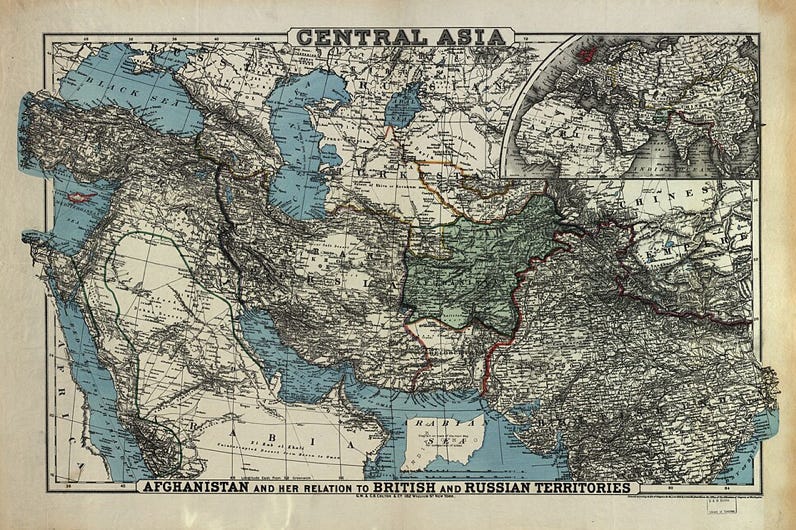
Those who are ‘awake’ are well aware of the origins of, and the real reasons for, the war in Ukraine. Many are fond of saying that it is the Great Game 2.0. However, that implies that the original Great Game had an ending and has somehow been re-born. A reading of Poe’s work should knock that idea fairly and squarely on the head.
So, if that has piqued your interest, read on and come with me on an intriguing journey, a broad-brush story, which started several hundred years ago with William Cecil and Francis Walsingham, spymasters to Queen Elizabeth I. They were the inventors of spy-craft and built webs of agents and informants throughout the British Isles and across Europe to protect their Queen. Once created, the knowledge, skills and techniques were built on, developed, and never lost to the English, and later the British state, so they were available from the very dawn of empire.
This damp little island was a minor power in the late 16th and early 17th centuries, dwarfed by the continental empires of the Hapsburgs, the rising Bourbons and the Ottomans. Further East, another power had taken shape, one which arose from the Rus, who had earlier ended the Khazarian Empire and beaten off the Mongol hordes – Muscovy. Eventually it became The Tsardom of Rossiya under Ivan IV (the ‘Terrible’) in 1547. Later, during the reign of Prussian-born Catherine the Great (1762-1796), it came into conflict with the Ottoman Empire. Victory in the Russo-Turkish war of 1768-1774 brought the area between the rivers Bug and Dnipro and Crimea into the Russian Empire. Supported by Britain, Russia colonised the territory it named Novorossiya along the coasts of the Black and Azov Seas. Many towns and cities were founded in the new territories on Catherine’s decree, including Odessa, Kherson and Sevastopol.

British support for Russia may seem somewhat surprising but we should remember that this took place before she lost the American colonies and turned her attention Eastwards. Things were soon to change, especially after Catherine developed her ‘Greek Project’ in the 1780s as a solution to the weakening of the Ottoman Empire. Her plan envisaged partitioning it between Russia and the Hapsburg Empire and the idea was that her grandson Constantine would become the first Emperor of a restored Byzantium which would once again be the centre of Orthodox Christianity. This would give Russia’s newly created Black Sea fleet easy access to the Mediterranean Sea which was immediately seen by Britain as a threat to its Eastern imperial interests. So was born British enmity towards Russia and the Great Game was afoot, nearly 250 years ago.
At the time this was going on, the forces of Louis XVI of France were aiding the American colonists in their War of Independence. It was a form of revenge for their earlier loss to Britain in 1763 of their ‘New France’ colony in North America. French soldiers, arms and materiel were sent to America under the direction of the Marquis de Lafayette which eventually helped to secure victory for the colonists at Yorktown. Lafayette thereafter became a major organiser of French help for the new republic. Some sort of ‘payback’ for France was due, and it soon came.
Growing demands for liberal reform in the France of the 1780s, inspired by the American Revolution, tended to come from people who were Anglophilic, and the British intelligence network took full advantage. Thomas Jefferson, at the time the US ambassador to France, accused the British of attempting to subvert the eventual revolution by sending ‘pretenders’ to Paris who infiltrated and crushed the genuine republicans in their own councils and turned the revolution towards destruction.
American historian Micah Alpaugh wrote a paper in 2014 which identified the London Revolution Society as the model for the Jacobin clubs of Paris and the source of many of their ideas. A letter from London radicals to the French National Assembly in late November 1789 called on the French to join with their English brethren and make the World a free and happy place. It was greeted with much enthusiasm. Jacobin clubs sprang up all over France and maintained ties with their English mentors. Much of what was fed to the French was a deception, no more than a smokescreen for British Imperial interests. These Jacobin clubs gave rise to Marat, Danton, Robespierre and the Terror leading to the execution of King Louis XVI and eventually to Napoleon, all of which was foreseen by Edmund Burke in his Reflections on the Revolution in France.
The Conspiracy of Equals led by François-Noël Babeuf tried to overthrow The Directory in 1796. They failed and Babeuf was executed. Marx and Engels were later to call him the first modern communist; thus, it is fair to say, communism was born during the French Revolution. Where did Babeuf get his ideas from? One of his mentors was James Rutledge who produced a paper in Paris called Courrier de l’Europe which promoted radical doctrines such as the overthrow of the French aristocracy and the creation of a classless society. The owner of the paper was a London wine merchant, Samuel Swinton, who was a former Royal Navy officer. A French historian, Hélène Maspero Clerc, confirmed in 1985 that, based on a study of his correspondence with the Secretary of the Admiralty in London, Swinton was a British intelligence agent.
So, the hidden hand of British intelligence could be found guiding French revolutionaries and it brought about a regime change which led eventually to the downfall of France at Waterloo. She has never been truly stable since and has been through three restorations of a monarchy and five republics altogether. There is even a movement today in favour of a sixth republic to replace the current political arrangements.
The covering up of the tracks began almost immediately. In 1797 accounts of the Revolution were published, by natural philosopher John Robison and the ex-Jesuit Abbé Augustin Barruel . They placed responsibility on the Freemasons infiltrated by the Bavarian Illuminati. The Illuminati was a real secret society, founded in 1776 to advance Enlightenment principles. Robison and Barruel argued that its members had a complex global plan to subvert the church, state, and society. By infiltrating Masonic lodges and other institutions, they had supposedly made their way deep into the French elite and, in the guise of Jacobins, overthrown the monarchy. These accounts were enthusiastically adopted and promoted by British elements to deflect suspicions.
Having learned how effective they could be in interfering with foreign governments, British intelligence services were not slow to attempt to use them again in the 19th century, especially during the wave of revolutions in 1848.
Poe contends that this is how the British Intelligence Services invented ‘colour revolutions’ as they have become known. In recent years they have been so refined as to be almost bloodless. Crowds of young people take to the streets under identifying symbols or ‘colours’ while armies and police forces look the other way and presidents and prime ministers flee. Portrayed as ‘spontaneous’, they are far from being so. The other difference is that it is not the British state behind them but the supra-national NGOs which have taken over. In so doing the provide ‘deniability’.
Revolutions don’t just happen. They take years of careful preparation. The state has a distinct advantage over any popular uprisings because it has superior forces at its disposal which can easily crush them. They have to be subverted or undermined first. Revolutions are top-down, not bottom-up. One ruling elite is replaced by another. The dark art of toppling governments under the guise of ‘people’s revolution’ was developed by an American political scientist, Gene Sharp, working under the guidance of some of the sharpest minds of British military intelligence at Oxford.
Back to the late 18th century. Meanwhile at home the British state, mindful of the lessons of the 17th century civil war and Cromwell’s protectorate, avoided revolution by embarking on some parliamentary reform which it could pretend would lead gradually to a semblance of democracy.
So, if Babeuf in the French Revolution, who else aided British intelligence? None other than Karl, the co-author of the Communist Manifesto, himself.
It is little known that Karl Marx had family connections to the British aristocracy. In 1843 he married Jenny von Westphalen, daughter of a Prussian Baron whose Scottish mother, Jeanie Wishart, descended from The Dukes of Argyll. Karl was no self-made man; he was born in bourgeois affluence. In 1854 he met Scottish aristocrat David Urquhart, a distant relative of Marx’s wife Jenny. Urquhart was a British diplomat and secret agent who had a fanatical hatred of Russia; Marx joined his cause to become one of the most enthusiastic anti-Russian journalists of his time. In his attacks on Russia, Marx wrote not as a revolutionary, but as a propagandist for British imperial interests which was very useful during the Crimean War of 1853-56, fought by Britain to contain Russian expansionism.
How did Marx the revolutionary and Urquhart the arch-reactionary come to collaborate? It is a subject ignored by the overwhelming majority of Marxist historians, not least the Russians themselves because Marx was revealed to them as a rabid Russophobe.
What probably bonded Marx and Urquhart was a common detestation of the middle classes, the bourgeoisie. At the time, an aristocratic society called Young England advocated a return to a feudal system. It argued that the working classes would be far better off under the old ways than under the vulgar, money-grubbing power of the middle-class factory and mill owners whose predominance they wished to extinguish. Socialists and communists had the same aims which made them natural allies for Young England, at least in the short term. Although Urquhart was not often mentioned in connection with the Young Englanders he certainly agreed with their views, and it brought him into contact with Marx who was not concerned about the aristocracy because he believed – erroneously – that they had already been vanquished.
It is thought that the Young England movement died out around 1849, yet its spirit lived on in different guises and not just through Urquhart and Marx. John Ruskin, the Victorian art critic, may have been a somewhat sad individual in some ways but he was able to inspire many through his lectures at Oxford, notably Cecil Rhodes, Alfred Milner and Arnold Toynbee. Ruskin had been particularly taken with the poem written by Alfred Lord Tennyson around 1840, Locksley Hall. Were these lines from it often quoted in his lectures? It is very tempting to think they were.
Till the war-drum throbb’d no longer, and the battle flags were furl’d
In the Parliament of man, the federation of the world.
There the common sense of most shall hold a fretful realm in awe,
And the kindly earth shall slumber, lapt in universal law.
Were they inspiration for such proto-globalists as Rhodes, Milner and Toynbee? We’ll never know, but it is plausible. They certainly believed it fell to them to extend English civilisation and rule to as much of the world as was possible, and this would only be achieved by recovering the United States of America to the Empire, or at the very least, getting it on-board with Britain’s imperial aims.
Rhodes was Prime Minister of the Cape Colony from 1890 to 1896, and Milner became governor of the Cape Colony from 1897 to 1901 and the Transvaal and Orange River Colony until 1905. Both Rhodes and Milner were instrumental in bringing about the Second Boer War (1899-1902).
A rival to Rhodes’s imperial ambitions in Africa was recently unified Germany, put together through the efforts of Otto von Bismarck. In 1914, Germany held the colonies of German South-West Afrika, German East Afrika, the Cameroons and Togoland.

Germany’s African colonies, 1914
Thus, there were two great continental Empires, Russia on the one hand which had designs on further territorial gains from the dying Ottoman Empire, and rising Germany which was industrially powerful on the other. Germany could easily unite with or absorb its ally the Hapsburg Austro-Hungarian Empire in the fullness of time to become a cultural, economic and industrial colossus. Both were Empires with Caesars (Tsar and Kaiser).

Europe 1914
In 1891, Rhodes along with W T Stead and Lord Esher had formed the ‘Society of the Elect’ or ‘Secret Elite’ as Docherty, McGregor and O’Dowd call them. Carroll Quigley simply calls them ‘The Network’. Alfred Milner, Lord ‘Natty’ Rothschild, Lord Roseberry and Earl Grey joined them later along with some others. As numbers grew, they formed two rings, the inner group, the ‘Society of the Elect’ and an outer group called the ‘Association of Helpers’. Rothschild was the link to the USA as shown in the diagram below. He controlled banking with suzerainty over Cassels, Barings, Waldorf Astor and Morgan Grenfell. It is important to understand that, in the USA, JP Morgan and Kuhn, Loeb &Co (Jacob Schiff) were fronts for Rothschild operations and that Rothschilds provided the finance for J D Rockefeller to get his oil and railroads empire off the ground.
In with the ‘Secret Elite’ and the ‘Association of Helpers’ in large numbers was the ‘Cecil Bloc’ put together over his lifetime by Robert Arthur Talbot Gascoyne-Cecil, 3rd Marquess of Salisbury, who was Prime Minister no fewer than three times. Salisbury was the archetypal conservative who is famous for not having done very much at all whilst in 10 Downing Street other than be a steady hand on the helm of the Ship of State. He was descended from Elizabeth I’s minister William Cecil. The Cecil Bloc which is described by Carroll Quigley in Chapter 2 of The Anglo-American Establishment was enormous and consisted of large aristocratic families inter-woven by marriage and landed interests for whom politics was a game. Salisbury would sprinkle appointments among them, practicing nepotism on a grand scale. But his people didn’t just get jobs in government and in the Empire simply because of who they were; they had to be intelligent and competent too. To that extent, it worked and worked quite well. In 1902, ill-health and grief over the death of Lady Cecil forced his retirement and he handed over the Premiership to his nephew Arthur Balfour who would later become better known for the Balfour Declaration. Britain therefore had a fourth Salisbury administration by proxy. They had it sewn up, these people.

While the Cecil Bloc was in the ascendency, Alfred Milner was, to some degree, under control. Following the death of Rhodes in 1902, Milner became the executor of his will to carry on what had been started in 1891. Milner was no conservative; he was far more ideological and a liberal by instinct. Not born to great wealth, he decided early in life to dedicate himself to the service of the state which he considered was the noblest thing any man could do. He became a lawyer, a colonial administrator and eventually a sort of Edwardian Thomas Cromwell with direct access to King Edward VII.
So, what was Milner’s ideology? In 1882, Milner and his friend Arnold Toynbee each delivered separate but eerily similar lectures on socialism. They each regarded Marx as a genius and thought that socialism should be Britain’s ‘secret weapon’ for heading off revolution, although they believed Marx had probably gone too far. They thought he was on the right track, but pure communism would be ‘impracticable’ for the time being. They implied that Marx’s true value to the Empire was to play the role of ‘bogeyman’ to keep the threat of bloody revolution in people’s minds so that the bourgeoisie would stay frightened. The form of socialism Milner and Toynbee approved of was that which would protect, rather than threaten, the position of Britain’s ancient aristocracy. It chimed perfectly with the ideas of Young England. So, almost from its inception, socialism was taken as a tool to be used by the elite to keep them where they were and the rest in place beneath them. Psy-ops were well under way in the late Victorian era.
The Fabian Society had been formed seven years earlier than the Rhodes’s ‘Society of the Elect’ and they would have known of its existence and principles. Was Alfred Milner a member of the Fabian Society? Well, surprise, surprise, he was. Beatrice and Sidney Webb deliberately moved among the wealthy trying to recruit them and they formed a dining club known as ‘The Coefficients’ as a forum for British socialists and imperialists. The two very different economic ideas were not then seen as mutually exclusive. Milner was a member along with Bertrand Russell, H G Wells and Leo Amery. At least one academic, Ioan Ratiu, thinks that there was a clear link between its activities and those of the Milner group and that is what laid the foundations for what is happening around us today.

With his influence at All Souls and Balliol colleges in Oxford and at the Times newspaper it was inevitable that Milner would come into contact with geographer Halford Mackinder and his theory of geopolitics which came to exercise the minds of those in government around the world. It would eventually morph into his ‘Heartland Theory” which he was formulating during the Edwardian years:
“Who rules East Europe commands the Heartland; Who rules the Heartland commands the World Island; Who rules the World Island commands the World”.
And which two empires were placed to do exactly this? Germany and Russia. Set against this were Britain and its dominions (Canada, South Africa, Australia and New Zealand) and the United States which formed the periphery of the ‘World Island’. Germany and Russia would be ‘Eurasia’; Britain, its dominions and the United States would be ‘Oceania’. ‘Eastasia’ was yet to take shape. Mackinder was also a Fabian and a member of ‘The Coefficients’.
The Milner Group, whose control of politics, opinion and the recording and teaching of history was complete, now set about whipping up a fear and loathing of Germany so that they could create the path to war. They needed to take on Germany and have Russia involved against Germany so that it too would be damaged. Ideally, they needed a war Germany would lose but which Russia would not win. It was a strange thing for Milner to do given that he was born in Germany and part educated there (his father was half German). King Edward VII and Queen Alexandra, dyed -in-the-wool Germanophobes both, were very much in favour.
The Entente Cordiale was constructed in 1904 which soon became the Triple Entente in 1907 when Russia was lured in so that both Germany and Austria-Hungary were surrounded. This was despite Britain’s hand in creating and training the Japanese navy to beat the Russian navy in the Russo-Japanese war of 1904-05. France was very much the junior partner, doing whatever London told it to do, and London’s fingers stretched, via Paris, into St. Petersburg.
Although the history of British intelligence organisations lies centuries ago, the British intelligence system as we know it today – with components for domestic, foreign, military, and communications intelligence – did not emerge until the years immediately preceding World War I. In 1909, the Security Service (MI5) and the Secret Intelligence Service (MI6) were founded and concentrated initially on the activities of Imperial Germany. They aided the Milner group’s orchestrated run-up to war as described by McGregor and his two co-writers in Hidden History and Two World Wars and Hitler.
Having got their war off the ground, it very soon became apparent that things were not going so well for the Russian armies in the East. By early 1915, Russia began to seek a separate peace agreement, so Alfred Milner had to put a stop to that. The ‘Network’ had a plan. If it was to stay in the war, Russia needed help so the Gallipoli campaign was conceived which went hand in glove with a promise made to the Tsar that, after the war, Constantinople would be Russia’s. That promise Britain had no intention of keeping despite there being a quid pro quo in the shape of Britain gaining the lion’s share of newly discovered oil fields in Persia.
The Gallipoli campaign was abandoned at the turn of the year with huge allied losses out of the 410,000 who landed on the beaches. Recklessness and incompetence supposedly cost Winston Churchill his post as First Lord of the Admiralty. But was it bungling or subterfuge? There have been assertions by several historians that Britain deliberately pulled its punches, and Gallipoli was never meant to succeed. It was no more than a rouse to keep the Russians fighting so as to further weaken the Tsar.
The killer blow came later in the war, in 1917. The Russian Duma had been infiltrated by British intelligence, and many Russian aristocrats were reformers who wanted a Constitutional Monarchy. Britain did not want the Romanovs to remain in place simply because their removal would lead, it was thought, to the break-up of the Russian empire. Rasputin, who had great influence on the Tsar and Tsarina and who was definitely not mad, had been removed at the end of 1916, ostensibly by Russian nobles, but with the hand of British intelligence involved.
Alfred Milner visited Tsar Nicholas II in St. Petersburg (now Petrograd) in early 1917 and told him Russia was on the brink of Revolution (planned by his organisation). He had to relinquish absolute power and establish democratic government. Milner was attempting to persuade the Tsar to cede power to the Duma, many liberal members of which were social democrats in the pockets of the British, but it was not a good time to democratise. The Tsar refused because he thought Milner’s demands were unreasonable.
The carefully prepared plan to give the Russians a communist revolution then went into operation, first with the February Revolution which was, in effect, a Palace Coup to topple the Tsar and then the October Revolution.
It is widely understood that the October Revolution was an uprising not of the Russian people, but of foreigners within Russia. The majority of the active revolutionaries were not Russian, and many were Jewish, financed by sympathetic Jewish bankers in New York. However, this construction ignores the fact that J P Morgan and Kuhn Loeb & Co, the prime financiers, were fronts for Rothschild operations so the link to Milner’s ‘kindergarten’ is evident. It was a British ‘Network’ plan. Nonetheless the idea was established that the Russian Revolution was a Jewish plot and that communism was a Jewish invention.
The Tsar and his family, relations of the British Royal Family, were not offered sanctuary in Britain. Although Prime Minister Lloyd George had been cautiously in favour despite his welcoming the Romanovs’ downfall, King George V’s private secretary persuaded him against it.
On ending Russia’s part in the war, Trotsky cancelled all treaties (including the agreement on Constantinople) but Britain got the oil in Persia. Trotsky too was a British agent – that’s why Stalin had him killed.
Following the armistice in 1918, Imperial Hohenzollern Germany had gone, the Hapsburgs had gone, The Romanov’s had gone and the Ottomans had gone. Only the British Empire was left, not only standing but augmented. In the midst of this, Poland a proud nation which had been partitioned between Germany, Austria-Hungary and Russia, had been reborn.
There followed in Russia the strangest civil war as the Red Army took five years to subdue the rest of the country. The 300,000 strong Bolshevik army were outnumbered by 300,000 White Russian and 180,000 allied troops, including 60,000 British. They were surrounded, cut off, and forced back into small areas around Moscow and Petrograd. Their commander, Trotsky, was bereft of any military experience, yet they triumphed. They could easily have been beaten but they triumphed. Why?
In the war against the Bolsheviks, Winston Churchill, whatever else he was, stands out as a voice of reason and clarity. He wanted to force them militarily to hold a general election which he knew they would not win. Prime Minister Lloyd George opposed his plan to destroy Bolshevism because the latter did not want a White Russian victory under any circumstances and the re-establishment of a Romanov dynasty, or any other conservative nationalist regime in Russia. Instead, the war was not waged vigorously, and the White Russians were betrayed and starved of weapons and finance. Had Churchill’s arguments in Cabinet prevailed, he might have saved Russia, along with Central and Eastern Europe, from decades of communism.
In a 1924 autobiography Memories of Russia 1916-1919 Princess Olga Paley, whose family had helped to bring down the Tsar wrote “A strange ally, Great Britain… in the history of Russia, the animosity of England traces a line across three centuries”. She writes that Britain had striven for centuries to stop Russia gaining a ‘free sea’ (warm-water ports) and much blood had been spilt over it. Bolshevism in her opinion was just one more weapon deployed by Britain to keep Russia weak. Over the next decade the creation of the Soviet Union submerged Russia and turned it inwards towards a bloodbath.

Princess Olga Valerianovna Paley (2 December 1865 – 2 November 1929)
By February 1920, it was time for another smokescreen and Churchill was deployed to reinforce the Jewish conspiracy idea. In February 1920 in the Illustrated Sunday Herald, he wrote an article entitled Zionism versus Bolshevism which contained this:
There is no need to exaggerate the part played in the creation of Bolshevism and the actual bringing about of the Russian Revolution by these international and, for the most part, atheistical Jews. It is certainly a very great one; it probably outweighs all others. With the notable exceptiion of Lenin, the majority of the leading figures are Jews. Moreover, the principal inspiration and driving power comes from the Jewish leaders. Litvinoff…Trotsky…Zinoviev…Radek—All Jews. In the Soviet institutions the predominance of Jews is even more astonishing.
He went on to describe the influence and role of “Jewish revolutionaries” throughout Europe, and the rest of the British press took up the refrain.
While this was happening, The Treaty of Versailles forced Germany to accept the blame for starting the war and imposed some truly draconian reparations on her under the threat of starvation, invasion and dismemberment. The terms of the Treaty, in the drawing up of which the Milner group were heavily involved, virtually guaranteed that there would be another European war against Germany. It is said by some that that was the aim because, although Germany had been damaged and deprived of her colonies, she was not utterly destroyed. That would come in 1945.
In order to do that there first needed to be a recovery of Germany following the Weimar Republic and one was duly arranged through the financial backing for, and the encouragement of, Adolf Hitler. McGregor and O’Dowd deal with this and the financing of the German Wehrmacht in Two World Wars. They name names, especially that of Ernst ‘Putzi’ Hanfstaengl, a multi-talented German-American with ancestry on his mother’s side stretching right back to the earliest days of the American colonies. His Wikipedia entry dismisses him as a Nazi but the truth, as McGregor and O’Dowd claim, is rather different. He was at Hitler’s side for fifteen years, encouraging him from the earliest days, editing Mein Kampf, being involved in the Reichstag fire and inventing the Nazi cry ‘Sieg Heil’. He had to flee Germany in 1937 after being supposedly denounced by Unity Mitford.
There were others. In addition to Hanfstaengl, numerous British intelligence agents were positioned in Germany. William de Ropp, like Hanfstaengl, managed to infiltrate the inner core of the Nazi Party and become a trusted confidant of Hitler. An RAF Group Captain turned intelligence officer, Frederick Winterbotham, also gained the confidence of Hitler. He made frequent trips back and forth to Germany and obtained highly confidential information about Hitler’s plan to invade Soviet Russia which would have delighted Milner’s Kindergarten.

Ernst ‘Putzi’ Hanfstaengl with Adolf Hitler
A full reading of Two World Wars puts the story of Dirksen Papers in a completely different light. Far from Neville Chamberlain being a simple appeaser, and the Federation of British Industry talking to the Reichsgruppe Industrie about a serious economic alliance with Germany, they were part of an elaborate intelligence plot. Yes, there was appeasement but with the aim of encouraging Hitler, drawing him in, and making him believe he was invincible and so leading to another war. To this end, Czechoslovakia was sacrificed. Even the short-lived uncrowned King, Edward VIII, whom many believed – and many still do believe – was a Nazi sympathiser, was probably a part of the deception. Even the vaguely ridiculous Mitford sisters, Unity and Jessica,daughters of the second Baron Redesdale may have been part of the plot. Remember that the aim, as always, was to remove opposition to Anglo-American global hegemony, so it’s not beyond the bounds of possibility that even a family such as the Mitfords would be used by MI5/MI6.
The reason Britain went to war – the guarantee of Polish neutrality – was betrayed at the end of it when it was abandoned to communism simply because Britain wanted the Mediterranean, so Stalin had to be given Eastern Europe while the USA got on with ‘business’, mortgaging the remains of Germany.
In more recent times the true genius of the British intelligence services has become apparent. In a word, it is understatement. In much the same way that some British aristocrats understate their wealth and influence, the British political and intelligence establishments do the same. They convinces the world that Britain is in decline and decaying, that because it has lost its heavy industry it is therefore weak. It understates its intelligence, especially its demonstrated ability to shift the blame onto others for anything that might be thought to be its own handiwork. Yet it continues to successfully play one protagonist off against another. The reality is, says Richard Poe, that the British intelligence and propaganda services are still without peer in the world. They “punch above their weight”. However, one does wonder if they haven’t lost their touch a bit when one examines closely the ‘narrative’ surrounding the supposed assassination attempt with ‘nerve agent’ on Sergei and Yulia Skripal in Salisbury in 2018 and the subsequent death of one Dawn Sturgess. The findings of the recent inquiry into Sturgess’s death are a case in point.
From Rhodes, Milner, Esher and their ilk onwards, the British political and military intelligence establishment were right bastards. It would be understandable to a degree if one were to adopt the line that they may be bastards but at least they are our bastards. However, their attitude towards the masses of their fellow countrymen forbids it. They thought nothing of the real sacrifices made by the families of those who did the fighting for them and they assumed that a few medals, a nice headstone with some suitable words on it, and an annual ceremony with some solemn music would be recompense and recognition enough.
Carroll Quigley, in Chapter 4 of The Anglo-American Establishment gives us a run-down if the individuals in Milner’s Kindergarten from 1902 to 1922. In there is a hagiographic appraisal of Milner, written several years later by the Scottish novelist and Governor General of Canada John Buchan who was himself a member of the kindergarten. Who could forget his tales of counter espionage derring-do in The Thirty-Nine Steps and Greenmantle. What is less well-known about Buchan is that he was Alfred Milner’s private secretary in South Africa from 1901 to 1903 so he must have known about Milner’s concentration camps in which 26,000 Boer women and children died. Buchan:
He had a vision of the Good Life spread in a wide commonalty; and when his imagination apprehended the Empire, his field of vision was marvellously enlarged. So at the outset of his career he dedicated himself to a cause, putting things like leisure, domestic happiness, and money-making behind him. In Bacon’s phrase he espoused the State. On the intellectual side he found that which wholly satisfied him in the problems of administration, when he confronted them as Goschen’s secretary, and in Egypt, and at Somerset House. He had a mind remarkable both for its scope and its mastery over details ― the most powerful administrative intelligence, I think, which Britain has produced in our day.
The concentration camps we might have expected of Cecil Rhodes, but the gifted Alfred Milner was supposed to be a man of higher honour and ideals. His aim may have been honourable, but what he and Rhodes started has morphed in the hands of American oligarchs into something utterly different.
In 1910, Milner and members of his Kindergarten founded The Round Table, to promote the cause of imperial federation and expansion. There were Round Tables in all the Dominions of the Empire and in the USA. In Britain it became the Royal Institute of International Affairs (Chatham House) and in the USA, it blended into the Council on Foreign Relations. After WW1 the League of Nations was its first attempt at creating an organisation with the Rockefeller family prominent that might lead to a World Government which later morphed into the United Nations after WW2. The ‘Network’ created the CIA with the help and guidance of MI5/MI6 in 1947. In 1954 the Bilderberg Group was formed, and Rockefeller involvement brought into being The Club of Rome, The World Economic Forum ( originally the European Management Forum) and the Trilateral Commission. These unelected organisations are where the globalist elite gather to talk about how they are going to acquire and control the totality of the World’s resources through the NGOs they have created. And that includes every one of us and all our property. They all spring from the Rhodes/Milner ‘Society of the Elect’ which laid the foundations of globalism and the foundations of UN agenda 21.
The British ‘elite’ of the late 19th and early 20th centuries knew that the USA would eclipse the British Empire. That’s why they wanted it back. That’s why they created this system of supranational control so that they could use the intelligence services and armed forces of both countries to their benefit. Britain would provide the intelligence and strategy while the US would provide the muscle for the Great Game of Geopolitics leading to the creation of their One World Government, whether the peoples want it or not. And that’s why it seems to us that our governments serve not us, the people, but other much more powerful interests.
In the introduction to the Anglo-American establishment, Carroll Quigley wrote that he identified with the aims of the ‘Society of the Elect’ or ‘Secret Elite’ but not its methods. Principally he didn’t like their secrecy while they maintained that there had to be secrecy, or they would never realise their aims. People would rebel. He also thought some of them were too casual, regarding it almost as an aristocratic parlour game in which they tended not to think things through before acting. Quigley:
To be sure, I realise that some of their methods were based on nothing but good intentions and high ideals – higher ideals than mine, perhaps. But their lack of perspective in critical moments, their failure to use intelligence and common sense, their tendency to fall back on standardised social reactions and verbal clichés in a crisis, their tendency to place power and influence into hands chosen by friendship rather than merit, their oblivion to the consequences of their actions, their ignorance of the points of view of persons in other countries or of persons in other classes in their own country – these things, it seems to me, have brought many of the things which they and I hold dear close to disaster.
To which we can only say, Amen to that.
You may think this is a fantastic story, too wild to give any credence, too riddled with ‘conspiracy theory’ and if you’ve never heard of any of this before, I understand why you’d think that. All I can say is read the books and look up some of the references. It isn’t the half of it.
The Russians, of course, know all this. That’s why they have escaped the clutches of international finance and that’s why Aleksandr Dugin, Putin’s favourite philosopher, regards Britain as the root of Western evil. And the Cold War? That was a part of the Great Game too, designed to keep Russia burdened with all the other republics of the Soviet Union and spending a huge proportion of its GDP on its military.
So, what now for the security and intelligence services of the United Kingdom as the ‘Network’s’carefully, even brilliantly constructed plan for a technocratic One World government unravels before their eyes? The internet, which was supposed to be for military use and the grid on which the global technocracy would be built, has turned out to be their undoing. Without it, far fewer people would have worked out what they have been up to which is why they are so desperate to control and censor it now. Some people think the critical overreach was the Covid episode. However, I’m more inclined to think the catalyst for the Great Awakening now under way was the Great Climate Scam.
Will the British intelligence and propaganda services, the servants of the ‘Network’ and not the the people, be content with playing a much less global game? We’ll see. We really do live in interesting times. Who would have thought it just ten years ago?
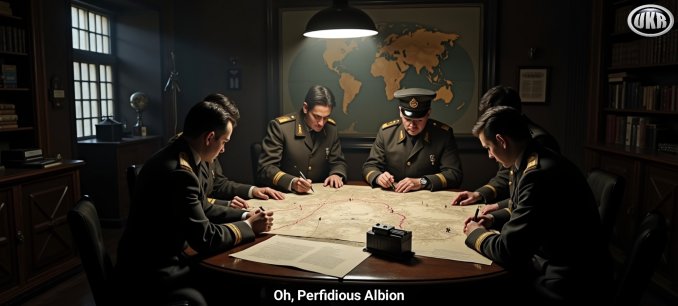
This article (Oh, Perfidious Albion) was created and published by Iain Hunter and is republished here under “Fair Use”

••••
The Liberty Beacon Project is now expanding at a near exponential rate, and for this we are grateful and excited! But we must also be practical. For 7 years we have not asked for any donations, and have built this project with our own funds as we grew. We are now experiencing ever increasing growing pains due to the large number of websites and projects we represent. So we have just installed donation buttons on our websites and ask that you consider this when you visit them. Nothing is too small. We thank you for all your support and your considerations … (TLB)
••••
Comment Policy: As a privately owned web site, we reserve the right to remove comments that contain spam, advertising, vulgarity, threats of violence, racism, or personal/abusive attacks on other users. This also applies to trolling, the use of more than one alias, or just intentional mischief. Enforcement of this policy is at the discretion of this websites administrators. Repeat offenders may be blocked or permanently banned without prior warning.
••••
Disclaimer: TLB websites contain copyrighted material the use of which has not always been specifically authorized by the copyright owner. We are making such material available to our readers under the provisions of “fair use” in an effort to advance a better understanding of political, health, economic and social issues. The material on this site is distributed without profit to those who have expressed a prior interest in receiving it for research and educational purposes. If you wish to use copyrighted material for purposes other than “fair use” you must request permission from the copyright owner.
••••
Disclaimer: The information and opinions shared are for informational purposes only including, but not limited to, text, graphics, images and other material are not intended as medical advice or instruction. Nothing mentioned is intended to be a substitute for professional medical advice, diagnosis or treatment.
Disclaimer: The views and opinions expressed in this article are those of the author and do not necessarily reflect the official policy or position of The Liberty Beacon Project.


Leave a Reply