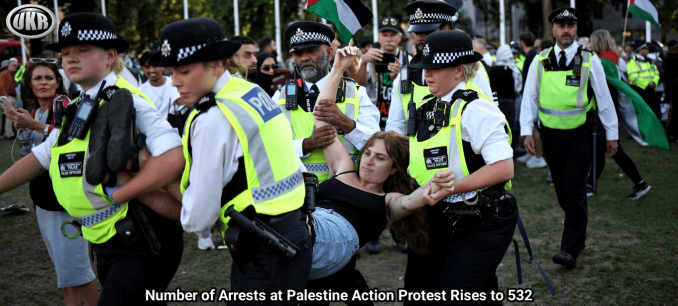
The number of militant activists arrested at a chaotic Palestine Action protest has surged past 530. The Mailhas more.
During a day of mayhem and farce, Left-wing protesters swamped London’s Parliament Square on Saturday in support of the organisation, which was proscribed by the Government last month as a terrorist group.
Hundreds held placards declaring “I oppose genocide. I support Palestine Action” in deliberate “idiotic” acts of law-breaking designed to overwhelm police resources and the courts.
Last night, the Metropolitan Police announced more than 360 people had been detained following the scenes of disorder – at an estimated cost of about £3 million.
Protesters were accused of a “colossal” waste of millions of pounds of taxpayers’ money after seemingly getting deliberately arrested by officers.
However, in an update on Sunday afternoon, the Met said the number of total arrests had skyrocketed to 532 – with 522 of these being for people allegedly displaying placards supporting the proscribed terror group. …
There were a further 10 arrests, which included six for assaulting police officers, one for racially aggravated public order, two for breaching a Section 14 Public Order Act condition and one for obstructing a constable in the execution of their duties.
The average age of those detained by police was 54, the force said, with the youngest person cuffed by cops being aged just 17. …
More than 850 officers were deployed on the huge operation, including 120 drafted in to bolster the Met from Wales, Lancashire, Greater Manchester and Cheshire.
Officers endured a torrent of abuse as they made arrests, with demonstrators screaming “shame on you”, “terrorists” and “fascist scum”. Violent scuffles broke out as officers attempted to lead those arrested away. The Met said none of its officers was seriously injured.
Speaking last night, Shadow Home Secretary Chris Philp estimated the police operation and subsequent legal costs to prosecute those arrested, including court time and legal aid, could cost taxpayers up to £3 million.
However, the latest arrests could see this figure soar to more than £4 million.
Today in Westminster, over 500 people plan to announce themselves as terrorists, all in full view of the police. Their methods are less molotovs-at-dawn and more Year 8 art project. All the protesters need to do is display a placard emblazoned with the words “I support Palestine Action”. This immediately invites arrest for an offence under the Terrorism Act 2000, with Section 13 outlawing the “wearing or displaying an article indicating support for a proscribed group”.
After passing legislation, you then have to apply it. This duty typically falls to beleaguered police services, who are blamed for laws conjured by their thoughtless political masters. Yet, if the issue at hand is Palestine Action’s proscription, after activists vandalised a pair of aircraft at RAF Brize Norton, the Terrorism Act 2000 is about so much more than the politics of Gaza. It speaks, rather, to 25 years of government failure, and how over-powered laws and under-powered cops collide to push Britain towards all-out chaos.
From a personal perspective, I’m sympathetic to banning Palestine Action. Whichever way you split it, breaking into an RAF base and deliberately disabling military aircraft isn’t just criminal damage, it’s a shameless assault on the armed forces. And besides, June’s attack came before the group’s campaign of industrial sabotage on companies it linked to Israeli interests. Reports suggest the total costs here could hit £55 million.
In practice, however, arresting hundreds of would-be “terrorists” is easier said than done. After all, the sentence for the offence detailed in the Terrorism Act is anything from six months to 14 years. It hardly helps that the police are refusing to back down, simply saying offenders will be dealt with. But even the Met, Britain’s biggest police service, will struggle with 500-plus public-order arrests. There simply isn’t the custody space, without creating emergency holding and charging centres anyway. On the other hand, though, not arresting offenders will invite more allegations of two-tier policing, especially when London’s mayor seems dubious about proscribing the group to start with.
The upshot, then, is that the Met will be made to look impotent, and the law an ass. Such a scenario is every radical activist’s dream, and every public order commander’s nightmare. And that’s before you consider the broader problem. State legitimacy bleeds away when it proves unable to uphold the rule of law. That was clear enough when Extinction Rebellion activists blocked roads with impunity — but terrorism? With the Westminster system already creaking, it’s easy to see how the Palestine Action debacle could spiral.
To understand how policymakers could have ended up in this mess, we must first appreciate how the Terrorism Act appeared. Passed by New Labour in its pomp, it offered the UK’s first statutory definition of terrorism, described as “the use or threat of action designed to influence the government or to intimidate the public… for the purpose of advancing a political, religious, racial or ideological cause”. If that sounds flexible, it’s because the Act was intended to be a permanent solution to older ad hoc legislation.
Drafted after the 1998 Good Friday Agreement, and the end of the Cold War, legislators identified the old Prevention of Terrorism Act as ripe for replacement. Introduced in 1974, in the aftermath of the IRA’s Birmingham pub bombings, the PTA was annually renewed by Parliament. From its introduction, indeed, it was always known as “temporary provisions”, such was their severity. Fair enough: it permitted the state to detain suspects for up to a week longer than usual before charging them, while also allowing for the proscription of Irish Republican and Loyalist terror groups.
Crucially, the term “terrorism” was never defined in the 1974 Act. At the time, it seemed quite obvious what terrorism was: blowing things up, especially people. That, of course, still left other radical groups, not of the bomb-making variety but still skating the edges of legality. Prior to 2000, the Government again preferred a fairly impromptu approach. Echoing the tactics of communist groups during the Cold War, it tolerated, engaged and influenced fellow travellers while disrupting hardcore activists. This lead investigators, eventually, to genuine terrorist suspects.
The period after the Good Friday Agreement in 1998 was pivotal here — existing laws were piecemeal and besides framed around the sensitivities of Irish terrorism. Especially with the rise of international jihadism in the late Nineties, the Government decided to enact permanent, overarching legislation.
“With the rise of international terrorism in the late Nineties, the Government decided to enact permanent, overarching legislation.”
The 2000 Act was passed just seven months before 9/11. Since then, it has been continuously amended, introducing new laws responding to the ever-evolving chimera of terrorism. That encompassed everything from banning the glorification of terrorism to creating Prevent, effectively replacing the traditional police monitoring of extremists. And, up to a point, this proliferation makes sense: who, in the naive digital world of 2000, could have predicted the vicious intersectional politics of today?
All the while, the thrust of the Blairite legal revolution was distinctly European, favouring statute over common law. Slowly but surely, with its focus on procedural fairness and (ironically) human rights, the law shaped the police response to terrorism and extremism. Many of the practices resulting from this approach, from Control Orders to Prevent, have subsequently been found wanting. Extremism as a shared social problem, rather than one of law enforcement, saw the police withdraw from swathes of counter-extremism: the sort that often presages actual terrorism.
No wonder, then, that the Terrorism Act 2000 is today the legislative equivalent of Frankenstein’s monster, applied to a dizzying range of social and technological problems. Deployed on the margins of extremism, it targets those shadowy slices of the Venn Diagram where radical politics, criminality and disorder all intersect. Indeed, had the often-violent Animal Liberation Front (ALF) not lost momentum by the late 2000s, it would almost certainly have been proscribed.
Why, then, wasn’t Palestine Action banned sooner, especially when the list of proscribed organisations reveals any number of neo-Nazi grouplets which exist mainly on the internet? Whitehall’s slowness here arguably hints at another issue: Labour’s confusion over Palestine. The party’s Left flank, especially in seats with significant Muslim communities, is under siege by “Gaza Independents”. Its grassroots are instinctively sympathetic to Palestine too. The party’s Right flank, however, is painfully aware of its funny bone around extremism: hard on what it considers the “populist” Right, but fuzzy around progressive protests over environmental issues, trans rights and Palestine. As and when a radical anti-immigration group appears, I predict it will receive harsher treatment.
This will simply accelerate our seemingly unstoppable cycle of discontent, one in which the Government finds itself increasingly trapped. It isn’t often I feel sorry for Keir Starmer or Yvette Cooper — but on this issue they’ve tied themselves into something of a Gordian knot. Arguably, they would have best been served by tackling Palestine Action as the Blair-era authorities dealt with the Animal Liberation Front. But that would have involved intrusive intelligence-gathering and Cold War infiltration. Instead, and especially given policing’s retreat from the wider field of extremism, anti-terrorism legislation is all that’s left. As the saying goes, when you only have a hammer, every problem is a nail.
Today, the police face 500 potential nails, from retired clergymen and elderly librarians to bright-eyed students, marching on the side of the angels. I’m not sure this was the intention of the Terrorism Act’s centrist architects, during those long-lost Blairite days. But policymakers’ errors are bread and butter for riot cops. And, if the proscription of Palestine Action tells us anything, it’s that our strange new world, one of endless, inchoate rage, defies containment by conventional politics. Only totalitarian regimes try to arrest their way out of social atomisation and dissent, and even if our Government wanted to try this, it’s unlikely to succeed. Yes, Whitehall needs hammers — but also other, subtler tools.
Dominic Adler is a writer and former detective in the Metropolitan Police. He worked in counterterrorism, anticorruption and criminal intelligence, and now discusses policing on his Substack.
The Liberty Beacon Project is now expanding at a near exponential rate, and for this we are grateful and excited! But we must also be practical. For 7 years we have not asked for any donations, and have built this project with our own funds as we grew. We are now experiencing ever increasing growing pains due to the large number of websites and projects we represent. So we have just installed donation buttons on our websites and ask that you consider this when you visit them. Nothing is too small. We thank you for all your support and your considerations … (TLB)
••••
Comment Policy: As a privately owned web site, we reserve the right to remove comments that contain spam, advertising, vulgarity, threats of violence, racism, or personal/abusive attacks on other users. This also applies to trolling, the use of more than one alias, or just intentional mischief. Enforcement of this policy is at the discretion of this websites administrators. Repeat offenders may be blocked or permanently banned without prior warning.
••••
Disclaimer: TLB websites contain copyrighted material the use of which has not always been specifically authorized by the copyright owner. We are making such material available to our readers under the provisions of “fair use” in an effort to advance a better understanding of political, health, economic and social issues. The material on this site is distributed without profit to those who have expressed a prior interest in receiving it for research and educational purposes. If you wish to use copyrighted material for purposes other than “fair use” you must request permission from the copyright owner.
••••
Disclaimer: The information and opinions shared are for informational purposes only including, but not limited to, text, graphics, images and other material are not intended as medical advice or instruction. Nothing mentioned is intended to be a substitute for professional medical advice, diagnosis or treatment.
Disclaimer: The views and opinions expressed in this article are those of the author and do not necessarily reflect the official policy or position of The Liberty Beacon Project.







Leave a Reply